Poland will spend over half billion euros on IRIS². The joint European programme is to provide reliable internet connection even in crisis, be it a Russian attack or a natural disaster. Some say it works better than Elon Musk’s Starlink.
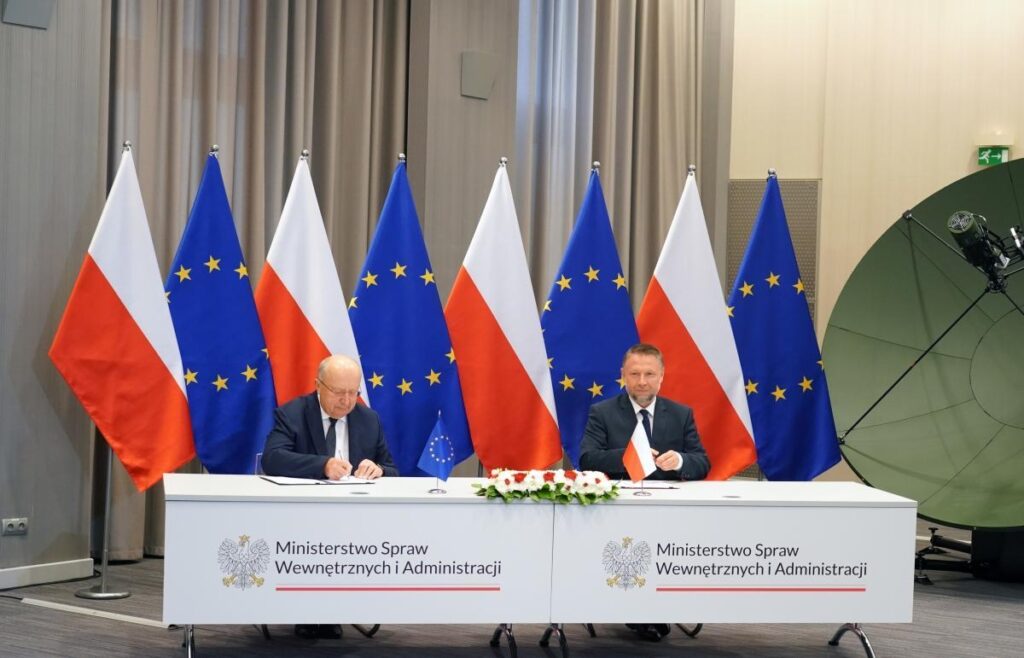
Poland signed a contribution agreement committing €656m from its EU Recovery and Resilience Facility allocation to IRIS², the European Union’s secure satellite-connectivity programme. The signing, on 21 July, brought together Marcin Kierwiński, Polish interior minister, and Andrius Kubilius, European defence and space commissioner in Warsaw. It was, said Mr Kubilius, “a big day for Poland, for the eastern flank and for the entire European Union.”
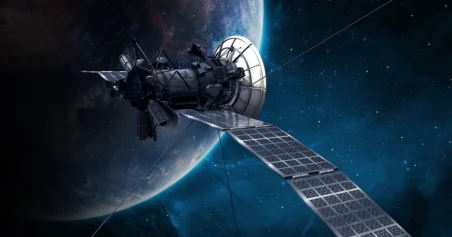
IRIS² is a new constellation of hundreds of satellites built by the European Union. It will provide fast, secure internet from space to every corner of Europe and beyond. The system will carry trusted communications for armed forces, police, border guards, and coast guards. It will protect the messages of governments and embassies from foreign espionage. Initial operations are planned for 2029, with full deployment by 2031–2032.
Sovereign system, built together
Poland’s contribution amounts to roughly 10 per cent of the programme’s total value. That makes Poland one of six leading players in the project alongside France, Spain, Germany, and Luxembourg. In Mr Kierwiński’s words, it is “a hub of good, reliable communication for this part of Europe.”
The logic behind Poland’s decision is straightforward. Mr Kubilius put it in layman’s terms: “It is better to develop one European system that can grow over time than to multiply separate national systems that are more costly, less interoperable and less efficient.” By integrating its own constellation into IRIS², Poland gains a comprehensive satellite system, a ground gateway on its own territory, and the ability to manage its capacities autonomously. At the same time, it will also strengthen the broader European network.
Mr Kierwiński framed the investment in terms of domestic need. All services under the Ministry of Internal Affairs and Administration (police, firefighters, border guards, and crisis-management centres) will gain access to communications “which will be safe, which will not be switched off”.
The minister drew directly on the experience of the 2024 floods, when first responders found communication in remote or damaged areas a serious challenge. “Communication is a foundation,” he said, “because it determines how fast search and rescue services are sent, how quickly decisions are made.”
The answer to fragmentation
The system will not serve only the state. Mr Kierwiński stressed that “In extreme cases… this system will give access to communication to citizens as well, not only to services.” That is a meaningful extension of what satellite connectivity programmes have traditionally promised.
Mr Kubilius was explicit about the competitive context. “IRIS² is moving towards quantum encryption “which perhaps can be a unique system at the moment in the world,” he said. Some experts, the commisisoner noted, believe it can outperform Starlink. “I do not argue against that opinion,” he said.
He reminded the audience that Europe’s record in space is stronger than its reputation suggests. “I would remind everybody that Galileo, our navigation system, is the best in the world. Our Earth observation system Copernicus is the best in the world.” IRIS², he argued, would follow the same trajectory.
The competent Poles
The programme’s industrial dimension matters as much as its technical one. Poland has nearly 400 companies active in the space sector. Mr Kierwiński said Polish firms have strong competences in low-orbit technologies and can act as technology and solution suppliers within the consortium.
Secure connectivity from space is our lifeline in times of crisis and war. — Andrius Kubilius, European commisisoner for defence and space
The ground gateway is a facility that will coordinate and manage satellites for Poland. The country will be its physical location; the operators managing it will be local, too. “Here I expect the main engagement of the Polish companies,” Mr Kierwiński said.
SpaceRise, the consortium of satellite operators comprises SES, Eutelsat, and Hispasat. It is building IRIS² and, on behalf of the EU, it welcomed the Polish commitment. Its representative described the programme as “more than infrastructure,” saying: “We are living in a world which is getting more and more fragmented, but today Europe chose to stand united.”
A stronger Eastern Flank
The geopolitical subtext of the Warsaw signing was never far from the surface. Mr Kubilius connected the programme directly to the security situation on Europe’s eastern border. “Secure connectivity from space is our lifeline in times of crisis and war,” he said. “Almost impossible for enemies to break into or take down.” He also noted that modern defence doctrine without space assets “is impossible to implement,” drawing on the Ukrainian experience.
Mr Kierwiński, asked about Russian provocation threats raised the previous day by Poland’s defence ministry, did not shy away. He referenced a Supreme Chamber of Control report, published two years ago, that painted a bleak picture of Poland’s telecommunications assets for top state management and the military. That report, he said, had driven three years of investment in crisis communications. The IRIS² agreement is the most advanced element of these.
Poland’s signing is also a signal to other member states. “I hope other member states will follow,” said Mr Kubilius. Poland’s investment, he argued, will make “the entire eastern flank stronger”, turn the country into a connectivity hub for the region. The broader message from Warsaw was that space is, increasingly, where European security is decided.