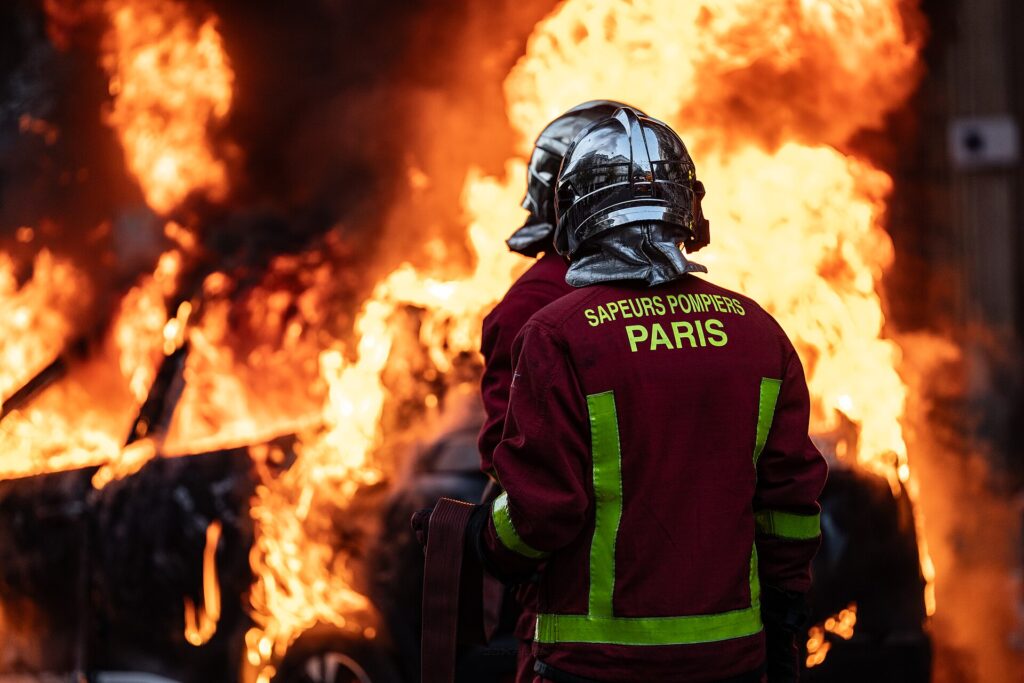
Burning barricades, tear gas and clashes with police filled social media over the weekend as protests swept across several European countries. But do similar scenes mean a shared cause? From France to Albania, we look behind the viral videos to explain what brought people onto the streets.
Students helped drive the protests in France, Belgium and Italy, where demands over education joined wider anger about living costs and public services. In Tirana, their participation gave fresh momentum to a months-long movement demanding Prime Minister Edi Rama’s resignation over alleged corruption.
The protests have different organisers, histories and demands, even as participants share slogans and express solidarity across borders. But a common thread runs through Europe’s streets: frustration with the economic pressures making everyday life harder, from unaffordable housing and education to rising living costs in an economy that increasingly feels like it is failing ordinary people.
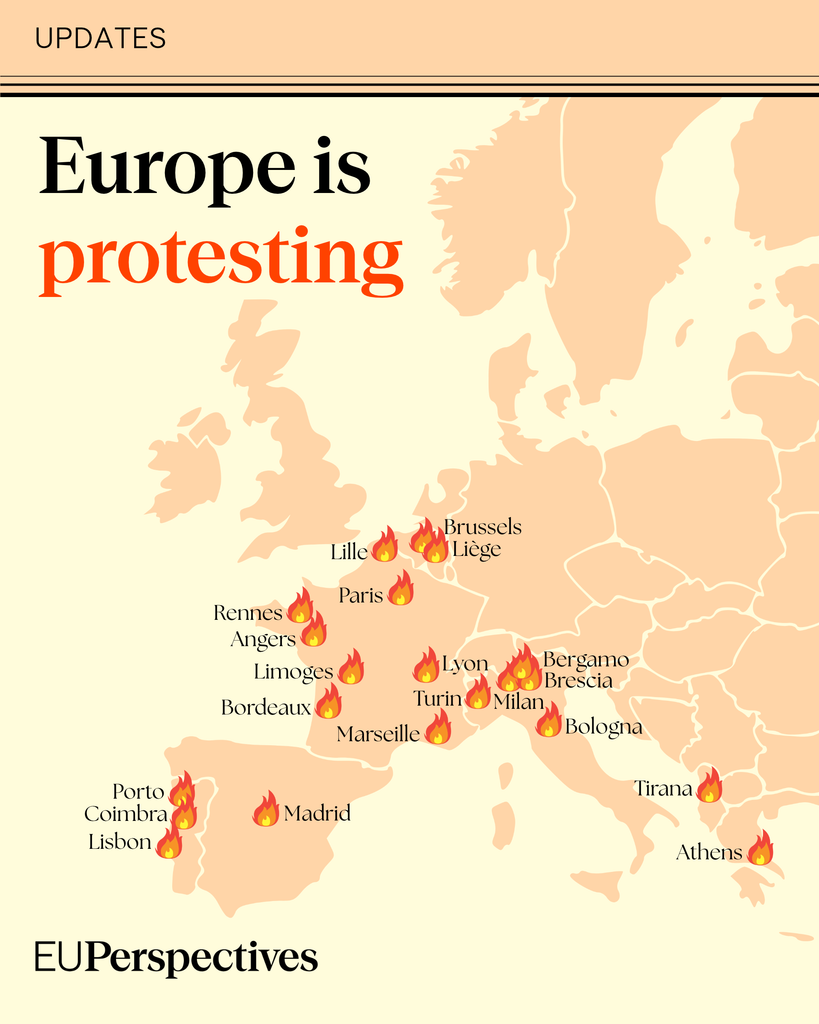
Governments are now responding with tighter security measures. France has introduced local curfews, while Italy has announced plans to send 500 additional soldiers to Milan. Protesters are also building connections: a Lisbon assembly called for a coordinated “Iberian general strike” with Spain on 11 November.
France: Lack of teachers leads to a revolt
France’s demonstrations began weeks before Saturday’s burning barricades and looted shops. Since September, secondary-school pupils have protested against missing teachers, overcrowded classes and deteriorating buildings. University admissions and exhausting timetables have added to their frustrations. What began as demands for a functioning education system spread through school blockades, marches and videos shared online. Human Rights Watch describes a movement rooted in underinvestment, with protests that were overwhelmingly peaceful despite violence by some participants.
Saturday’s mobilisation brought that student anger together with a much broader protest over living costs and public services. Trade unionists and Yellow Vest demonstrators joined the marches. More than half a million people participated nationwide, according to the authorities. The shared frustration was that everyday life was becoming harder while services people relied on were failing them.
Shops were looted, public buildings attacked and the town hall in Limoges set on fire. The destruction was real, but protesters dispute the suggestion that it represented the purpose of the marches. Participants told Reuters that most people demonstrated peacefully and blamed much of the damage on people seeking confrontation. The government, meanwhile, attributed violence to radical far-left groups and criminals involved in looting.
Police conduct has itself become a reason to demonstrate. Before the weekend, Human Rights Watch reported serious injuries to children, including a 15-year-old who lost a hand to a police stun grenade. “French authorities should stop treating peacefully protesting children as a danger that needs to be neutralized,” its researchers wrote. The Ligue des droits de l’Homme has also condemned police tactics, reporting that its observers were targeted with grenades. These accounts warrant scrutiny of police conduct, but do not establish what happened before every confrontation captured on video.
France’s crisis consequently has two overlapping dimensions: anger about education and living standards, and anger about how the state responds to the protests. Footage of looting cannot explain the demands of peaceful marchers. Equally, an individual video of police using tear gas needs its location, timing and surrounding events established before it can demonstrate how a confrontation began. Understanding Saturday means examining both the grievances that filled the streets and the actions that turned parts of them into scenes of violence.
Authorities have since imposed local curfews to prevent further disorder. Paris police restricted overnight access to two areas of the capital, while several northern cities introduced evening curfews for under-18s. The measures followed Monday’s crisis talks over the weekend’s violence. Yellow Vest organisers have meanwhile called for another day of protests on Saturday, 24 October.
Belgium: Anger over the cost of studying
Belgium’s protests echo France’s education grievances, but have their own roots. Since June, students in the French-speaking education system oppose higher fees and reforms they fear will make studying less accessible. The standard annual university fee is rising from €835 to €1,194, with reduced rates for eligible students. Protests predate this weekend: students and teachers have been mobilising for months, before the latest French demonstrations helped inspire further action.
The pressure extends beyond tuition. In a statement published by their school, students at Saint-Luc arts college in Liège described taking on more paid work to cover fees, accommodation and materials, leaving less time for their studies. The CSC-Enseignement union has defended young people’s grievances while rejecting violence against people and property. Their demands also overlap with wider opposition to government spending cuts.
Saturday’s demonstrations in Brussels and Liège included clashes and property damage. Police used tear gas and water cannon in Brussels, and reported 195 arrests across the two cities, according to Anadolu. Saturday’s crowds were smaller than those at the earlier anti-austerity demonstration in Brussels on 9 October, despite the prominence of the clashes online.
Italy: School funding, living costs and opposition to Meloni
Italy’s protests brought together education grievances and opposition to Prime Minister Giorgia Meloni’s government. Friday’s “No Meloni Day” demonstrations demanded better school buildings and more education funding, while opposing military spending and proposed restrictions on foreign pupils in classrooms. Students also expressed solidarity with French protesters. ANSA reported marches across cities including Turin, Rome, Bologna and Naples.
Saturday brought further demonstrations against expensive food, fuel and everyday living costs. In Milan, a march organised under the name “Italia in Piazza” descended into clashes, with shops looted and street furniture used to build burning barricades. Violence also broke out in Turin and Bologna, where police used water cannon and tear gas. Masked participants broke away from the Bologna procession and threw objects at officers.
The unrest continued in Milan on Sunday. On Monday, Deputy Prime Minister Matteo Salvini announced plans to deploy 500 additional soldiers to the city, presenting the measure as part of a security decree due on Tuesday. Milan’s mayor, Giuseppe Sala, had said the protesters’ grievances were understandable while condemning the violence. The government’s response now puts security at the forefront, alongside unresolved demands over education and living costs.
Spain: Housing anger has its own history
Spain’s protests centre on the cost of finding and keeping a home. A protest camp began in Madrid’s Puerta del Sol on 26 September, following the eviction of 87-year-old Maricarmen Abascal. Demonstrators remain in the square, demanding action on rents and forced evictions. Their demands include rent reductions, indefinite rental contracts and the expropriation of homes held by investment funds, according to Spanish news agency EFE.
The movement brings together tenants facing eviction and people whose wages no longer cover housing costs. The encampment has kept pressure on politicians between marches, with protesters demanding stronger protection against losing their homes. Separate teacher demonstrations over cuts and working conditions have added to the protests over public services and living standards.
Portugal: Higher wages and a place to live
Portugal’s demonstrations brought together workers demanding better pay and housing activists struggling with rents. On Saturday, the CGTP trade union federation organised marches in Lisbon, Porto and Coimbra for higher wages, better pensions and stronger public services. The protests were accompanied by specific demands: a general pay increase of at least 15%, with a minimum rise of €150, and a national minimum wage of €1,100 in 2027.
In Lisbon, a separate housing protest followed the union march, with demonstrators pitching tents in Rossio square. Participants voted on Sunday to maintain the camp, public broadcaster RTP reported. The tents made the grievance visible: people unable to secure affordable housing were occupying public space to demand action. Similar protests were already under way in Porto, so the mobilisation was not simply a response to events in France.
Portugal’s protests were largely peaceful, unlike some of the clashes elsewhere in Europe. Lisbon’s march and housing encampment proceeded without major violence, but policing came under scrutiny in Porto. Housing activists there alleged that a police intervention on 15 October injured 37 participants, including two seriously.
There is now a more explicit cross-border initiative. A popular assembly in Lisbon called on Sunday for an “Iberian general strike” on 11 November, coordinated with the Spanish movement, Le Monde reported. The call establishes a concrete connection between organisers in the two countries, although it does not mean every union has endorsed it.
Greece: Students pitch tents over housing costs
University students pitched tents in Athens’ Syntagma Square on 13 October to protest high rents and inadequate student accommodation, continuing despite heavy rain, Kathimerini reported. Food and energy bills have added to the pressure. School pupils have also protested over classroom mergers, poor buildings and missing teaching materials.
Activists also called a gathering in Athens on Sunday in solidarity with French protesters and against police repression. That provides a direct link between the demonstrations, alongside shared concerns about education and living costs. The Greek protests have included encampments and solidarity gatherings, with no evidence in these sources of joint leadership across countries.
Albania: A wider revolt against corruption and political power
Albania’s unrest is part of a months-long anti-government movement, rather than simply a student protest spreading from France. Demonstrators have demanded Prime Minister Edi Rama’s resignation, investigations into alleged corruption and changes to an economy they believe benefits politically connected businesses while leaving ordinary people behind.
The “Flamingo Revolution” began in late May over a luxury tourism development linked to Jared Kushner, Donald Trump’s son-in-law, on Albania’s southern coast. Plans affecting protected natural areas became a focus for anger over transparency, environmental damage and who benefits from development. The movement subsequently broadened beyond that project, challenging the influence of both governing and opposition elites, according to the Centre for Eastern Studies.
Students joining on 13 October brought fresh momentum and additional grievances: university conditions, education costs and poor employment prospects. Their involvement connected frustration about young people’s futures with the movement’s wider demands for accountability. The Flamingo platform told EFE that those demands were “a natural extension” of its concerns about corruption and living costs.
The confrontation has included attacks on government buildings, banks and businesses. Fires broke out at the Education Ministry and two banks during Wednesday’s unrest, while police deployed water cannon and tear gas. Repeated clashes continued into the weekend, turning central Tirana into the most visible expression of a political conflict that had been building for months.
Mr Rama, who denies wrongdoing, has refused to resign and says his government respects the right to protest. That leaves a more fundamental standoff than a dispute over a particular fee or spending cut. Demonstrators are challenging the government’s legitimacy and demanding political change. Albania shares Europe’s wider anger over affordability and public services, but its movement has its own origins, targets and history.
Elsewhere: French slogans meet local demands
In Berlin, students blocked school entrances on Friday with bins and carried placards reading “Solidarity with France”, “Smaller classes” and “Education, not war”. Their demands combined more education funding with opposition to compulsory military service, Anadolu reported. Smaller solidarity gatherings also took place in Prague and Manchester, where participants condemned the treatment of French pupils.
German politicians drew different lessons from the unrest. CDU representative Yannick Bury called it a “double warning” against underestimating far-left violence and allowing blocked reforms to destroy trust in mainstream politics. Green parliamentary leader Britta Haßelmann condemned the destruction but insisted that peaceful demonstrators protesting education problems and rising living costs must be heard, Deutschlandfunk reported.
France’s protests are already influencing debates abroad, even where the crowds remain small. The question is whether this wave of mobilisation will fade, or whether the economic and social grievances behind it will continue to fuel protests.