The ice remains thick but, after years of frozen relations, faint signs of a thaw are emerging between the European Union and Belarus.
For most of the past four years, the relationship between the European Union and Belarus has been simple to describe: non-existent. After Alexander Lukashenko allowed Russian forces to use Belarusian territory as a launchpad for the February 2022 assault on Kyiv, Brussels responded with sweeping sectoral sanctions and the effective suspension of diplomatic contact. Minsk, for its part, showed little interest in repair.
The two sides settled into a posture of mutual hostility that seemed, for a long time, entirely stable. It may be becoming less so. At the European Council summit of 18-19 June 2026, EU leaders quietly tasked the Commission and the European External Action Service with drawing up, by mid-2027, “policy options for conditional engagement with Belarus” — language that, in the measured grammar of Brussels communiqués, amounts to a meaningful shift.
Looking for a door
Around the same time, Minsk was sending signals of its own. In October 2026, Deputy Foreign Minister Yuri Ambrazevich dispatched invitations to EU ambassadors in Paris, seeking to “reduce Minsk’s isolation”. It was the most obvious Belarusian diplomatic outreach since 2020. Neither gesture constitutes a breakthrough; together, they suggest that both sides are, at minimum, looking for a door.
What has changed? Partly the arithmetic of Belarusian survival. As Ekaterina Zolotova of Geopolitical Futures has argued, Mr Lukashenko’s Belarus is a small country between Russia and NATO, and its overriding interest is not ideological alignment but strategic balance. “Belarus has nothing to gain and much to lose from getting tangled up in the fighting in Ukraine. Its army is too small to protect the homeland and simultaneously make a meaningful impact on the battlefield,” she wrote earlier this month.
The country’s location primes it to serve as a transit route and intermediary, roles that generate revenue, support sovereignty and prevent overreliance on any single partner. That logic has translated into a series of gestures toward Brussels that, taken individually, are modest but, taken together, form a pattern. Between July 2024 and December 2025, four waves of presidential pardons released 617 political prisoners. In June 2025, opposition leader Siarhei Tsikhanouski was freed along with 13 others; Minsk made no secret that the release was a signal to Brussels.
A mass amnesty in March 2026 freed a further 250 prisoners. EU officials privately welcomed each move while insisting, publicly, that roughly 1,000 political prisoners remain and that the underlying repression has not stopped. Minsk has also reopened informal channels via Paris and Vienna, and floated the idea of ‘humanitarian cooperation’ with several EU capitals.
Relationship with a history
Mr Lukashenko himself has declared readiness to host Russia-Ukraine peace negotiations in Minsk. The proposal serves his interests as much as anyone else’s, but that signals a desire to be seen as something other than a Russian auxiliary. “Translating rapprochement into Belarusian strategic autonomy requires the EU to respond to Minsk’s signals with targeted relief,” as the Clingendael Institute, in a 2025 paper, captured the underlying dynamic.
The current outreach is not the first. Relations between Brussels and Minsk have oscillated for three decades, shaped by the EU’s attachment to human-rights conditionality and Mr Lukashenko’s periodic need for economic breathing room. The Eastern Partnership offered Belarus a framework for gradual integration; Minsk engaged selectively, pocketing trade benefits while resisting political reform.
(Belarusian) army is too small to protect the homeland and simultaneously make a meaningful impact on the battlefield.
— Ekaterina Zolotova, GeopoliticalFutures.com
The fraudulent 2020 presidential election and the brutal suppression of the protests that followed ended that phase definitively. The forced diversion of a Ryanair flight to arrest a dissident journalist in 2021 prompted the first round of serious EU sanctions. The 2022 invasion completed the rupture, and what followed was four years of tightening restrictions, culminating in Council Regulation (EU) 2026/1846, which aligned the Belarus sanctions regime with the restrictions against Russia.
What a thaw would be worth
The case for engagement, if the conditions could be met, is substantial on both sides. For Belarus, the arithmetic is stark. Its economy is in recession; EU export bans on potash, petroleum products and financial services have cut off hard-currency revenues. Partial sanctions relief would be transformative, and restored access to EU loans and Eastern Partnership funds would reduce Minsk’s near-total dependence on Moscow.
For the EU, the gains would be geopolitical as much as economic. A Belarus less tightly bound to Russia is one from which Russian forward-operating forces might eventually be asked to leave, pushing Moscow’s military posture back toward Smolensk and stabilising NATO’s Baltic perimeter. Restored cooperation on border management would curb Minsk’s past weaponisation of irregular migrants, a tactic that caused acute political difficulties for Poland and Lithuania.
Belarusian armed forces
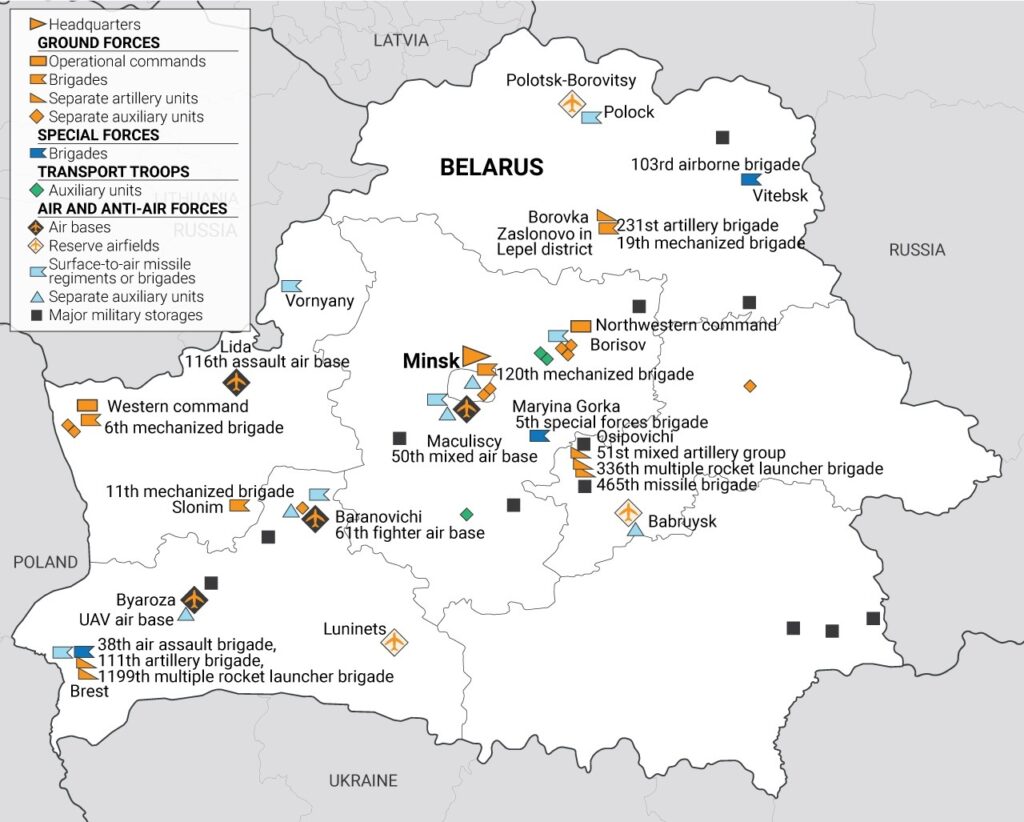
The geostrategic implications extend further. Russia would lose its most significant western staging ground. The Kremlin would almost certainly retaliate—through energy price hikes or political pressure on Minsk’s hard-liners—but Belarus’s leverage would grow in proportion to its alternatives. A genuinely rebalanced Belarus would redraw the map of eastern Europe’s security architecture in ways that no amount of NATO spending can replicate.
The obstacles remain
None of this is imminent. Around 1,000 political prisoners remain in Belarusian jails. Belarusian territory continues to host Russian nuclear-capable missiles. Belarusian logistics and ammunition production continue to support Russian forces. Baltic and Polish governments insist that human-rights progress must precede any détente, and they carry considerable weight in EU councils.
Translating rapprochement into Belarusian strategic autonomy requires the EU to respond to Minsk’s signals with targeted relief.
— Clingendael Institute
Minsk’s room for manoeuvre is also genuinely constrained. Russia supplies cheap energy and security guarantees that Belarus cannot easily replace. Any Belarusian leader who moved too visibly toward Brussels would risk the kind of Kremlin response that has ended careers and governments elsewhere in the post-Soviet space. The road map, if there is one, is hazy and incomplete. But the fact that both sides are apparently willing to look down it is itself a change worth noting.