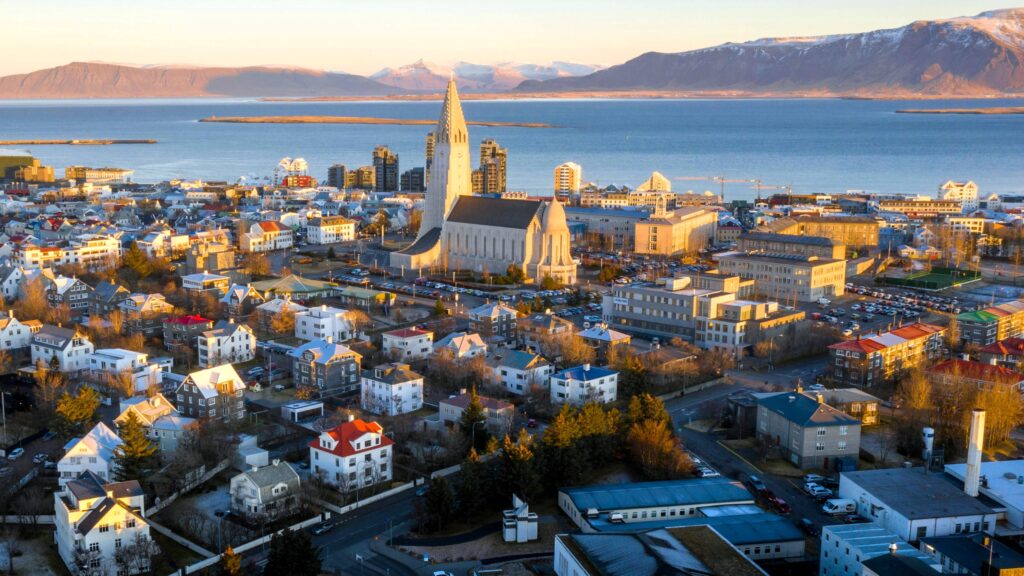
The long-awaited referendum is here. On Saturday, Icelanders will vote on whether their country should return to the negotiating table with the EU after more than a decade. Brussels has already signalled that its door is wide open: Iceland could become a member by 2028.
The question sounds simple enough: Should Iceland reopen accession talks with the European Union? The answer will be either yes or no. What comes next is rather more complicated.
For starters, Saturday’s referendum is not a vote on joining the EU. A “yes” would merely clear the way for new negotiations. If those talks eventually produce an accession treaty, Icelanders would vote on membership itself in a second referendum.
Nor would it be a completely fresh start. Iceland announced in 2015 that it no longer wanted to be considered a candidate country, but it never formally withdrew its membership application. The European Commission therefore considers the accession process suspended, rather than definitively closed.
Too close to call
Early voting for those unable to take part in Saturday’s referendum began on 27 July. Turnout has been substantial. More than 40,000 voters had already cast their ballots, according to Sigríður Kristinsdóttir, district commissioner for the Reykjavík area.
Polls have consistently pointed to an exceptionally tight race. A Maskína poll published on Tuesday gave supporters of reopening talks only a narrow lead: 51.3 per cent to 48.7 per cent. An early-August poll by consultancy Gallup put both sides on exactly 46 per cent, with 8 per cent still undecided. That promises tension right up to the counting of the final ballot.
There is another intriguing paradox at the heart of the campaign. When voters are asked directly about EU membership, the balance shifts slightly towards “no”. For at least some Icelanders, this is not really about joining the EU. It is about finding out what is on the table — what membership would actually mean and what terms Reykjavík could negotiate.
“It’s preserving optionality: do you want the option of seeing what the agreement looks like?” Icelandic Prime Minister Kristrún Frostadóttir said earlier. Her Social Democratic Alliance is one of the main forces within the governing coalition backing a return to accession talks.
Iceland is already halfway in
And this is where Iceland’s situation differs from that of most countries seeking membership. It is part of the European Economic Area and has access to the single market. It is also in Schengen and already applies European rules in many areas. Yet it has no seat at the table when those rules are made.
Former Icelandic President Guðni Th. Jóhannesson has also pointed to this contradiction. Sovereignty, he argues, is not simply about being able to make your own decisions. It is also about having a say in decisions you cannot make alone. “Iceland is not a sovereign and independent nation despite the international cooperation we have engaged in, but rather because of it,” he said.
An even stronger signal came directly from Brussels. Enlargement Commissioner Marta Kos said on Tuesday at a conference of European ambassadors in Zagreb that Iceland could complete the accession process by 2028 if talks were reopened. “Already part of the single market, it could finalise accession negotiations in one to two years from now,” she noted.
European Parliament President Roberta Metsola struck a similar note earlier this week, stressing that EU enlargement was not an act of charity. “It’s a win-win choice for countries that are in the EU and for the countries that want to join us,” she said at the 2026 Rimini Meeting.
For an island nation of just over 400,000 people, Saturday’s referendum therefore pits two visions of sovereignty against each other: control over your own decisions, and the ability to influence decisions made by a larger European whole.
Fish remain the biggest obstacle
If “yes” wins, none of these questions will be settled overnight. Quite the opposite. They will only return to the negotiating table. And one issue is almost certain to be more sensitive for Iceland than any other: fishing.
Icelandic politicians have repeatedly said they want to retain full control over their fishing resources. Foreign Minister Þorgerður Katrín Gunnarsdóttir has even drawn a hard line: Iceland, she says, will not sign a deal unless it guarantees “full sovereignty and control” over fisheries.
This is about more than economics. Fishing is woven into Icelandic culture, tradition and national identity. The question, then, is how flexible Brussels could be if it really wants Iceland on board.
Has Trump changed Iceland’s EU debate?
US President Donald Trump’s claims on Greenland and the Arctic’s growing strategic importance have changed the security environment in which Iceland is making its choice. Iceland is a NATO member but has no standing army of its own. Uncertainty over the future role of the US has therefore fuelled debate about whether closer European ties could give Iceland another layer of security.
Commissioner Kos sees it that way too. In her view, EU enlargement is no longer simply about making the bloc bigger. “Enlargement is about making ourselves stronger,” she said, arguing that no European country can withstand pressure from major powers on its own in today’s environment.
But an analysis by the Arctic Institute warns against explaining the referendum simply through the prism of Trump and Greenland. The decision to hold the referendum was already part of the governing coalition’s agreement at the end of 2024. “The international framing of the debate as a response to Arctic geopolitical tensions, particularly the crisis over Greenland, obscures more than it reveals.”
That is also reflected in the campaign itself. As Tobias Etzold of the European Policy Centre points out, the security argument has gradually faded into the background. The debate is increasingly about economics, sovereignty and fishing.
What do “yes” and “no” actually mean?
If “yes” wins, Iceland will open the door to negotiations. According to the Icelandic government, they could begin later this year. The talks would build on the work carried out between 2009 and 2013, when Iceland opened 27 of the 35 negotiating chapters and provisionally closed 11.
For Brussels, this would not simply be another accession process. Iceland is small, wealthy and already deeply intertwined with the EU. Ms Kos has previously called Iceland a “strong and trusted partner” and stressed that accession talks always take into account the “specific realities” of individual candidates.
If the “no” camp prevails, the talks will not reopen. The government has pledged not to return to accession negotiations, bringing Iceland’s attempt to join the EU to an end.
But Iceland would not be leaving Europe. The status quo would remain. The island would stay in the EEA, the single market and Schengen. It would remain deeply connected to the EU and continue to enjoy many of the benefits of integration. But when decisions are made in Brussels, Iceland would still have no seat at the table.