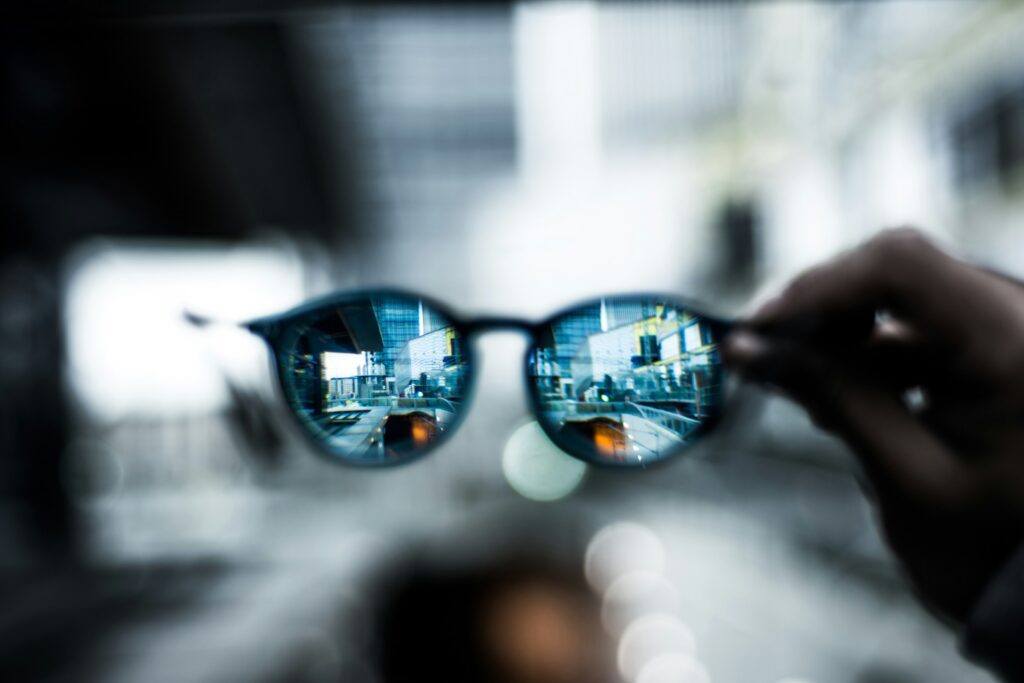
A stranger could be filming you, and the only warning is a tiny white light on their glasses. Meta’s AI glasses now face a criminal complaint in Germany over fears they can record people without consent. As cameras get harder to spot, some designers are turning privacy into something you can wear.
HateAid has filed a complaint in Germany, arguing that such glasses can function as a concealed recording device. It targets Meta as well as Ray-Ban and Oakley owner EssilorLuxottica, and German retailers including Fielmann, Apollo-Optik, Mister Spex and MediaMarkt.
‘Pervert’ glasses film you without consent
The glasses look like ordinary Ray-Bans. But they include a camera, microphones, speakers and Meta AI software. People can use them to take photos, videos, ask for translations, directions, and use AI to understand what they are looking at.
A white LED lights up when a photo or video is being captured. For HateAid managing director Josephine Ballon, that small signal is exactly where the problem begins. “Our main concern is basically that everyone has to expect to be filmed in public or in semi-public areas every time. Because they look like normal glasses, and you can never know which one can film you or not,” she told EU Perspectives.
HateAid also warns about women being secretly filmed in sexualised situations, only for the footage to be uploaded online later. Someone can be captured at the beach, in a gym, and the video can be posted without them ever knowing. The same images can also become raw material for sexualised deepfakes. Ballon said victims sometimes only discover material years later, after friends or family recognise them online.
The glasses have been nicknamed ‘pervert glasses’, after people used them to record strangers. In the UK, some theatres, pubs and other venues have started restricting this type of equipment.
Look for the tiny white light
Ballon stressed that smart glasses can have legitimate uses, like helping people with visual or hearing impairments, providing directions or translating conversations. Public filming can also be lawful in some circumstances, just as filming with a phone can be. HateAid’s complaint argues that the glasses fail to comply with Germany’s Telecommunications-Digital Services Data Protection Act, which prohibits devices intended for unnoticed recording or eavesdropping disguised as everyday objects.
For Meta, the light turning on informs people they are being recorded. “Whenever content is being captured for your gallery, this white light blinks to let people know you’re capturing content,” the company states. The glasses’ LED, turned on when recording starts, cannot be disabled, and detection stops the camera from operating if the light is covered or damaged. Ray-Ban also states that the LED signals people nearby when the wearer is taking photos or videos.
Ballon questions whether it gives meaningful notice. She argues that in bright sunlight or from a distance, the light may be difficult to see. Besides, a white light is not a universally understood signal for ‘being recorded’. On top of that, by the time it appears, recording has already begun. HateAid wants responsibility to start with the companies designing and selling the product.
When surveillance is wearable, so is privacy
A clothing company, Urban Privacy, uses its products to challenge surveillance. Its designs resemble parts of human faces to feed misleading information to facial-recognition systems. To a person, they look like patterns; to some computer-vision systems, they can appear as multiple false faces. The label also sells a smartphone bag with two compartments: one keeps the phone connected, while the other blocks signals. “So you can have your phone with you, but go off the grid when you want to,” founder Daniel Preuß told EU Perspectives.
For them, Meta’s AI glasses have made the surveillance debate more immediate. “We think that products like Meta’s AI glasses are just the latest step in a long line of concerning developments,” he told us. “AI glasses probably made bigger waves because they intrude on a very intimate, interpersonal level. If someone you are having a conversation with is wearing these, the problems of surveillance are literally ‘in your face’. It is so much more tangible than a camera three stories up on a building wall.”
For Urban Privacy, fashion is particularly suited to the surveillance debate because both are concerned with identity. “While one aims to capture, the other can simultaneously express and conceal,” he added. Their clothes are intended to confuse surveillance systems and make people think about the technology around them.
If glasses film you, can clothes protect you?
Nevertheless, the clothes are not an invisibility cloak. Urban Privacy stresses that effectiveness depends on the algorithm and the conditions in which the clothing is used. Most importantly, it does not prevent glasses from recording someone. That limitation is also why the designers do not present fashion as a replacement for regulation, but a form of protest.
If societies increasingly accept surveillance in exchange for security, “the individual will have no choice but to protect themselves.” Even then, they acknowledge that clothing cannot solve the underlying problem. “We do not think that clothing on its own can compensate for a loss in freedom. Its main goal is to raise awareness and spark a public discourse, so that we can set boundaries for surveillance systems in time.”
Potential victims should not be responsible for protecting themselves from being filmed. — Josephine Ballon, HateAid managing director
That raises another problem: anti-surveillance fashion is an individual response. It is available only to people who know it exists, decide to use it and can afford it. For HateAid, responsibility cannot end up with the person standing in front of the camera. She described such individual measures as a form of ‘self-defence’ rather than a solution. To her, potential victims, she said, “should not be responsible for protecting themselves from being filmed”.