Fabricated news reports, impersonated media outlets and AI-generated videos are becoming part of a wider Russian-linked effort to influence political debate across Europe. With elections approaching in several countries, the campaigns are moving from one political target to another.
The tactics are remarkably portable. In France, fabricated reports have targeted former prime minister Gabriel Attal. In Germany, more than 180 false posts have appeared ahead of September’s regional and local elections. The formula is simple: invent a scandal, wrap it in the branding of a trusted media outlet, and let social media do the distribution.
Four cases in two weeks
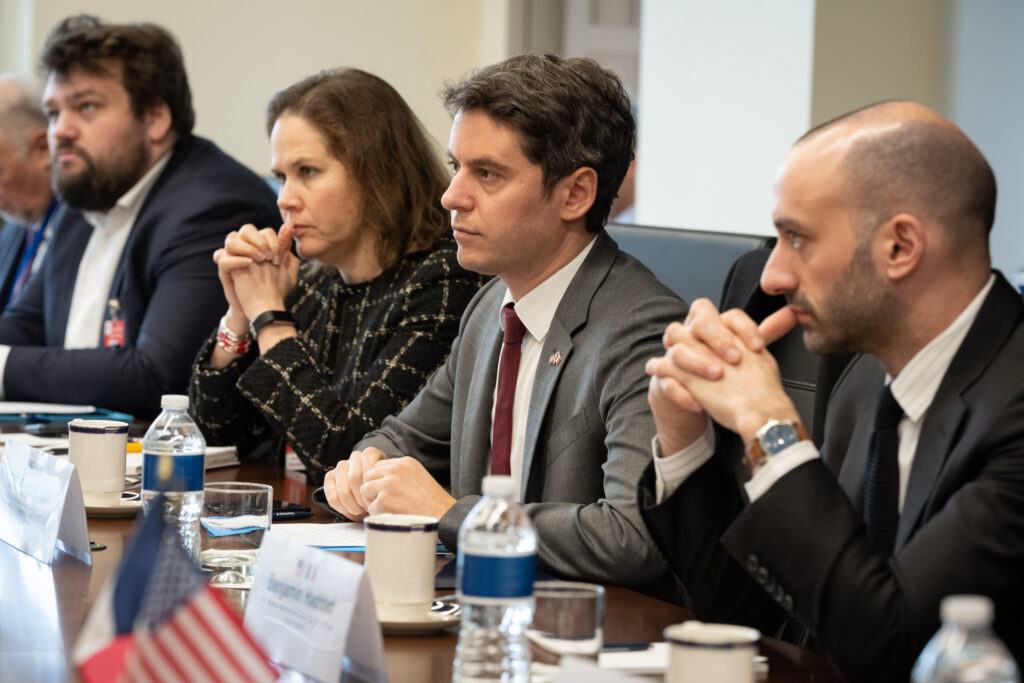
Former French prime minister Gabriel Attal has faced four suspected Russian interference operations within two weeks, BFMTV reported. One circulated 10 fabricated reports and newspaper front pages containing false claims about his health and alleged corruption. Another used an AI-generated video showing insulting caricatures of him projected onto the Panthéon in Paris.
Mr Attal, who leads the centrist Renaissance party and is running in France’s 2027 presidential election, filed a foreign-interference complaint on 7 August.
Former prime minister Édouard Philippe and Member of the European Parliament Raphaël Glucksmann (FR/S&D), both considered possible presidential candidates, have faced similar campaigns. French prosecutors have opened investigations into the suspected pro-Russian operations, although the content reportedly attracted limited public attention.
Mainstream politicians in the crosshairs
Similar tactics have appeared in Germany ahead of regional and local elections in September. More than 180 false social media posts associated with the Russian-linked Matryoshka network have been identified, according to Deutsche Welle.
Also known as Operation Overload, the campaign produces fabricated videos carrying the branding of recognised media organisations. The material includes false allegations against politicians involving corruption, sexual harassment and abuse.
German security sources told Reuters that the campaign was centrally coordinated from Russia. It has mainly targeted politicians from the Christian Democratic Union, Social Democratic Party, Greens, and Free Democratic Party ahead of elections in Berlin, Saxony-Anhalt, and Mecklenburg-Western Pomerania. The pattern is notable: the campaign has focused on mainstream political parties rather than the far ends of Germany’s political spectrum.
A spokesperson for the German Interior Ministry said that “this campaign is not achieving significant reach online. That is not to say we can let our guard down or anything of the sort.” Russia has denied interfering in German elections and described the allegations as anti-Russian hysteria.
A playbook that travels
Operation Overload is not confined to France and Germany. The Institute for Strategic Dialogue analysed 135 pieces of content published during the first three months of 2025 and found material directed at 10 countries.
Alongside France and Germany, the campaign targeted Denmark, Italy, Poland, Spain, Ukraine, and the UK, as well as Canada and the US.
“At the moment, this campaign is not achieving significant reach online. That is not to say we can let our guard down or anything of the sort. It remains a serious disinformation campaign.”
— Spokesperson, German Ministry of the Interior
Three-quarters of the content focused on Ukraine and EU member states, with France, Germany and Ukraine receiving the greatest attention. The operation impersonated more than 80 media organisations, universities, and law-enforcement bodies. Some videos combined genuine footage with AI-generated voices to make journalists, academics, and police officers appear to deliver false or inflammatory statements.
Most of the posts received little engagement. But threre are outliers. One fabricated video reached more than 4 million views after prominent accounts shared it. Researchers said the operation’s high output increased the likelihood that some content would eventually reach a wider audience.
The legal ambiguity of online propaganda
EU law does not generally prohibit every false or propagandistic statement, partly because restrictions must respect freedom of expression. Instead, it places obligations on online platforms and sets transparency rules for political advertising and AI-generated content.
The Digital Services Act requires very large platforms and search engines to assess and reduce risks affecting elections and public debate, including coordinated disinformation and manipulated content.
Separately, AI Act transparency provisions started applying on 2 August. Providers must make AI-generated content detectable, while deployers must disclose when images, audio or videos are deepfakes.
The rules could help identify material such as the video targeting Mr Attal, although enforcement against anonymous operators outside the EU may remain difficult.
The latest operations show how quickly Russian-linked networks can shift between countries and political targets. As elections approach in France and Germany, authorities will need to identify those behind the campaigns, while platforms will face pressure to prevent fabricated reports and manipulated videos from reaching wider audiences.