
You didn’t choose Proximus. In Brussels, it chose you. Belgium’s former state monopoly built most of the capital’s fibre network, and is on track to control most of the country’s too.
When I moved to Belgium, choosing a WiFi and cellular provider was obvious. It was Proximus, I mean everyone uses it, it’s all around, so surely it’s because it’s the best company. Well, maybe, maybe not. It’s hard to know when Proximus is basically the only game in town.
Proximus is the dominant fibre provider in Belgium. Its network reached around 42 per cent of the country’s premises by the end of 2025, and the company is set to own up to 80 per cent of Belgium’s entire fibre infrastructure.
Dominant by design
In Brussels, Proximus pulls even bigger weight. Fibre already reaches more than 57 per cent of households, and Proximus built essentially all of it. Part of that reach is its integration with the state, which is the majority shareholder in the company at just over 53 per cent. That makes Proximus the most state-owned major telecom operator in the EU.
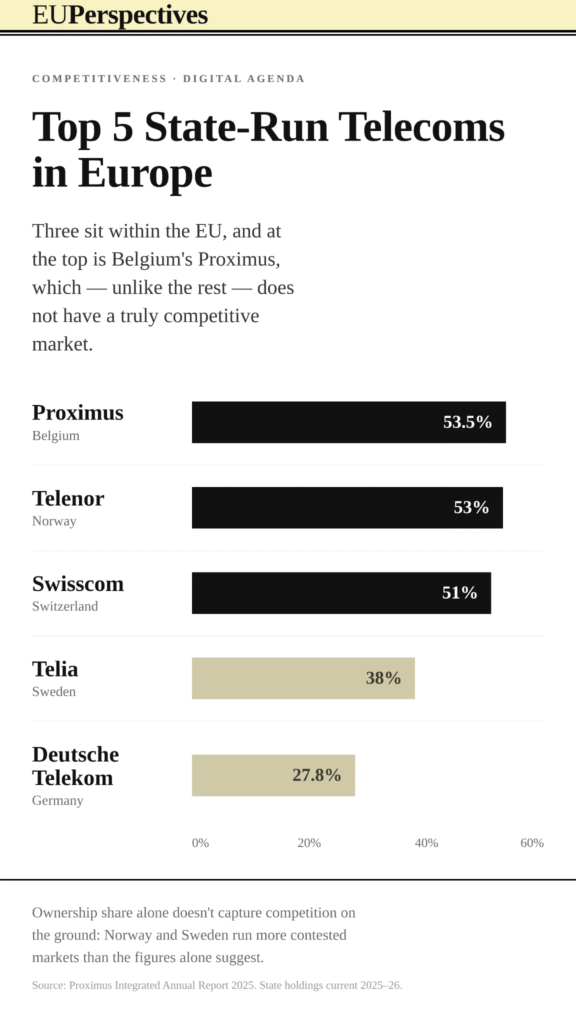
Officially, the Belgian regulator (BIPT) has designated Proximus as a “significant market power” (SMP) or in other words, the dominant player in the market. But is it dominant or is it a state-run monopoly? There, the line begins to blur.
The competition problem
In 2009, the Belgian Competition Council hit Proximus with a €66.3m fine, its largest ever at the time, for abusing its dominant position in mobile. Triggered by a complaint from rival Base, the case found Proximus had used a “margin squeeze” in 2004–2005, pricing calls so competitors could not match it, squeezing them out of the business market.
In fibre, as an SMP operator, Proximus is legally required to offer competitors wholesale access to it, but in practice, that also has not materialised, so most people on a Proximus street effectively only get Proximus.
Today, the main alternative to Proximus is Scarlet. It is also owned by Proximus. It markets itself as the cheaper alternative for price-sensitive customers, but it has been a subsidiary of Proximus since 2008.
Real competitors do exist, but they split by region and technology in ways that thin out fast once you get to fibre. Proximus’s biggest rival is Telenet, the cable operator dominant in Flanders, owned by Liberty Global, its network branded Wyre. Another is Orange Belgium, strong in mobile and now owner of the francophone cable operator VOO.
But these are largely cable, and largely outside Brussels. The one genuinely independent challenger relevant to fibre was Edpnet, which served tens of thousands of customers over both copper and fibre. But even it became a Proximus target.
The one that fought back
In early 2023, when Edpnet entered judicial reorganisation, a Ghent court initially awarded it to Proximus as the highest bidder. Months later, the Belgian Competition Authority opened an ex officio abuse-of-dominance case under the EU’s Towercast doctrine, and in June 2023 imposed interim measures blocking the deal.
By November 2023, Proximus was forced to divest Edpnet to Citymesh, the company behind DIGI, the now aspiring fourth operator which is undercutting Proximus in price.
Yet fibre itself in Belgium, for many, is just a Proximus game, via its affiliates Fiberklaar and Unifiber. Scarlet, often mistaken for an alternative, is just Proximus’s own budget brand.
You are left with one option: the state-backed enterprise that is Proximus.
Proximus is not a monopoly, strictly speaking. Competitors are legally allowed. Cable exists too. But for anyone actually trying to get fibre in Brussels, the difference does not matter much. You are left with one option: the state-backed enterprise that is Proximus.