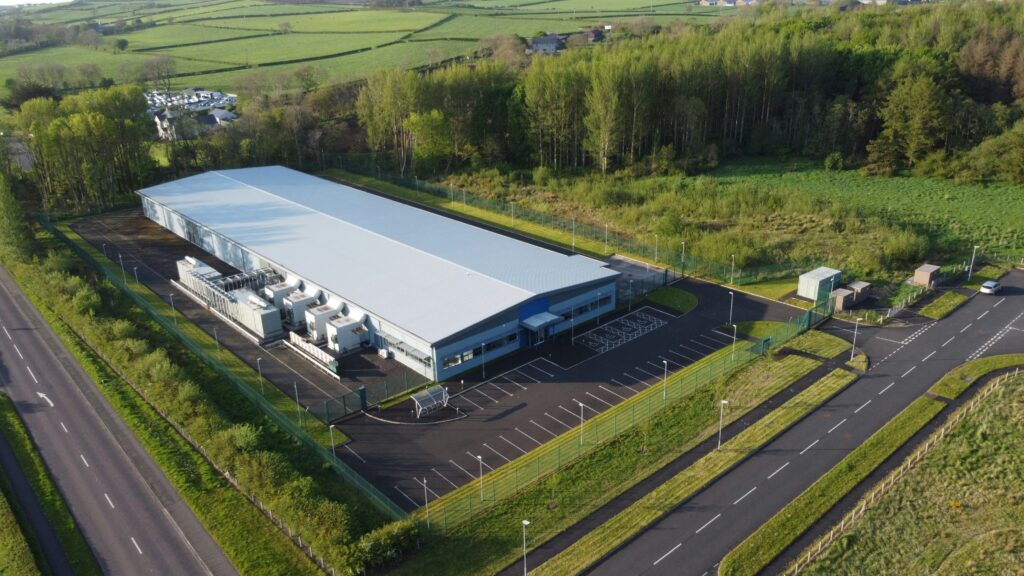
Brussels wants to triple data centre capacity. But much of the investment comes from the US, which undermines the goal of strengthening Europe’s digital autonomy.
Microsoft is planning 14 data centre projects in Europe, while Google aims for nine. Good or bad? The Cloud and AI Development Act (CADA) aims to give Europe more infrastructure to compete and reduce dependencies. However, research by SOMO, a digital marketing agency, found that data centres in the EU are largely financed by US investors.
The analysis points to the contradiction. “Data centres in the EU are largely financed by US investors. Planned data centres remain heavily dependent on demand from US tech companies,” it reads.
Microsoft, Google take the lead
“Letting these companies simply build their data centres in Europe will not improve the EU’s resilience or autonomy,” Margarida Silva, co-researcher of SOMO analysis, told EU Perspectives. “The data hosted within it would still be under the reach of the US administration,” she said. If the US administration wanted to, it could, under the US Cloud Act, cut off access to them.“ This is not sovereignty,” Ms Silva said.
Amazon, Microsoft and Google together control more than 70 per cent of the European cloud market. Meanwhile, the share held by EU providers fell from 29 per cent in 2017 to 15 per cent in 2022. Since then it has stagnated. The EU wants more computing infrastructure partly to tackle that dependency. But SOMO’s analysis shows another side. Microsoft has 14 upcoming data-centre projects in the EU and Google nine.
Among major co-location providers, the American Digital Realty and CyrusOne each have eight planned projects. They can build and operate data centres and lease capacity to other companies. Besides, US Equinix has six. Among european based businesses, Spanish real-estate agency Merlin Properties and France’s DATA4 also each have six planned projects.
Amazon, Google, Meta and Microsoft are also major customers of co-location companies. This means that even when data centre is owned by an EU company, it can serve foreign players. McKinsey estimates that Big Tech could account for around 65 per cent of European data-centre demand by 2028.
Can safeguards work?
For the reserarchers, this raises questions over who’s ultimately benfiiting from the investments. “Who will this extra data centre capacity actually serve and who will be reaping the rewards?” Ms Silva asked. “If we allow new data centres to be built within Europe, taking up energy and land resources, they should be contributing towards the local capacity”.
“Technological sovereignty is about making Europe stronger, more resilient and less exposed to critical dependencies,” a Commission spokesperson told EU Perspectives. “CADA introduces a practical sovereignty framework for cloud services, with multiple levels of assurance based on objective criteria, such as where infrastructure is located, who controls the software supply chain and the level of cybersecurity,“ they add.
The EU is heavily dependent on just a few US cloud companies, which have increasingly aligned themselves with the Trump administration. — Margarida Silva, SOMO
Brussels argues that this push will make Europe an ‘AI continent’, while supporting research and innovation in sustainable technologies. The Commission disputes the idea that Europe’s need for more capacity comes only from US hyperscalers taking up existing infrastructure.
A sovereignty test
Responding to SOMO research, the Commisison says Europe faces a broader problem of “limited, geographically concentrated and insufficiently predictable data centre capacity”. “It is also not accurate to suggest that Europe’s capacity challenge results only from US hyperscalers taking existing capacity,” the Commission wrote.
Safeguards are included to stop large players from locking competitors out of the new capacity. It requires the allocation and use of resources inside the zones to be “fair, reasonable and non-discriminatory”. The goal is to prevent speculative reservation or practices that could undermine competition.
For SOMO, the question of sovereignty is political. “The EU is heavily dependent on just a few US cloud companies, which have increasingly aligned themselves with the Trump administration, risking that the infrastructure upon which we depend can be leveraged against us or that we can be cut off from it,” Ms Silva said. She pointed to the International Criminal Court losing access to Microsoft services and the US government restricting access to Anthropic models as examples of how political decisions can affect access to technology.
A moratorium on Big Tech
SOMO calls for a much stricter approach to the expansion. “There should be a moratorium on all new data centres that are owned by or serving Big Tech firms,” Ms Silva said. She argues that new facilities should be required to reserve a meaningful share of their capacity for European companies.
There is also a question over what Europeans are being asked to accept in exchange for that infrastructure. “The problem here is that controversial projects that consume a lot of energy and water, take up land space, and might lead to higher prices for consumers, are being sold to people as a means to achieving more control and autonomy over digital products,” Ms Silva said. “Yet, if they remain in the service of Big Tech companies, that won’t happen. Instead, we will just make a few tech and finance billionaires richer than they already are.”