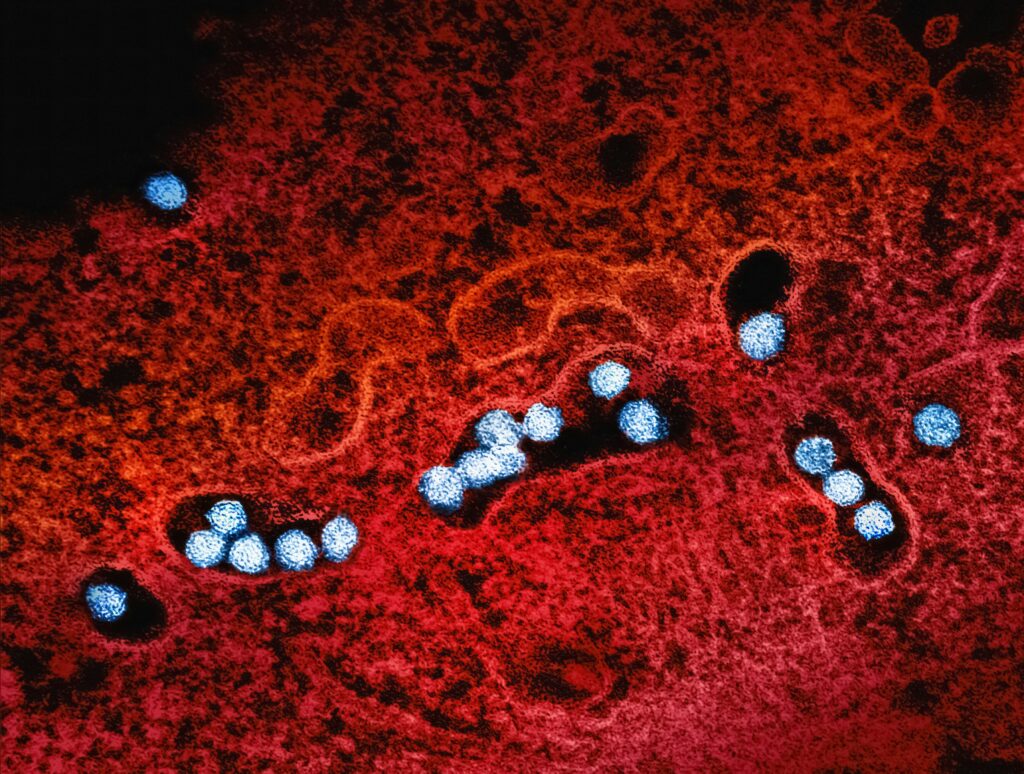
People in the Netherlands, Greece, and Italy are dying form West Nile virus infection. Europe has no specific treatment against it, Brussels has confirmed.
The Dutch National Institute for Public Health and the Environment (RIVM) announced the country’s first West Nile virus death in six years on 26 August. The person caught the virus in the Netherlands and died in hospital.
It has been a tumultuous fortnight. RIVM has now confirmed three locally acquired infections this year. The first surfaced on 17 August in a blood donor in Utrecht who had no symptoms and had not travelled. “This is the first confirmed case of a human infection in 2026 that originated in the Netherlands,” RIVM said then.
Outrunning the reports
The European Centre for Disease Prevention and Control (ECDC) counts 625 locally acquired cases in 12 countries and 99 regions, using data up to 21 August. Italy had the most cases with 311, Greece 157 and Spain 63. Twenty-one areas are reporting transmission for the first time this season. Those figures are already behind events. Greece and Italy have since reported 664 cases between them, more than ECDC’s total for the whole continent, because national data reaches ECDC on a lag. The same table lists two Dutch cases, one fewer than RIVM has confirmed.
Eight days before that count, ECDC marked World Mosquito Day with 429 cases in nine countries. The season added almost 200 cases in little over a week. Transmission usually peaks in August and early September, so the numbers will climb further.
Greece, Italy: dozens of deaths
Greece has recorded 232 cases and 19 deaths, according to the National Public Health Organisation (EODY), with a median age of 85 among the dead. Seventy-five of those cases were diagnosed in a single week. Twenty-six patients are in intensive care. All of 2025 brought 96 cases and nine deaths.
Italy has almost twice as many patients and slightly fewer deaths. The National Institute of Health (ISS) counted 432 cases and 17 deaths on the same date, one of them imported, across 17 regions and 66 provinces. Sixty-three of those cases turned up in blood donors who felt nothing at all, the same way the Dutch outbreak first came to light.
The two outbreaks look different up close. In Greece, 165 of the 232 patients had an infection that reached the central nervous system. In Italy, 223 of 432 did. Italy also reports a falling death rate among its most serious cases, 7.2 percent against 13.9 percent at the same point in 2025.
The Commission admits the gap
The European Commission’s Health Emergency Preparedness and Response Authority (HERA) ranks vector-borne viruses as one of its four priority threat categories. Its verdict on the medical toolkit is clear. “Vaccines are unavailable for diseases, such as West Nile virus and CCHF,” the authority writes, using the abbreviation for Crimean-Congo haemorrhagic fever. “No specific antiviral treatments are currently available for dengue, chikungunya, West Nile virus or CCHF,” it remarked.
That leaves one line of defence, which is killing mosquitoes before they bite. HERA is candid about that too. “Vector control is constrained by the limited availability of effective biocidal products, increasing insecticide resistance, insufficient evidence on the effectiveness of novel control methods, and uneven implementation across member states,” the page says. The Commission last updated it on 5 August, three weeks before the Dutch death.
The implementation of mosquito control is challenged by fragmented governance, limited data on cost-effectiveness and safety of different measures, and a narrow range of approved biocidal active substances.
Five substances for the whole outdoors
ECDC scientists set out the problem in the journal Eurosurveillance on 20 August. The implementation of mosquito control, they write, “is challenged by fragmented governance, limited data on cost-effectiveness and safety of different measures, and a narrow range of approved biocidal active substances”.
They put a number on how narrow. A search of the European Chemicals Agency database found 12 active substances authorised for use against adult mosquitoes, “most of which are pyrethroids”. Only five of those 12 sit in products authorised for outdoor use. The rest are restricted to indoors.
Resistance is catching up with the five. “There is evidence that insecticide resistance in mosquitoes is increasing, and it is especially worrying that resistance against pyrethroids has been reported, as most biocidal products used for controlling adult mosquitoes rely on this class of chemicals,” the paper says.
Replacements are slow to arrive. The authors point to “the relatively small European market and the high costs associated with obtaining authorisation” under the EU’s Biocidal Products Regulation. They add that mosquito-borne diseases “are not always perceived as a political priority, which can limit investment in surveillance and control”.
Céline Gossner, deputy head of ECDC’s One Health-related diseases unit and one of the paper’s nine authors, made the same case in plainer words when ECDC published it. “The expansion of West Nile virus transmission as well as the spread of invasive mosquito species demonstrate why Europe needs to strengthen its mosquito-control capacity,” she said.
What the EU is actually spending
HERA lists €11.6 million to strengthen vector surveillance and control across member states, €10m for faster diagnostic tests. I also allocates €20m for the first specific treatments against dengue.
HERA’s work plan for 2026 adds €0.6m. That money buys a study of the “scientific, regulatory, operational and market-related factors delaying the development, authorisation and deployment of new MCMs”, meaning medical countermeasures. The operational work rides on grants agreed under earlier budgets.
One EU-funded West Nile vaccine project does exist. LWNVIVAT has €5.77m from Horizon Europe and runs to November 2027, coordinated by IrsiCaixa in Spain. Any vaccine from it would reach patients years later.
Endemic since the 1960s, and still spreading
West Nile virus is not new to Europe. The Eurosurveillance authors note it has been endemic here “since the 1960s”, carried by native Culex mosquitoes that breed across the continent. Birds keep it circulating. People and horses catch it by accident, and “do not pass the virus back to mosquitoes and are therefore considered dead-end hosts”.
Most infections pass unnoticed. “Severe neurological disease occurs in fewer than ine per cent of WNV infections,” the paper says. The risk “is highest among older and immunocompromised individuals”, and among severe cases roughly one in ten dies.
What has changed is the reach. The EU’s worst year for case numbers remains 2018, with 1,549 locally acquired infections. But 2024 brought the widest spread yet, “affecting 166 regions (NUTS-3 level) in 14 EU countries”. This season the virus has turned up in six European regions that had never reported it, and in the Netherlands it has killed for the first time.
The European Commission quotes ECDC’s own conclusion, that Europe is entering a phase in which “Longer, more widespread and more intense transmission of mosquito-borne diseases is becoming the new normal.” The season still has September to run. Until it ends, the response rests on repellent, window screens and a handful of ageing insecticides, because there is no vaccine and no treatment. Whether that changes depends on decisions the Commission has not yet taken, and the work plan for 2027 is where they will first become visible.