When the bill arrives, Europe’s defence unity starts to crack. How much money for Ukraine, how to harden external borders, and what to do over the Middle East is where today’s informal defence ministers meeting is likely to find major sticking points.
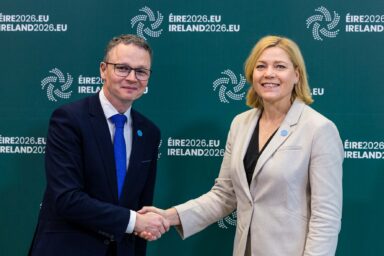
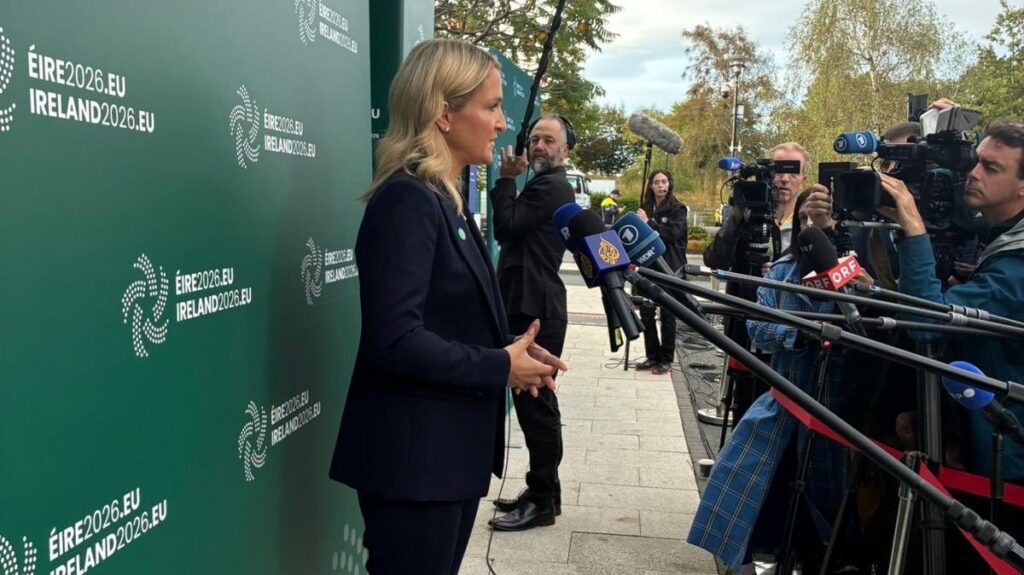
The first defence ministers’ meeting of the Irish presidency would focus first on Ukraine, Kaja Kallas and Helen McEntee said in Wicklow, Ireland, on Tuesday morning. The Union’s foreign policy chief wants the European Peace Facility unblocked. She also said that if funds return to member states, “many member states have already said that all the funds that they are getting back they will give to Ukraine”.
That is where the first friction lies. Some governments want rapid military aid, especially air defence. Others will resist open-ended commitments, and Ms Kallas conceded that she could not name concrete numbers yet. This augurs much haggling.
Deterrence on the agenda
EU support for Ukraine will also test how far capitals are willing to move on Russian pressure. Ms Kallas linked the discussion to sabotage, drone attacks, and wider Russian provocation, asking what the EU can do to deter Moscow from “going any further.”
She also pointed to a second fault line: Europe’s own capacity gaps. “We have some critical capability gaps,” she said, adding that the Union must make the process faster if it wants to close them. That is a polite way of saying that some states will want speed, while others will want caution and control.
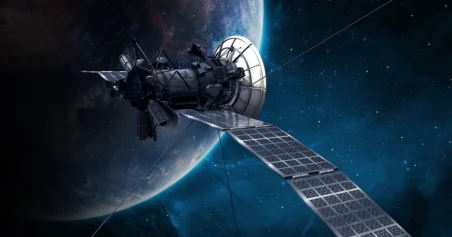
Space is another item. Ms Kallas said it is “a key enabler of defence”, with civilian and military uses. That should sound uncontroversial, but it will still raise questions over funding, industrial workshare, and whether the EU should try to act as a real space power rather than a loose coordinator.
Then comes maritime security, where the arguments grow sharper. Ms Kallas warned that the Strait of Hormuz needs free navigation, and said there should be “No tolls, no fees for these routes that have been open before.” She also flagged undersea cables and Lebanon.
The cost of collective action
Ms Kallas put the issue in her trademark straightforward manner. “We will discuss the maritime security and, as you say, it’s a great concern for all of us because there are cables that are underneath the sea and that are really affecting the everyday lives of people,” she said. Some states will see this as a call for more naval spending; others will hear another demand on already thin budgets.
A separate row concerns the West Bank. Ms Kallas said the videos from there are “extremely disturbing” and noted that some member states have proposed banning trade with settlements. But she also admitted that no concrete proposal is on the table, and that unanimity is not available.
Many member states have already said that all the funds that they are getting back they will give to Ukraine. — Kaja Kallas, the EU’s top diplomat
That means the familiar divide: Ireland and other advocates of tougher action on settlements on one side, and Germany, Austria, Hungary, and Czechia on the other, if their stated veto position holds. Ms Kallas did not name them as complicit. She said simply that states must explain their choices, and that the EU still lacks agreement.
Neutral, but present?
Helen McEntee, Ireland’s defence minister and host of the meeting, struck a more national tone. Ms McEntee said Ireland’s presidency will centre on Ukraine, maritime security, space, and Lebanon. She stressed that the talks are taking place in a “challenging time” and that hybrid activity now spans land and sea.
On Ukraine, Ms McEntee said the European Peace Facility “needs to be unlocked” and that “what Ukraine needs now at the moment is more defence capabilities.” She backed more air support and said Ireland’s own funding over the summer would go towards air capabilities.
But Ms McEntee also exposed the state-by-state divide on defence spending. Ireland has raised its defence budget by 43 per cent in four years, she said, and is investing in air capability, radar, and counter-drone technology. Still, she defended Ireland’s neutrality and argued that support for partners does not require joining a military alliance.
43 per cent, still not enough
On maritime security, Ms McEntee made the logic explicit: the threat is broader than any one country, and “The EU must work collectively, together to respond to those threats.” Yet she also insisted that Ireland is increasing its own spending and that it should not be judged on one metric alone.
Lebanon will add another layer of disagreement. Ms McEntee said UNIFIL’s drawdown is a “profound regret” and that Ireland, with Spain and Austria, has proposed a new CSDP mission. She wants an EU answer, but states will differ over mandate, force levels, and whether the mission is worth the risk.
The meeting’s mood, then, is one of urgency without unanimity. Ukraine needs more help; maritime threats are rising; and space matters more and more. But the same old EU problem remains: every file is broadly supported in principle, and each becomes harder when the bill arrives.