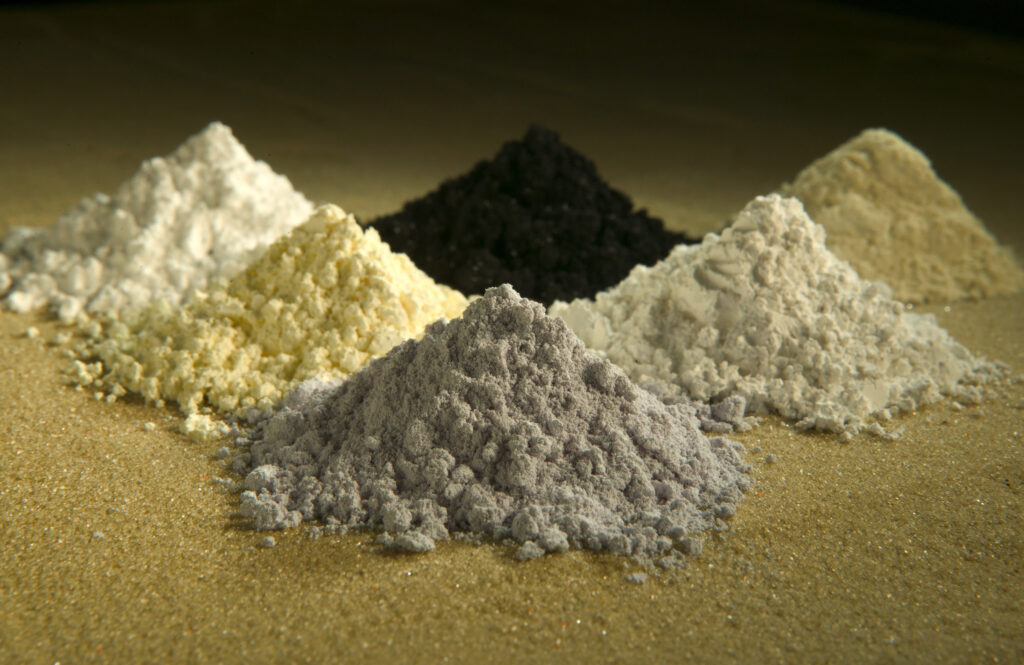
A rare earth mine without a separation plant is like an oil well without a refinery, Peter Tom Jones of KU Leuven told EU Perspectives. That missing link gives China its grip on the magnets in Europe’s cars, wind turbines, and defence systems. Europe has started to build it. Now it has to prove it works.
China’s expanded rare earth export controls are on hold, but only for now. In July, Beijing barred 14 EU companies, among them Rheinmetall, from receiving Chinese dual-use goods in response to the EU’s latest Russia sanctions package. Later this month, the EU and Canada are expected to announce a critical minerals deal at a summit in Montreal.
Peter Tom Jones directs KU Leuven’s Institute for Sustainable Metals and Minerals and hosts the RAW MATTERS podcast on critical minerals. In this interview, he explains where Europe stands in the global race for these materials.
China’s broader rare earth controls are suspended only temporarily, and in July Beijing barred 14 EU companies from receiving Chinese dual-use goods. If China tightens again, where would Europe feel it first, and how quickly?
If restrictions tighten again, it is European manufacturing that will be hit hardest. The sectors most exposed are automotive, robotics, advanced electronics, and defence manufacturing. Some companies could feel the impact within weeks if supply chains tighten and inventories start running down.
You have argued that Europe’s real weakness is refining and separation, not mining. How much has that actually changed in the past year?
Europe has spent years discussing and researching where rare earths could be mined. Through numerous FP7, Horizon 2020, and Horizon Europe projects, we’ve studied potential deposits and flowsheets in Sweden, Finland, Norway, and Greenland for well over 15 years. At KU Leuven we have been part of that endeavour. But so far, none of these projects has become a producing mine because of permitting delays, difficulties in securing a social licence to operate, and major financing challenges. That is regrettable and it certainly contributes to Europe’s dependency.
China controls that chain from end to end, and that is where its leverage lies. — Peter Tom Jones, director of KU Leuven’s Institute for Sustainable Metals and Minerals
But the debate has also evolved. The critical question is no longer who owns the rare-earth ore body or who operates the mine. The critical question is who controls the technologies and industrial processes that transform rare earth-bearing minerals into products. Let me put it bluntly: a rare-earth mine without a solvent-extraction separation plant is like an oil well without a refinery. The real challenge is therefore not just upstream mining. It is the entire mine-to-magnet supply chain. China controls that chain from end to end, and that is where its leverage lies.
In particular, China effectively controls the separation of the heavy rare earths dysprosium and terbium, which are indispensable for high-performance neodymium-iron-boron magnets used in electric vehicles, direct-drive wind turbines, and defence applications. This remains one of the major strategic chokepoints in the global economy. China is also highly dominant in metallisation, alloy-making, and magnet manufacturing.
There is some encouraging news, though. As we discussed in a recent RAW MATTERS podcast episode with Neo’s Vasileios Tsianos, we are beginning to see meaningful investments in separation, recycling, metallisation, and magnet manufacturing. Estonia, in particular, has quietly become one of the most important rare-earth processing hubs outside China thanks to the Neo Silmet ecosystem. France is also moving forward through Carester’s investments in magnet recycling and heavy rare-earth separation capabilities.
That said, I would add a note of caution. As US rare-earth expert Jack Lifton recently observed, many companies are announcing commissioning dates, pilot production runs, and qualification milestones. These are important achievements, but they should not be confused with sustained commercial production and customer-qualified deliveries.
The coming three to five years will therefore be decisive. We are entering the period where projects will have to prove they can deliver tonnes, not presentations.
Prices for heavy rare earths outside China are now many times higher than inside China. Can European projects survive that gap without permanent public support, such as guaranteed prices or EU joint purchasing?
Europe needs to stop viewing rare earths exclusively through the lens of lowest-cost procurement. As my RAW MATTERS co-host Agathe Destresse recently remarked, we also need to account for the cost of resilience. If rare earths are genuinely critical for the energy transition, digitalisation, and defence, then they need to be treated as strategic assets. Every major industrial power understands this. China certainly does.
The reality is that emerging European and North American projects are competing against an ecosystem that China has spent decades building and integrating. The playing field is simply not level. This does not automatically mean permanent subsidies. But it probably does mean investment support, strategic offtake agreements, demand aggregation, and public procurement strategies that allow projects to reach industrial scale.
Again, I think Jack Lifton makes an important point here. In Europe (and the US), we should focus less on announcements and more on deliveries. The crucial question is whether companies can consistently deliver customer-qualified dysprosium, terbium, and neodymium products at commercial scale. That is ultimately the benchmark that matters.
The EU is setting up a joint stockpile and joint purchasing. Will these make a real difference, or are they too small and too late?
They will help, but they will not solve the problem. Strategic stockpiles are useful because they buy time. Joint purchasing can strengthen demand signals, reduce market fragmentation, and provide greater certainty for investors. But rare-earth resilience cannot simply be stockpiled into existence. A stockpile is essentially an insurance policy. It helps you survive a disruption. It does not build separation facilities, metallisation plants, alloy-making facilities, or magnet factories.
Rare-earth resilience cannot simply be stockpiled into existence. — Peter Tom Jones
The real measure of success is whether, five years from now, Europe can point to a substantial mine-to-magnet ecosystem operating at commercial scale. If that happens, stockpiles will have played a useful supporting role. If it does not happen, stockpiles will merely help us manage recurring crises rather than solve them.
Canada and the EU are expected to announce a critical minerals deal in Montreal this month, and Ukraine is often presented as a future supplier. Realistically, what can each offer Europe on rare earths, and by when?
Canada and Ukraine are often mentioned together, but they occupy very different positions on the timeline. Canada is a near-term opportunity. It combines strong geological resources, technical expertise, political stability, and a growing rare-earth processing ecosystem. Importantly, Canada is trying to move downstream into higher-value processing, rather than simply exporting concentrates. Canada is also a like-minded partner that is genuinely interested in closer cooperation with Europe. We should seize that opportunity. As Mark Carney put it, the middle powers need to stick together: principled and pragmatic.
Ukraine is a completely different story. In general, Ukraine may be a long-term opportunity for several critical raw materials. But when it comes to rare earths specifically, the story is often misunderstood. Ukraine is endowed with resources such as lithium, graphite, and titanium. However, it is not a significant rare-earth country.
A great deal of confusion has arisen because journalists, policymakers, and even President Donald Trump frequently use the terms ‘rare earths’, ‘rare metals’, and ‘critical minerals’ interchangeably, even though they refer to very different things. Let’s be clear: Ukraine has critical raw materials, but it is not a major future supplier of rare earths.
To conclude on the rare-earth conundrum: the winning strategy combines reliable partners such as Canada, Australia, and Norway with much stronger European capabilities in (at least some) domestic rare-earth mining, enriched by separation, metallisation, alloy-making, magnet production, and recycling. Make no mistake about it: building a competitive rare-earth supply chain in Europe will be an uphill battle. As Pink Floyd famously put it: “Don’t give in without a fight.” And that fight will require coordination across the entire value chain, strategic financing, industrial synchronisation, and, above all, perseverance.