
EU unemployment remained near historic lows in July, but the stable headline rate masked increasingly divergent national trends. Unemployment rose in low-rate Czechia, Poland and Malta, while Spain, Estonia and Greece recorded substantial annual declines.
The EU unemployment rate held at 6.1% in July, unchanged from June, while the euro-area rate remained at 6.4%, according to figures published by Eurostat on Tuesday. Both were slightly higher than in July last year. Around 13.5 million people were unemployed across the bloc. The number of unemployed people declined modestly from June but was almost 300,000 higher than a year earlier.
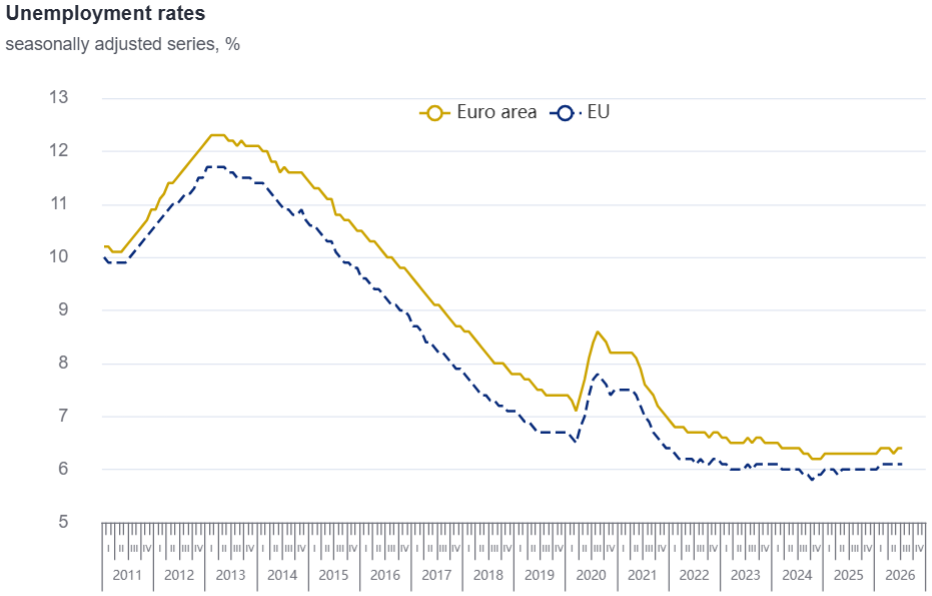
The figures point to a labour market that remains broadly resilient despite weak growth and higher energy costs. The European Commission expects EU unemployment to remain close to 6% through 2027, partly because labour-market flows have increased since the pandemic
“Compared to before the pandemic, more people outside the labour force began searching, while at the same time more unemployed people left,” its recent analysis said.
Finland and Spain head in opposite directions
Finland recorded the EU’s highest unemployment rate at 10.5%, followed closely by Spain at 10%. But while Finland’s rate has climbed steadily, Spain’s has continued to fall.
Finnish unemployment has risen from 8.3% in July 2024 and 9.6% a year later. Statistics Finland reported that the number of unemployed people increased by 20,000 over the past year, with most of the rise occurring among women.
The European Commission attributes Finland’s weaker labour market to subdued economic activity, limited demand for workers and an increase in the number of people participating in the labour force. It expects unemployment to decline only gradually as the economy recovers.
Compared to before the pandemic, more people outside the labour force began searching, while at the same time more unemployed people left.
— European Commission Analysis, Taking stock (and flow) of unemployment rates
Spain, by contrast, is continuing a longer improvement. Its rate declined from 10.6% a year earlier and is approaching single figures for the first time since the financial crisis. Estonia recorded an even larger decline, from 8% to 6.9%, while Greece fell from 8.9% to 7.9%. Employment growth and migration have expanded both the number of workers and the labour force in Spain. But structural unemployment remains substantially above the EU average.
Even Europe’s strongest labour markets are diverging
At the other end of the scale, Czechia retained the EU’s lowest rate at 3.3%. But that was 0.5 percentage points higher than in July 2025. The increase was particularly pronounced among women, whose unemployment rate rose from 3.1% to 4.1%, while the rate for men changed only slightly.
Poland recorded the second-lowest overall rate at 3.4%, up from 3.1% a year earlier. Malta also experienced an increase, from 2.5% to 3.5%. Slovenia moved in the opposite direction, with unemployment declining from 3.8% to 3.5%.
The divergence shows that even Europe’s strongest labour markets are no longer moving in lockstep. Czechia, Poland and Malta remain among the EU’s lowest-unemployment countries, but their lead over the bloc as a whole has narrowed.
Youth unemployment improves
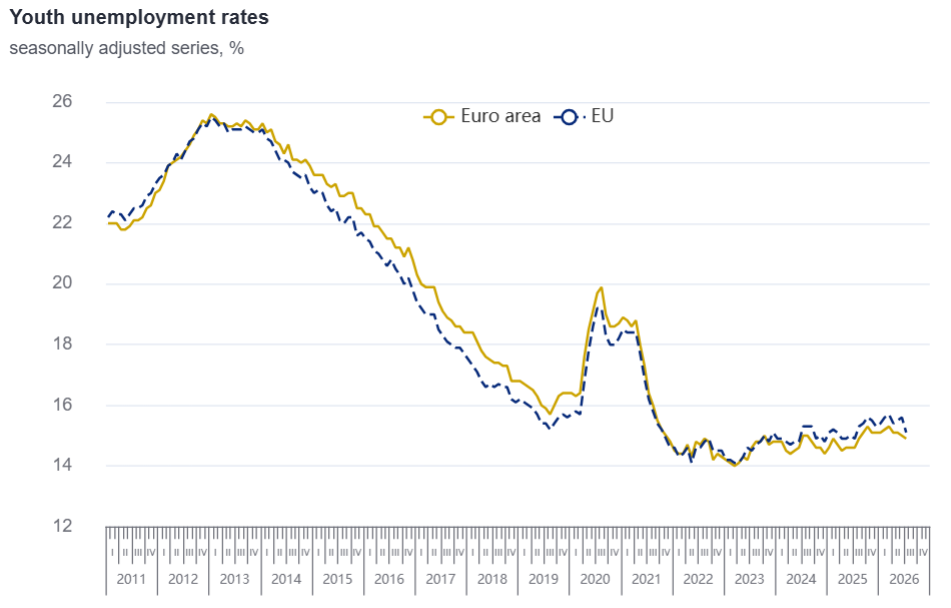
The clearest monthly improvement occurred among people under 25. The EU youth unemployment rate declined from 15.6% to 15.1%, leaving around 2.9 million young people without work.
The number fell by almost 100,000 during July, although it remained slightly higher than a year earlier. Among countries with July data available, Estonia recorded the highest youth unemployment rate at 26.1%, followed by Sweden at 24.4% and Finland at 23.4%. Seven EU countries recorded rates above 20%. Romania’s latest quarterly figure was higher still, at 30.8%, but Eurostat did not publish a separate rate for July.
July can bring seasonal shifts as students enter the labour market or take temporary jobs. Eurostat seasonally adjusts its headline figures for these recurring patterns, however, so the latest movement cannot be explained simply by the summer season.