Ditch both obsolete doctrine and haute couture production, the commissioner exhorted. Eliminating a threefold deficit—institutional, industrial, and financial—is critical, as Russia is still outproducing Europe.
“The definition of insanity,” Andrius Kubilius told European parliamentarians, “is doing the same thing over and over and expecting different results. I hope we are not insane,” he said, ever the optimist.
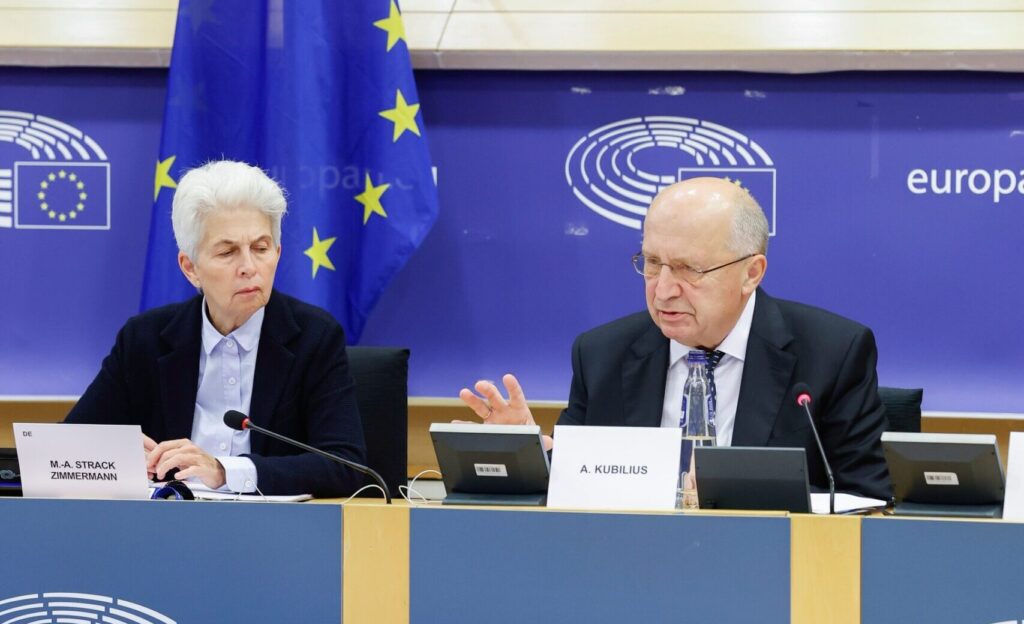
The defence commissioner arrived to the European Parliament’s security and defence committee (SEDE) on Thursday to explain how the Union is navigating the Roadmap for Readiness 2030. He shared both frustration and offers of reassurance. Facing a set of demands, he served the MEPs the sanity warning borrowed from fellow physicist Albert Einstein.
The SEDE committee session covered four areas: institutional architecture, support for Ukraine, industrial readiness, and space. What united them was a single uncomfortable thread. Europe is moving, but not fast enough, not collectively enough, and not smartly enough.
Our defence doctrine, our institutions, and our decision-making have not kept pace with a new reality. — Andrius Kubilius, EU defence and space commissioner
MEP Marie-Agnes Strack-Zimmermann (Renew/DEU), SEDE committee chair opened by naming the central frustration. “We still see too much distance between what we agree here in Brussels and what actually happens in the capitals,” she said. “We create the instruments. But member states are reluctant to use them together or to move at the speed the situation requires.” Mr Kubilius did not disagree. He built his entire statement around that gap.
New reality, new architecture
The Commissioner began with the Commission President’s State of the Union address, which he described as “an important breakthrough in European defence”. Two passages, he said, were decisive. First: “Our defence doctrine, our institutions, and our decision-making have not kept pace with a new reality.” Second: the announcement of plans for a European Security Council including Canada, Norway, Ukraine, and the United Kingdom.
For Mr Kubilius, these were not rhetorical flourishes. They pointed to what he termed “institutional defence readiness”, the most neglected of the three pillars he uses to frame the challenge. The other two are material readiness and political readiness: sustaining public will in the face of Russian hybrid operations.
His own prescription was direct. “We urgently need a new European defence architecture to resolve two major issues,” he said. The first is geographic: a European Defence Union should include not only EU member states but also the United Kingdom, Ukraine, Norway, and Canada. The second is decisional: “That is why we need, in my personal opinion, an E5-type European Security Council.”
Such a body could serve as the leadership organ for a broader Defence Union, working alongside a general assembly of all members. More clarity, Mr Kubilius said, would come with the European Security Strategy, expected by the end of October. “It’s not against NATO,” he said in reply to concerns voiced by MEP Mārtiņš Staķis (Greens-EFA/LAT). “It’s exactly the opposite; it’s how to make Europe stronger, which will make NATO stronger.”
Wavering on Ukraine
On Ukraine, the numbers were sobering. The €28.3bn weapons loan for 2026 is on track, with €12bn already disbursed. But Mr Kubilius was clear that this falls short. “Russia is escalating,” he said, “and we need to make our support stronger, more effective, and predictable.”
Ukrainian defence faces a deficit of €23bn, the result of unfulfilled promises made at the Ankara NATO summit. Three-quarters of all individual European support for Ukraine, Mr Kubilius noted, comes from just five member states. “Where are the others?” he asked.
We urgently need a new European defence architecture to resolve two major issues. That is why we need, in my personal opinion, an E5-type European Security Council. — Andrius Kubilius
MEP Sven Mikser (S&D/EST) pressed on air defence: Russia has shifted to striking civilian targets, winter is approaching, and anti-ballistic assets are critically short. Mr Kubilius laid out the arithmetic. Ukraine faced roughly 1,000 Russian ballistic missiles last year. This year the figure approaches 2,000. American PAC-3 production runs at around 750 missiles annually, and destroying one Russian ballistic missile requires approximately two PAC-3 rounds.
His short-term fix: persuade member states holding PAC-3 stockpiles to transfer them to Ukraine now, in exchange for missiles Ukraine has on order for 2027. He cited SACEUR General Alexus Grynkewich‘s public statement that such a swap would not endanger any EU member state.
Longer term, he pointed to the joint Freyr and Blixam anti-ballistic projects as potential game-changers. “Putin needs to feel, to understand, finally, that he is not able to achieve anything in this war,” Mr Kubilius said, “and that the war is coming closer and closer into Russian territory itself.”
Rearming, but too slowly
MEP Nicolás Pascual de la Parte (EPP/ESP) had set the political context starkly. Russian defence spending is up 20 per cent. Foreign Minister Sergey Lavrov dismissed talks with Germany’s foreign minister as a waste of his time. Elections across France, Italy, and Spain risk bringing to power parties that favour a ceasefire at any cost.
Mr Kubilius agreed on both the diagnosis and the urgency. “Peace in this war can come only through the formula of strength,” he said, “and that strength should be on the Ukrainian side.”
The most pointed section of Mr Kubilius’s statement concerned industrial readiness. He cited a European Defence Agency report, still classified at the time of the hearing, that Reuters had summarised bluntly: “The European Union is not rearming quickly or effectively enough to meet its goal of being ready to defend against Russia by 2030.” Mr Kubilius called it “a warning signal”.
His diagnosis was specific. Too much of European defence industry still makes the best enemy of the good. It is technically sophisticated, expensive, and impossible to scale. “We must move more of our attention from what is called haute couture production to good enough production,” he said. “Good enough to hit the targets. Less technically advanced, cheaper, and easier to scale.”
The structural problem
A second structural problem is procurement. In some member states, up to 80 per cent of what major defence primes produce is bought directly by governments, often without competitive tender, using the Article 346 security exemption. The consequence: primes have no incentive to innovate, and small firms and start-ups have no room to enter the market.
“If I were the CEO of a prime and I knew that the government will buy whatever I am producing—80 per cent—why should I look into how to innovate?” Mr Kubilius asked. A defence market package, including revision of the procurement directive, is due by the end of November or early December.
We still see too much distance between what we agree here in Brussels and what actually happens in the capitals. — MEP Marie-Agnes Strack-Zimmermann (Renew/DEU)
MEP Assita Kanko (ECR/BEL) pressed on European preference, asking whether quality or provenance would govern purchasing decisions. Mr Kubilius drew a sharp distinction between EU money, where preference rules apply, and national spending, which dwarfs it entirely.
If the next multiannual financial framework delivers €130bn for defence and space over seven years, member states will spend roughly €6tn over the same period to meet their NATO pledges. “So six trillion and one hundred billion,” he said. “That’s the difference.”
Logistics, drones, and space
On military mobility, Mr Kubilius offered a figure that illustrated the scale of the challenge. Transporting one brigade, roughly 5,000 troops, from Belgium to Lithuania requires a truck convoy 12 kilometres long, bumper to bumper. NATO’s first-wave preparedness target requires 100,000 troops to move within ten days of a conflict beginning.
He invoked the American general John Pershing: “Battles are won by infantry, wars by logistics.” He warned that the Council is looking to relax requirements on the emergency mechanism and readiness pool in the military mobility package. “Let’s keep our military mobility package ambitious,” he said.
On drones, Russia will use approximately 10 million against Ukraine this year, around 30,000 per day. Europe currently produces 1.5 million annually. Scaling immediately to 10 million would be a mistake, Mr Kubilius argued: FPV kamikaze drones become obsolete within two months as adversaries develop new jamming techniques.
The answer is ever-warm facility contracts: companies that produce at peacetime rates but maintain lines, components, and trained workforces ready to surge output the day after an attack. MEP Petras Auštrevičius (Renew/LTU) asked when Europe would have its own Shahed equivalent. Mr Kubilius pointed to the EU-Ukraine Drone Alliance and stressed that hardware is secondary.
Learning from Kyiv
He went on to stress how the Union must draw on Ukraine’s hands-on war experience. “Learning from Ukrainians—all that ecosystem, how to create, how to be very dynamic, how to get also practice from the front line and immediately react if Russians are starting to jam— that is what is crucial in all our future plans of drone defence,” he said.
On space, Mr Kubilius outlined four priorities. These are the IRIS2 secure satellite communications system, due in 2029 with 350 satellites; a governmental earth observation service for defence and security; a low-Earth-orbit navigation system significantly harder to jam from 2027; and a push to expand European launch capacity, which he described as dangerously inadequate.
I hope we are not insane. — Andrius Kubilius
The commissioner also announced a “launching tour” of European spaceports and launch-vehicle manufacturers. This is to follow an earlier “missile tour” in order to assess how quickly capacity can grow.
What must change
The session did not close the gap between Brussels decisions and national implementation. But it sharpened the terms of the debate considerably. Mr Kubilius’s message, stripped to its core, was that Europe faces three simultaneous deficits—institutional, industrial, and financial—and that addressing any one in isolation will not be enough.
The Einstein quotation was not decorative. The implicit charge was that member states and procurement systems are still operating on peacetime logic: buying from familiar primes, resisting joint projects, and treating defence as a sovereign prerogative rather than a collective emergency. Mr Kubilius spent the better part of an hour explaining, in precise and sometimes bleak detail, exactly what overcoming all this would require.