The Catholic Church warned European lawmakers against concentration of AI power and unsupervised algorithmic decision-making about humans.
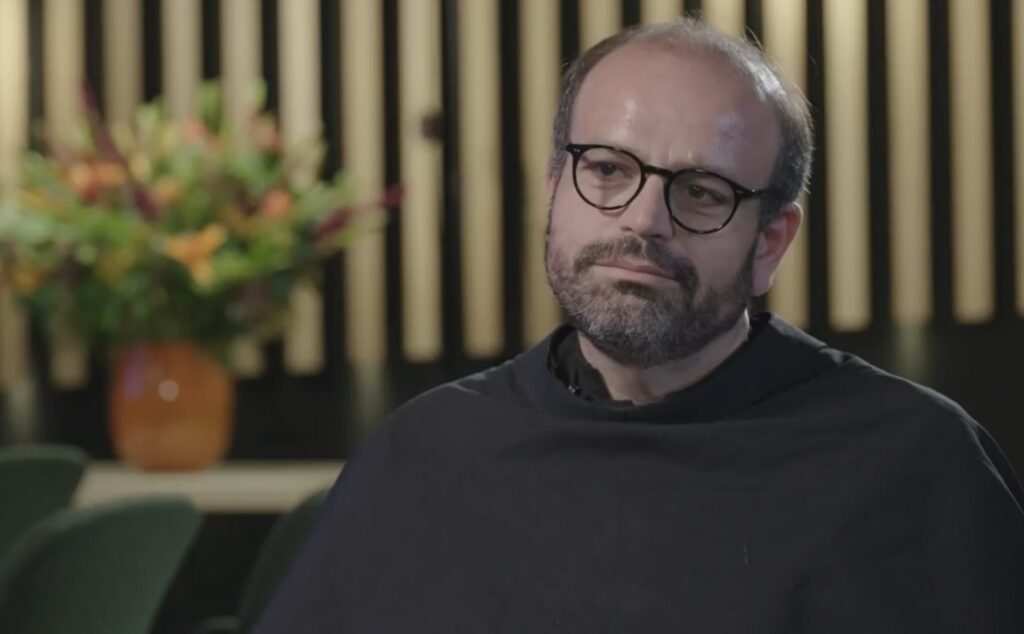
Evolution and innovation are “pressing hard” but the Vatican and the European Union’s AI Act are on the same page, more or less, according to Paolo Benanti, a Franciscan priest and a foremost Christian scholar. As a representative of the Catholic Church, Mr Benanti exchanged views on AI governance and its implications with the European Parliament’s committee on internal market and consumer protection (IMCO) in Strasbourg on Monday.
The Italian theologian and member of the United Nations AI committee said that fundamental resonances are emerging between various AI-related EU legislation and the thinking within the Vatican. He specifically referred to Magnifica Humanitas, the encyclical letter Pope Leo published this past May.
The historical commitment of Christians is to make principles of justice and peace visible. — Paolo Benanti, Pontifical Gregorian University
Mr Benanti was an advisor to Pope Francis on the issues of AI and the ethics of technology. He told the MEPs that he fears that “Some of the apocalyptic announcements coming from the companies producing these technologies are to prevent political bodies from enacting laws.”
This, in his view, is “allowing the companies to self-regulate which, in traditional economic terms, amounts to a cartel”. “We need the rule of law (because) it is not enough for companies to simply self-regulate,” he warned, giving the members the rare experience of a prominent Vatican figure railing against the perils of centralised power.
Magnifica Humanitas’s voice in Brussels
To date, Pope Leo’s appeal regarding AI ethics, included in his first encyclical, has succeeded in uniting 28 major religions the world over. For once, the conspicuous rise of AI has apparently provided politics and religion with a common purpose.
The Encyclical focuses entirely on safeguarding the human person in the age of AI and is the first papal document of its kind dedicated to the subject. Referring to Magnifica Humanitas, Mr Benanti explained to MEPs that AI can be either a weapon or a tool. “I think what we would like to see now including from the Church’s perspective is a ceaseless, ongoing duty to transform that very substance into something used to sustain life, provide bread, and cultivate the land, rather than to kill others,” he stressed.
In this context, “The historical commitment of Christians is to make principles of justice and peace visible. This type of teaching emerged as a distinct body of doctrine with the Industrial Revolution and the profound social transformation it brought about,” the scholar said. For obvious reasons, he did not dwell on the fact that the distinct body of doctrine—i.e., Protestantism—emerged against the will of the Catholic Church.
From Arendt to migration concerns
The current era is largely defined by AI-driven digital revolution. Mr Benanti argued that the EU must recognize that “This type of technology is a form of power, a force capable of fundamentally altering the normal democratic functioning of society.”
The concentration of power in the hands of a few AI entities (and the global consequences this is generating) parallels the issues Hannah Arendt highlighted in her seminal work The Origins of Totalitarianism when fascism and Nazism rose to power in Europe. “If we remove another layer of friction—namely, human decision-making—in favour of algorithmic decision-making, well, this effect could be amplified,” Mr Benanti explained. “We might witness a more despotic outcome within a decision-making system that simply no longer requires any form of accountability during the process.”
This type of technology is a form of power, a force capable of fundamentally altering the normal democratic functioning of society. — Paolo Benanti
Speaking about the EU, Mr Benanti was forthright about the issue of migration and the way asylum seekers are being “automated”. Referring to experiments currently involving asylum seekers and refugees (with the help of eu-Lisa and Europol), he noted “a tendency to perceive human judgment as inherently biased and to assume that algorithmic judgment might be fairer”.
The AI Act: for better or worse
Yet, he said, in many cases involving asylum seekers “We are replacing the traditional process—where an official listens to the applicant’s story—with an algorithmic decision-making system that simply demands data from these human beings.” The warning to the MEPs present was clear: the European Union must understand the value “we place on human dignity in the public sphere,” the theologian issued an impassioned plea.
The AI Act prohibits data-driven automation and decision-making regarding human beings without safeguards. According to Mr Benanti, this represents “the ultimate affirmation of what it means to be human within the context of the continent’s understanding of the rule of law”.
The MEPs across political lines showed interest and curiosity on the matter. MEP Sandro Gozi (Renew/FRA) went straight in medias res, asking what specific requirements should the AI Act include to ensure genuine human oversight and respect for human dignity, and if the text is “comprehensive”.
The nuts and bolts
In his answer, Mr Benanti tried to connects some dots. “There is a vast difference between applying an algorithm to make choices about things and applying one to make choices about people. And this represents a distinctively European approach—one that only Europe can currently propose in a practical way—capable of avoiding harm to both the economy and human beings,” he said.
Furthermore, the scholar noted that the EU was born after “We Europeans, in the last century, managed to kill six million people based on a single piece of data about them: their religion.” (In other contexts, this could be a controversial statement, as the Nazis used primarily the ethnic criterion to determine who is Jewish.)
There is a vast difference between applying an algorithm to make choices about things and applying one to make choices about people. — Paolo Benanti
Not all is rosy with the AI Act according to Mr Benanti, however. The legislation has “some missing pieces” such as the creation of a standard that would make the protection of human beings “practically enforceable”, he said. This, he argued, could be done by “by granting the user or the individuals interacting with the machine meaningful scope for decision-making”.
The major provisions of the AI Act became fully applicable and enforceable this past August.