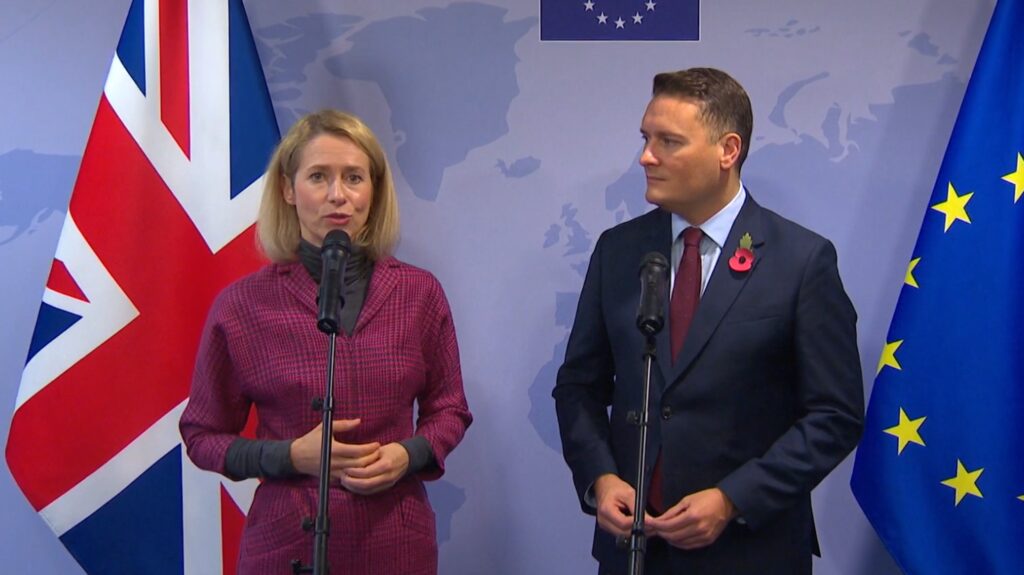
Kaja Kallas offered Britain kind words but no concessions as Wes Streeting urged the EU not to exclude British firms from its defence splurge.
Wes Streeting, Britain’s defence secretary, spent his Monday in two European capitals. In Brussels he met Kaja Kallas, the EU’s foreign policy chief. In Berlin he saw Boris Pistorius, his German counterpart. His message was consistent: Britain wants to be part of Europe’s defence effort, not shut out of it.
His errand was commercial as well as it was diplomatic. The EU wants to boost sectors such as cars and defence by obliging firms to buy European if they want public money. London fears exclusion. Britain has already clashed with France and others championing a ‘Made in Europe’ approach. It threatens to leave London (and UK companies) out of recent EU defence industrial initiatives.
The trip was Mr Streeting’s first to Brussels as defence secretary. It came a week after he met Mr Pistorius, Ms Kallas, and the Italian, French, and Polish defence ministers in Paris. He was also due to meet Andrius Kubilius, the EU’s defence industry commissioner. The latter had not, by the time of writing, produced any media output.
A warning on protectionism
The timing matters. A UK–EU leaders’ summit is due on 20 November, and Mr Streeting’s tour helps prepare its defence elements. Russia’s invasion of Ukraine and US President Donald Trump’s taking the side of Russia while hobbling NATO partners have made defence one of the best areas of cooperation since Britain left the bloc in 2020.
Standing beside Ms Kallas, Mr Streeting argued from economics rather than grievance. “The truth is that even if every NATO member could afford to double defence spending tomorrow, we wouldn’t be able to spend it because the industrial base isn’t strong enough,” he said.
He called a focus on jobs and growth from defence spending healthy and necessary. The danger, he said, is that it spreads into self-defeating protectionism. In his telling, the stronger Europeans are together, the likelier they are to deter Russia and other threats.
Playing to the home crowd
Mr Streeting gave the impression of a man always running for office, even as he is holding one of Whitehall’s coveted portfolios. During the press conference, he invoked his boss, Prime Minister Andy Burnham, and his qualities no less than three times. The defence secretary praised Mr Burnham’s “leadership”, “courageous conversation”, and “ambitious agenda on Europe” as if he had picked the wrong talking-point memo on his way across the English Channel.
Asked by Sky News whether he wanted Britain to rejoin the EU, and how fast, the secretary had this to offer: “I’m really proud of the prime minister’s leadership.” He added that Mr Burnham is willing to confront big challenges, from social care to Europe.
The UK’s policy on defence is NATO first, not NATO only. — Wes Streeting, UK defence secretary
Asked what would be easier if Britain were back in the EU, he again addressed voters at home. Leaving, he said, had hurt the economy, and Brexit had not worked as well as promised. “We fought hard in the referendum. We lost,” he said, adding that his Labour party respected the result, which now even many erstwhile Brexit supporters view as a mistake.
Kallas: ‘Not there yet’
Ms Kallas gave little ground. She said EU member states benefit from cooperation with Britain and its defence industry. But she conceded there had been no result on British participation in the SAFE agreement. “We have other ways to cooperate,” she said, while stressing that Britain should be part of the wider European defence alliances.
She pointed instead to the Framework Participation Agreement, which would cover British participation in civilian and military missions. Talks continue. On a possible SAFE 2, she said the EU was “not there yet”. Mr Streeting said Britain would judge whether taking part served its interest. “The UK’s policy on defence is NATO first, not NATO only,” he said.
Earlier this year, Mr Streeting assumed the mantle of backstabber-in-chief when he helped slaughter the premiership of Sir Keir Starmer, Mr Burnham’s predecessor. On Monday, he said that the current prime minister wants to take the country back, and the conversation must involve the British people. Mr Streeting judged that Mr Burnham’s character leaves him uniquely placed to lead it. Brexit, he added, was a loss to the EU too.
Cool in Brussels
Yet Mr Streeting was careful not to promise a return. “You can’t just leave the European Union and then expect to turn the switch back on and rejoin the European Union,” he said. Nor would the press conference begin negotiations for re-entry, he refused to take the bait from a British journalist asking about details.
Ms Kallas was cooler still. She said any decision rests first on what British people wish to see. Then came a reminder of the mood in Brussels. “There’s a lot of traumatised people from Brexit here in the European Union,” the EU’s foreign policy chief said.
We have other ways to cooperate. — Kaja Kallas, EU foreign policy chief
“These negotiations will be difficult, but we are not there yet,” she added. She spoke warmly of closer ties all the same. “We are stronger when we work together,” she said. Her advice was to proceed step by step, starting with the November summit.
Ukraine filled much of the rest. Mr Streeting said the chancellor, John Healey, had committed £10bn to Kyiv in last week’s budget, with £500m immediately for the winter. Ms Kallas noted that “July, August and September have been the deadliest months for Ukrainians during this whole war”.
Berlin offers a warm welcome
Berlin offered an unusually warm reception. Mr Pistorius, a vocal supporter of including Britain in European defence-industrial initiatives, greeted Mr Streeting with military honours. That is a somewhat unusual step for a brief working visit by a mere cabinet member.
Before the talks, Mr Streeting wrote in the Frankfurter Allgemeine Zeitung that the two countries would extend their Cyber Lighthouse project to cover artificial intelligence. “Through joint testing, development and ultimately the introduction of AI in our armed forces, we will deepen our cooperation and keep pace with those who seek to harm us,” he wrote.
Officials and industry figures are due to meet in spring 2027 to shape the plan. No systems, programmes, or budgets have been named. The International Committee of the Red Cross has warned that an arms race in AI is under way, and has called for legally binding rules on autonomous weapon systems.
Money is flowing already. Mr Streeting said German companies had committed £800m (about €956m) to British defence since the two countries signed a pact in 2024. Among them is Helsing, which opened a Plymouth factory last year to build AI-powered underwater gliders. Britain’s route to Europe’s defence table, for now, seems to run through Berlin more smoothly than Paris or Brussels.