Car buyers have never had so many cheap Chinese models to choose from. The people who build European cars have rarely had so much to lose. Next week, a record 20 Chinese brands bring that clash to the Paris Motor Show, while Brussels weighs how hard to push back.
More than one in ten new cars sold in Europe between April and June carried a Chinese badge. A year earlier, it was closer to one in twenty. According to Schmidt Automotive Research, Chinese brands now hold 10.7 per cent of Europe’s new-car market. That is more than the Japanese, who arrived in Europe in the 1970s. Shut out of the US and facing weaker demand at home, Chinese carmakers have made Europe their main target. “The Chinese are saying ‘we’ve got to try and dominate Europe because we can’t do anything in the US’,” said Brad Kunz, a partner at consultancy Grant Thornton Stax.
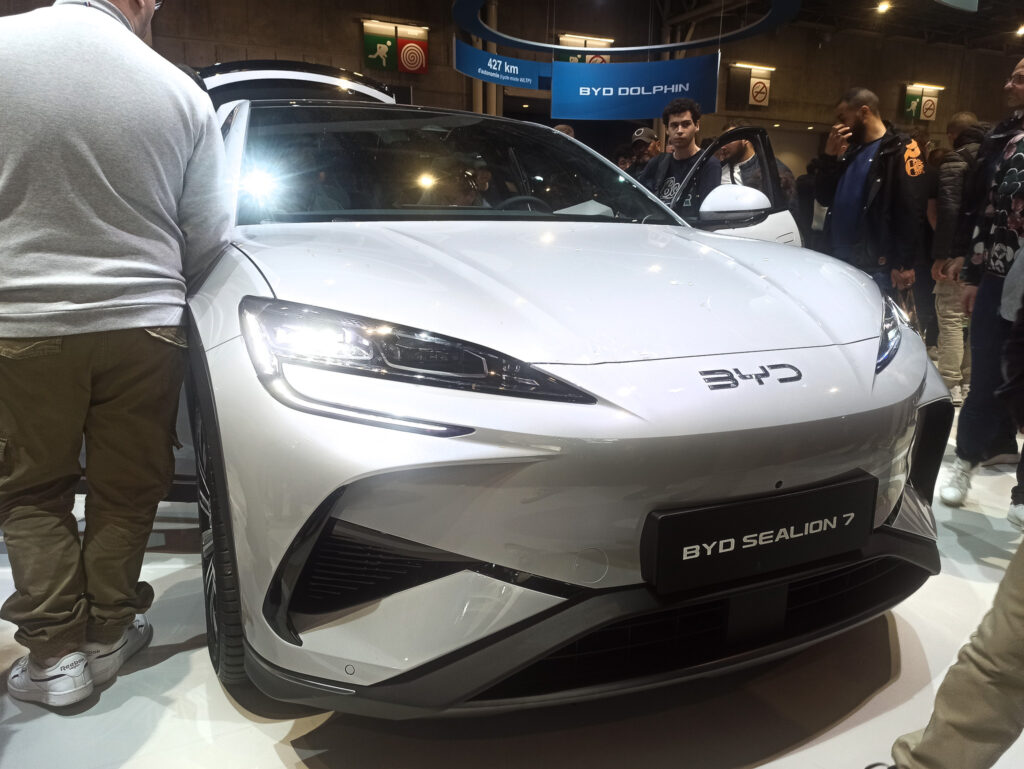
On Monday, they will show how serious they are. A record 20 Chinese brands will exhibit in Paris, twice as many as in 2024, Reuters reported. The show opens to the press on 12 October and to the public a day later. BYD and Chery will stand alongside newcomers such as Aito and Avatr. Aito, the premium brand of Seres Group, sells less than one per cent of its cars abroad today. It wants to reach 20 per cent within three years and will bring four electric SUVs for European buyers.
How hybrids got past the tariffs
Brussels saw the wave coming. In 2024, it imposed duties on Chinese-made electric cars. But the duties covered only fully electric models, and hybrids still pay just the standard 10 per cent. Chinese carmakers filled the gap fast. They took more than 26 per cent of the Western European plug-in hybrid market in the second quarter, up from 2.2 per cent two years earlier. For buyers, that meant cheaper hybrids. For European factories, it opened another front.
Brussels is now looking for ways to close that gap too. EU Trade Commissioner Maroš Šefčovič has spent two days in Beijing with Chinese Commerce Minister Wang Wentao. According to sources cited by the Guardian, Brussels hopes for a pilot deal on cars that it could later extend to other sectors. The stakes are high. The EU’s trade deficit with China now runs at about €1bn a day.
Whatever comes out of Beijing will land on the table of EU leaders at their summit on 15–16 October. Member states have hardened their stance in recent weeks. On 5 October, Germany and France urged the EU to adopt new powers to hit back quickly at countries that harm its economy. For Germany, long cautious because its carmakers sell so much in China, that marks a clear shift. The Commission has not yet proposed any new measure on hybrids.
Brussels is also preparing a quieter weapon. Planned ‘Made in Europe’ rules would require electric cars to contain a minimum share of European components to qualify for subsidies or public contracts. In practice, public money would go to cars built and sourced in Europe, whatever the logo on the bonnet.
Europe’s double game
On the factory floor, the pressure is already real. Volkswagen is cutting thousands of jobs and weighing plant closures, and BMW is shedding thousands of workers too. Sales by European carmakers in China have slumped since the pandemic, so losing ground at home hurts twice. “This motor show will probably be the most important one in the region since the pandemic,” said automotive analyst Felipe Munoz.
Yet European carmakers are not simply fighting back. Many also do business with their rivals. They sell Chinese groups spare capacity in underused factories and borrow their electric-car technology. Stellantis, for example, has teamed up with China’s state-owned Dongfeng. “The Europeans are playing a sort of double game,” said Pedro Pacheco, vice-president of research at Gartner. Their counterattack in Paris includes a revived Citroën 2CV, a small electric car that will test new rules allowing carmakers to drop some features and cut prices.
For years people were buying cars, now manufacturers have to sell them.
— François Roudier, Secretary-General, International Organisation of Motor Vehicle Manufacturers
François Roudier, Secretary-General of the International Organisation of Motor Vehicle Manufacturers (OICA), sees the Chinese wave as a wake-up call. In his view, it has revived motor shows after some traditional manufacturers lost interest. “For years people were buying cars, now manufacturers have to sell them,” he said. Carmakers that stayed away from Paris “have made a mistake”, he added. “It’s no show, no sell in a way.”