Brussels wants Frontex to become the engine of Europe’s deportations, with almost twice the money to do it. Rights groups are critical. They warn the plan could send migrants to countries they barely know and expose them to abuse far beyond the EU’s reach.
Money sits at the heart of the plan. The European Commission wants €11.8bn for Frontex, the European Border and Coast Guard Agency. The sum is part of the EU’s next long-term budget for 2028–2034. That is almost double the agency’s current allocation of about €6bn.
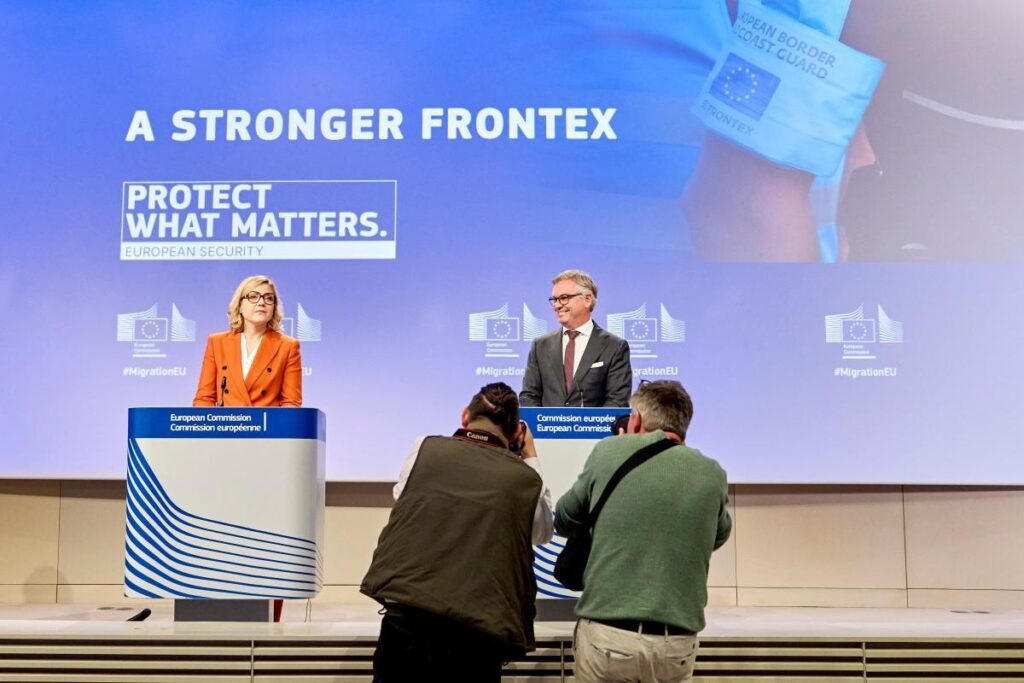
Magnus Brunner, Commissioner for Internal Affairs and Migration, presented the proposal on 27 October. He said member states themselves had asked for the increase. The reform has two aims. First, it should help Frontex protect the EU’s external borders. Second, it should turn the agency into the bloc’s operational arm for returns.
Human rights organisations did not wait for the details. Even before the reform came out, they raised the alarm. In their view, more powers and money for Frontex could mean more rights violations at Europe’s borders. Once the proposal was out, other groups joined in. Among them were Caritas Europa, a Catholic charity network, and the Platform for International Cooperation on Undocumented Migrants (PICUM). They criticised a “political obsession with deportations that ignores the realities of migration and Europe’s own economies”.
New powers, old fears
The reform holds few surprises. Frontex gets a bigger role in returns and closer ties with non-EU countries. It also gets an explicit mandate to monitor public social media. In addition, it could help carry out returns from one non-EU country to another. Critics say this opens the door to so-called ‘return hubs’. These are centres outside the EU where member states can send people with no right to stay.
“These powers and resources risk exposing refugees and asylum seekers to a greater danger of persecution,” said Sissy Katsoni, a legal consultant for Front-LEX. She pointed to the agency’s failure to meet its fundamental rights obligations. Sarah Chander, director of the Equinox Initiative for Racial Justice, sees another risk. The reform, she warned, could deepen Frontex’s role in individual returns. At the same time, digital tools and data sharing could blur the line between migration control and police work.
Josephine Solanki of the Abolish Frontex network questioned the need for more money. “It is not true that there is a lack of resources to ensure safe and dignified reception for migrants. It is a matter of priorities,” she said. David Yambio, co-founder of Refugees in Libya, condemned interceptions at sea and the transfers to Libya that follow. In detention centres there, he said, people face torture, exploitation, and sexual violence. Mr Yambio wants guarantees for migrants who might end up in ‘return hubs’ in third countries. He also called for effective ways to protect their rights.
Together, the organisations want clear conditions. Any expansion of the agency’s mandate should depend on effective oversight and accountability. Stronger internal monitoring bodies are not enough, they argue, if violations carry no real consequences. Yet the proposal goes the other way. It would narrow the reach of the agency’s own rights watchdog and pass complaints on to national authorities.
Abuses beyond Europe’s borders
Caritas Europa then took a closer look at the proposal. Its analysis focused on Frontex’s wider cooperation with non-EU countries on returns. Secretary General Maria Nyman spoke to EU Perspectives. “This could open the door to Frontex involvement in return hubs, which may be established in third countries under the new EU return regulation. We reiterate our concerns regarding these hubs, which risk leading to widespread human rights violations, legal limbo, ‘chain refoulement’, and de facto detention outside of Europe,” she said.
‘Chain refoulement’ means that countries pass people on, one to the next, until they end up where they face persecution. Ms Nyman also warned about the hubs themselves. They are possible under the Return Regulation, in force since 16 October. Such hubs “could result in people being deported to countries with which they have little or no connection, potentially for extended periods of time”, she said.
Governments should be investing in policies that protect people’s rights (…) rather than pouring more resources into an increasingly expansive deportation apparatus. — Chiara Catelli, Advocacy Officer at PICUM
PICUM shares these concerns. “Deportation operations and immigration detention centres in the EU are already rife with abuse, and we fear that expanding Frontex’s role will exacerbate these abuses within the EU and extend them beyond its borders,” said Advocacy Officer Chiara Catelli. She also questioned the priorities behind the reform. “At a time of growing inequality and economic insecurity, governments should be investing in policies that protect people’s rights and enable them to move, settle, and work in dignity, rather than pouring more resources into an increasingly expansive deportation apparatus.”
Battle lines in Parliament
The reform still has a long way to go. Both the Council of the EU and the European Parliament must approve it. In Parliament, a common front of the European People’s Party (EPP) and the far right now backs tougher migration rules. The European Conservatives and Reformists (ECR) group is already celebrating. In its view, the tighter rules follow “the political line charted by the Italian government”.
The Greens, however, see it very differently. “The Commission is pandering to populism and the far right on migration,” said MEP Tineke Strik (NLD). In her view, the Commission “risks turning Frontex into a European version of ICE”, the US Immigration and Customs Enforcement agency. The Socialists and Democrats (S&D) group also rejects the plan. It opposes tasking Frontex with “implementing a ruthless deportation policy”, even beyond the EU’s borders.