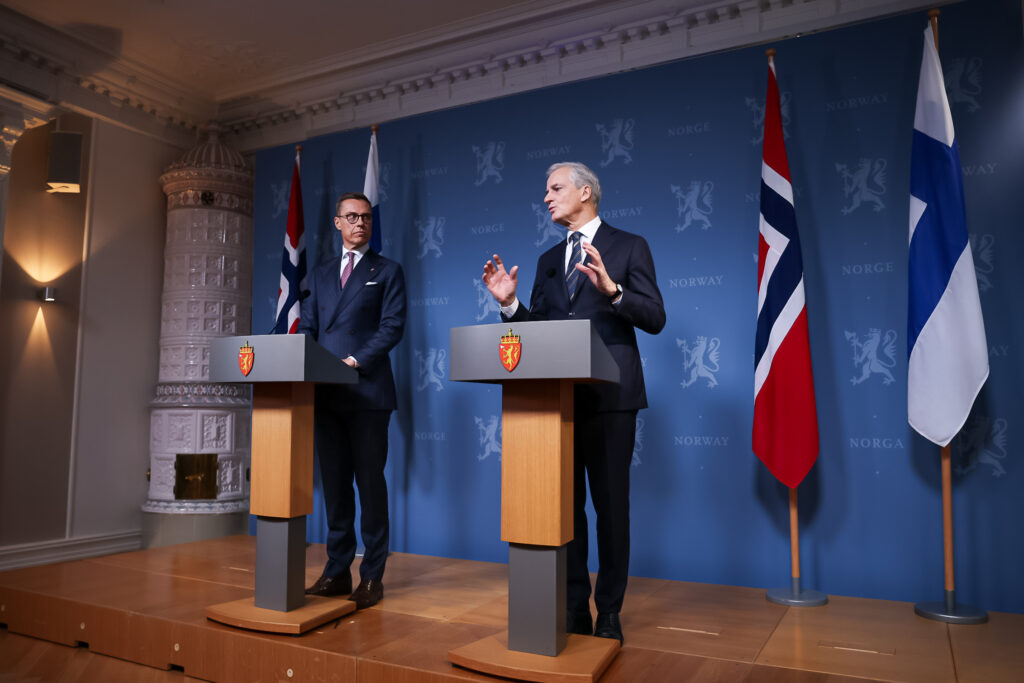
Finland and Norway have opened a rare direct line to the Kremlin. President Alexander Stubb and Prime Minister Jonas Gahr Støre phoned Vladimir Putin on Tuesday to pass on messages ahead of peace talks in Abu Dhabi. Both insisted they spoke for their own countries, not for Europe.
The two Nordic leaders made the call from Helsinki on 27 October. According to the Finnish president’s office, they initiated it in consultation with Ukraine. The aim was to convey messages to the Russian president about future negotiations to end the war. Kremlin spokesman Dmitry Peskov confirmed that the conversation took place.
Straight after the call, Mr Stubb and Mr Støre briefed Ukrainian President Volodymyr Zelenskyy. “Finland and Norway will continue to support Ukraine, and the efforts to find a just and lasting peace,” Mr Stubb wrote on X afterwards.
Road from Oslo to Abu Dhabi
The call built on a meeting in Oslo on 20 October. There, Mr Stubb and Mr Støre sat down with Mr Zelenskyy and US special envoy Steve Witkoff. A day later, Mr Witkoff travelled to St Petersburg to meet Mr Putin. The Kremlin then said it was ready to resume US-mediated talks with Ukraine in November, for the first time since February.
Negotiators from Ukraine, Russia, and the US have since agreed to hold technical-level meetings in Abu Dhabi in early November, Mr Zelenskyy said on Friday. Mr Stubb’s office linked Tuesday’s call directly to those meetings. After the Witkoff talks, Kremlin foreign policy aide Yuri Ushakov also said that any negotiations to end the war must include Europe, which backs Ukraine.
Neither leader claimed a mandate from the rest of the continent. The joint statement stressed that both took part as leaders of their own countries. They also underlined a shared interest in stability in the Baltic Sea region and the High North. Finland and Norway, they added, will keep up their long-standing support for Kyiv.
The Kremlin offered its own reading. According to Russian state news agency TASS, Mr Peskov said Mr Putin told the pair that a just and lasting peace is possible only if it takes Russia’s interests into account. The three leaders also agreed to stay in direct telephone contact, he added.
Rare contact with the Kremlin
Western European leaders have largely shunned Mr Putin since Russia launched its full-scale invasion in February 2022. According to Bloomberg, Tuesday’s call was the first direct contact between Mr Putin and a leading European backer of Kyiv since French President Emmanuel Macron phoned him in July 2025. Mr Støre last spoke to the Russian leader in March 2022, a month after the invasion began.
Ending the war requires direct discussions.
— Alexander Stubb, President of Finland
For Mr Stubb, the call caps a gradual shift. After winning the presidency in 2024, he saw no prospect of talks with the Russian leadership while the war went on. Last year, he began to argue that Europe should talk to Mr Putin. “The discussion was frank and substantive. We are neighbouring countries to Russia. The outcome of this war will have a direct impact on our and the broader European security. Ending the war requires direct discussions,” he said on Tuesday.
Mr Støre focused on the human toll. “The war comes with enormous human and material costs. The suffering and destruction will impact generations. In the call we stressed the importance of de-escalation,” he said.
The call may also feed a wider debate about who should speak for Europe in future talks with Moscow. Last week, The Telegraph named Mr Stubb and Mr Støre among five leaders under consideration as Europe’s main interlocutors with Mr Putin. The list reportedly also includes Italian Prime Minister Giorgia Meloni, Danish Prime Minister Mette Frederiksen, and Czech President Petr Pavel.