The connection between Russia’s war on Ukraine and Iran’s war on Middle East countries, the success of the next NATO summit, and the gradual elimination of Moscow’s shadow fleet dominated today‘s informal meeting of the European Union’s foreign ministers in Warsaw.
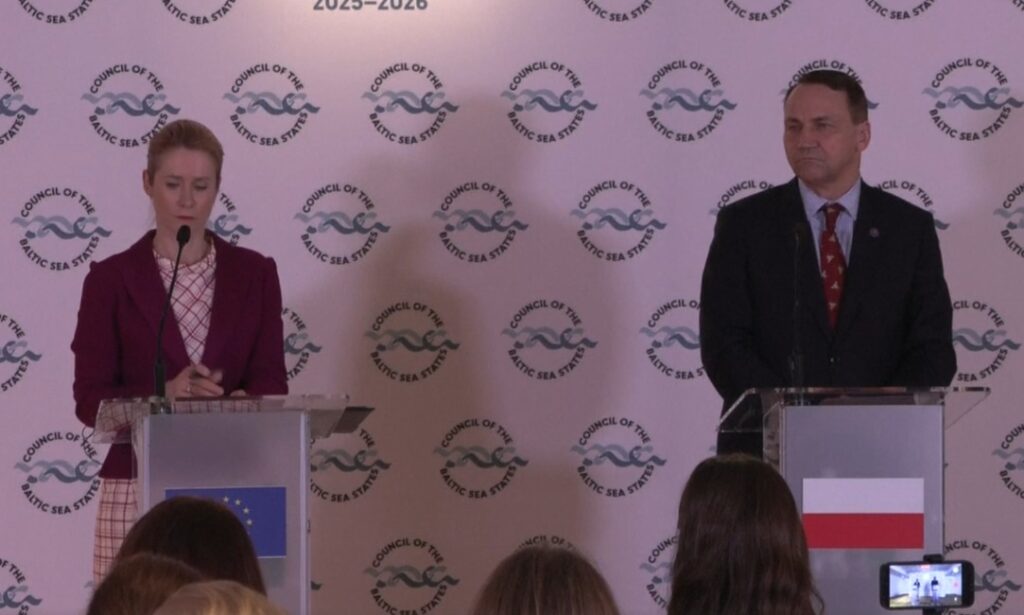
Two heavyweights of European politics found a way to one Warsaw stage on 4 March.“This was an extraordinary meeting, a ministerial meeting of the Council of the Baltic Sea States convened naturally before the war in the Middle East, which was also obviously on the agenda,” said Radek Sikorski, Poland’s foreign minister. “However, the main focus of our discussions was the region and the war in Ukraine.”
At his side stood Kaja Kallas, the European Union’s high representative for foreign affairs. The pair had just hosted an informal gathering of EU foreign ministers, a curtain-raiser for the formal Foreign Affairs Council that opens on March 5th.
NATO and Ukraine top the agenda
Mr Sikorski set out the day’s structure with military precision. “Our meeting consisted of three parts.” First came NATO housekeeping before the Ankara summit in July. “First, we talked about the internal NATO policy and about NATO itself in view of the upcoming summit of the Alliance in Ankara.”
Second was Ukraine. “Second, we talked about how to support Ukraine in the negotiations concerning the country’s future and how to stop the Russian aggression against Ukraine.” Third was enlargement. “Thirdly, we talked about the prospects of Ukraine’s EU accession.”
“We want the NATO Summit to be successful.” He barely paused before adding the real aim. “We want Europe’s standing vis-à-vis the US to increase so we can have a say in the US-Russia negotiations concerning Ukraine.”
Pressure, pipelines and principles
Ms Kallas seized the microphone to warn against strategic distraction. “As the world focuses on the war in the Middle East, we cannot let Ukraine slip off the agenda.” She noted that Russia’s onslaught grinds on. “There are no signs that Russia’s war is slowing.”
The Kremlin still seeks maximal gains: “Moscow’s maximalist demands remain Europe has a clear and legitimate interest in how this war should end.” Her solution was blunt. “If we do not articulate ourselves, no one will do it for us.” And the risk of delay is acute: “And if we wait too long, it might be too late.”
(We must ensure) that we have a peace, not a ceasefire. — Radek Sikorski, Poland’s foreign minister
Standards for any peace, she insisted, must be high. “Respect for borders and end to sabotage, compensation for war damages and the return of kidnapped Ukraine children aren’t just far-fetched demands.” She delivered the punch line. “They should be the baseline.” Ms Kallas dismissed the notion that Europe should temper its stance. “Russia’s maximalist demands cannot be met with minimalist response.”
A drone-studded thread
Funding must follow rhetoric. “We agreed to provide Ukraine with a 90 billion loan, a Euro loan, and this we also must deliver.” Ms Kallas jabbed at technical holdups. “A broken pipeline should not hold Ukraine’s defense hostage.” Speed matters elsewhere, too. “Likewise, the next sanctions package must follow as soon as possible.” One plank is oil. “A full maritime service is banned on Russia’s oil exports would go a long way to decimate Moscow’s war funds.”
Mr Sikorski linked Europe’s two hot wars by way of Iranian drone technology. “There is a thread that links the two wars.” He spelled it out: “And the thread is the Shahed drone.” The numbers jarred. “Thousands of these machines of destruction have hit countries that did not attack Iran, 57,000 have already been launched at Ukraine.”
The lesson, he hoped, was clear to Washington. “So I hope it makes U.S. decision-making realize that Russia and Iran are in it together and that both Israel and Ukraine need security for development,” he said. Ms Kallas has a soundbite ready: „By indiscriminately attacking its neighbors, the (Iran) regime is making a strong case for its own demise,“ she quipped.
Ships, sanctions and Hungarian spanners
The Polish minister admitted to a nagging fear. “Yes, the worry is there that it’s diverting attention away.” Europe must counter that drift. “And that’s why today also we had this meeting that we can’t let it slip off the table because this is the real and very close threat to Europe.”
He ticked off logistical headaches. “Of course, also what is worrying is that all these capabilities that are needed in the Middle East are also needed in Ukraine.” The remedy lies in factories. “So, you know, the production, we need to speed up because there is more need and we really need to deal with this.” Yet he ended on a shard of optimism. “What is maybe a positive side is that Russia has lost another ally.”
By indiscriminately attacking its neighbors, the (Iran) regime is making a strong case for its own demise. — Kaja Kallas, High Representative of the European Union
Journalists quizzed the duo on the Kremlin’s shadow tanker fleet skirting sanctions. Mr Sikorski favoured blanket coverage. “Let me remind you that the number of vessels on the sanctions list increased during the Polish presidency from dozens to several hundreds, high hundreds.” He demanded harmonisation. “All vessels should be covered regardless of the list they are on.” Tricks at sea must be punished. “We also need to intervene when a false flag is flown or no flag is flown at all.” The goal is plain. “We also need a ban on any services for vessels of the Shadow Fleet.”
‚We are not waiting‘
Ms Kallas nodded through a practical checklist. “On the last Foreign Affairs Council, we also shared the paper of best practices, how to deal with the ships really so that member states can use this.” Brussels now blacklists tankers case-by-case. “We are putting it on. We are not waiting for a package of sanctions, but doing this on a rolling basis.”
Outreach matters too. “We are also working closely with the flag states.” Cooperation, she added, is improving. “I must say, they are really cooperative with us to make the steps so that we can, you know, limit the shadow fleet from moving.”
But progress stalls elsewhere. “And last week, during the Foreign Affairs Council, we were hoping to adopt the 20th sanctions package.” Her face tightened. “It was vetoed, however, by Hungary, by the ideological allies of our opponents.”
Talk turned to mooted Russo-American peace talks. Ms Kallas would accept no sidelines. “We need to be at the table.” She linked this to earlier debates. “And that’s why we also discussed this today.” Europe’s demands mirror Ukraine’s, she argued. “There are issues that are mirroring the requests that are already on the table for Ukraine.” They apply to Moscow too. “They should be also on the Russian side.” Broad security architecture must be addressed.
Seats at the table
“And there are also issues that concern European security architecture where we clearly also have requests for Russia in order to have a sustainable and long-term peace.” The stakes are existential. “It means that Russia is not attacking neighboring countries and how we can live with such neighbor in the future.” Hence the bottom line. “And that’s why it’s important that Russia also takes concessions.”
Mr Sikorski backed her to the hilt. “Poland supports the high representative on this.” He claimed near unanimity among ministers. “And judging from the discussion today as the chair, of the Council of Baltic Sea States, I can say that there was virtually unanimity on this, that this negotiation shouldn’t be a process of satisfying Russia for it to stop.” Peace must be durable. “It has to be a process of creating a new balance of power and a new system of guarantees and concessions and confidence-building measures on both sides so that we have a peace not a ceasefire.”
The formal Foreign Affairs Council will sift these ambitions on Thursday. For now Warsaw has thrown down a gauntlet: matching lofty sentences with hard deliveries.