The European Parliament’s trade negotiators agreed this week to suspend EU-US trade talks, even as Trump threatened fresh tariffs on Spain and signaled new Section 301 measures that negotiators warn would effectively kill the deal.
“We want to have clarity that they are sticking to the commitments made in Turnberry,” wrote Bernd Lange (S&D/DEU), chair of the Parliament’s International Trade Committee.
Lack of clarity reflects the Trump administration’s continued reliance on the strategy of tariff pressure on its European allies. “We’re going to cut off all trade with Spain,” Mr Trump said sitting next to German Chancellor Friedrich Merz in the Oval Office. “We don’t want anything to do with Spain,” he continued.
Trump’s remarks came after the Sánchez government refused to allow the US to use jointly operated bases on Spanish soil to support strikes on Iran—a decision Madrid defended on the grounds that the offensive violated its bilateral agreement with Washington and the UN Charter.
You might be interested
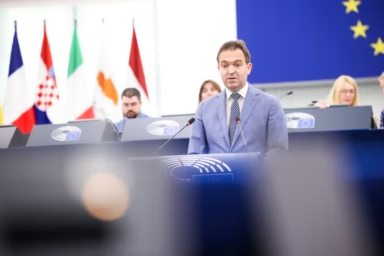
The European Commission expressed “full solidarity” with Madrid and asked the US to “fully honour” the trade deal the next day.
An American barrage of tariffs
An embargo on Spain is far from the only concern coming out of Washington. “If the US imposes new tariffs linked to the claim that we are censoring them via the Digital Services Act (DSA)—it’s completely finished,” said MEP Brando Benifei (S&D/ITA).
As the Supreme Court ruled that Trump exceeded his presidential authority in imposing sweeping tariffs under the International Emergency Economic Powers Act (IEEPA), Trump’s team has prepared alternative measures to replace them: Section 122 tariffs, Section 232 and Section 301 investigations which are linked to claims of violation by the DSA.
Kimberly Clausing, former Deputy Assistant Secretary for Tax Analysis under President Biden and now a professor at UCLA School of Law, told EU Perspectives last week that the tariff threats on the table may be more concerning than what SCOTUS struck down.
Despite the uncertainty and risks to crumbling, much of the politics are refusing to lose hope on the deal.
The EPP and Commission are married to the deal
The Commission has been starkly behind advancing this deal and are worried about the fallout of the deal falling through. Such commitment reflects the EPP’s support for the deal as a result of the preference of the markets. As MEP Benifei puts it, “Most companies, most businesses, prefer to be treated badly rather than face total uncertainty.”
The EPP has wanted to fast-track the deal and approve it, but has faced resistance all around. The Social Democrats, liberals, and Greens voted against moving forward, and the far-right groups, the European Conservatives and Reformists (ECR) and Patriots for Europe, which the EPP has formed a voting coalition with before are also divided amongst themselves via diverging national preferences.
The deal is suspended until March 17 when the EP negotiators will again reassess whether to schedule a committee vote that same week. If it moved forward, it could be ratified in a plenary session on March 25-26, though with the Trump administration moving forward with tariff threats, that seems unlikely.