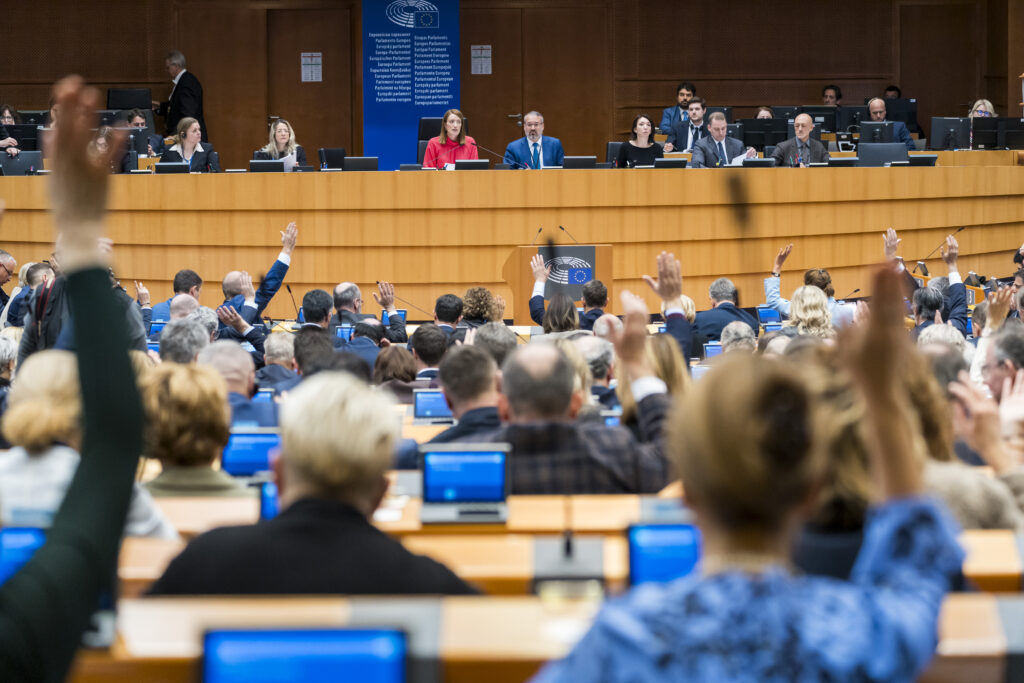
Asylum seekers and undocumented migrants could soon face automatic detention and deportation to countries they have never visited. The European Parliament voted 389 to 206 to open negotiations on a new Return Regulation. The majority came from the EPP, ECR, Patriots, and the far-right ESN—collapsing the centre-left coalition that had previously held the line on migration policy.
The text was co-drafted by Italian MEP Alessandro Ciriani, a member of Giorgia Meloni’s Brothers of Italy party. It broadens the definition of where migrants can be sent, including third countries they may never have visited. The proposal also prioritises forced removal over voluntary departure and opens the door to ‘return hubs’ in third countries.
Talks broke down between Malik Azmani, the Renew Europe’s liberal steering the file, and the Socialists and Democrats. That collapse cleared the path for the EPP. It pushed the text through with support from the right and far right.
The cordon sanitaire cracks
Murielle Laurent, the Socialists and Democrats’ lead voice on the file, was quick to condemn the outcome. “This mandate raises serious concerns—from return hubs without any binding legal framework to rules on automatic large-scale detention, the abolition of voluntary return, and an absence of meaningful procedural safeguards,” she said.
The S&D group called it “the result of a deeply troubling political alliance and opaque negotiations between the EPP and the far right.” They added that the text ignores core rights in the EU Charter—human dignity, liberty, asylum, effective remedy—and undermines international law.
The Greens, the Left, and much of Renew also voted against. “By seeking to challenge this mandate, The Left, together with S&D and the Greens/EFA, are demonstrating our resistance not only to this democratic scandal but also to this racist regulation, which has no place in Europe,” TheLeft group said in a statement.
The WhatsApp files
A leaked WhatsApp group chat revealed the extent of coordination between EPP members and the far right. Participants included MEPs from the EPP, the European Conservatives and Reformists (ECR), Patriots for Europe, and the AfD.
Among those in the chat was Mary Khan of the AfD. She proposed amendments including expanded powers for age assessments of asylum seekers through medical testing—suggestions that EPP members reportedly welcomed. EPP president Manfred Weber, despite backing the broader alliance, publicly distanced himself from the chat group.
“Recent revelations about coordinated contacts, including WhatsApp exchanges, make this even clearer,” said Ana Catarina Mendes, S&D vice-president. “Democratic law-making must respect the rights laid down in our Charter—it cannot simply treat these rights as optional. We urge the EPP to rethink its position and work with pro-European groups on a regulation that guarantees effective, sustainable, and dignified returns.”
Rights groups sound the alarm
Under the new rules, member states must issue a return order to anyone without the right to stay. This applies regardless of whether removal is actually feasible or lawful. People could be sent to countries they have never set foot in, on the basis of a single bilateral agreement. Families and young children are not exempt.
Opposition extends beyond the political groups that voted against the text. Caritas Europa, together with six Christian organisations representing Anglican, Orthodox, Protestant, and Catholic churches across Europe, has voiced deep concern about the Parliament’s position. Doctors of the World warned that the regulation risks cutting undocumented people off from basic healthcare.
We risk turning our schools, hospitals, reception centres, workplaces, public transport, and even our homes into immigration control centres. — Doctors of the World
“We are fighting racial profiling and risk turning our schools, hospitals, reception centers, workplaces, public transportation, and even our homes into immigration control centers. For undocumented people, this creates a climate of fear. Fear drives people to avoid healthcare: they postpone medical visits and isolate themselves, causing their health conditions to deteriorate,” they said in a joint statement.
Negotiations between the Parliament, the Council, and the Commission began the same afternoon. The outcome will shape the fate of hundreds of thousands of people without legal status in Europe. It will also test how far the EU’s political mainstream is willing to go—and with whom—to get migration off the agenda.