
The EU is tightening the screws on corruption. On Thursday, the European Parliament approved its first bloc-wide criminal law framework — a move with potentially far-reaching implications for national anti-corruption regimes.
In 2024, Italy abolished the crime of abuse of office, with Giorgia Meloni’s government arguing that the law was too vague and discouraged public officials from taking decisions for fear of prosecution. The move drew sharp criticism from magistrates, anti-corruption watchdogs, and opposition parties, who warned it removed a key safeguard against abuses of power and could weaken oversight of public administration.
Now, the country may be required to reintroduce the criminal offence.
“Although in Italy the crime of abuse of office has been abolished, it must be reinstated.” — MEP Raquel García Hermida-Van Der Walle
On Thursday, the European Parliament voted by 581 votes in favour to give its final approval to the Anti-Corruption Directive. 21 members voted against, and 42 abstained.
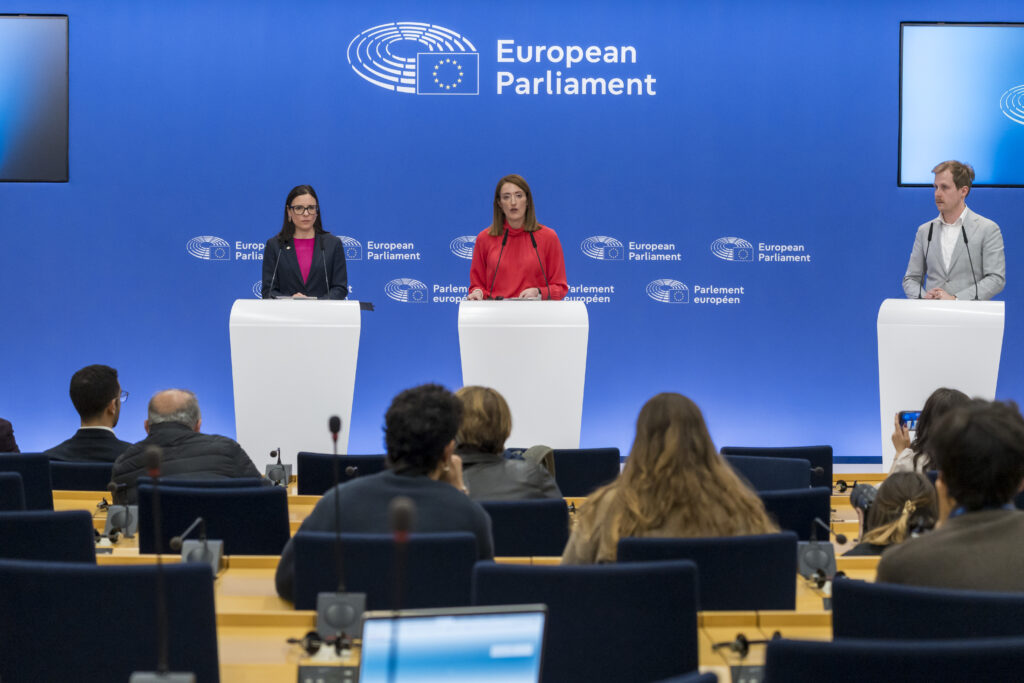
“Italy will have to mandatorily criminalize at least two of the most serious crimes falling within the scope of office offence,” said member of the European Parliament Raquel García Hermida-Van Der Walle (Renew, NL) on Thursday.
Europe’s first-ever
The directive defines the types of corruption that must be classified as criminal offenses by EU countries. These include bribery, misappropriation, obstruction of justice, trading in influence, unlawful exercise of functions, illicit enrichment linked to corruption, concealment, and private-sector corruption. It also harmonizes penalties for these crimes, ensuring that maximum penalties under national rules aren’t too low, while allowing member states to adopt stricter rules and tailor provisions to their national legal systems.
By adopting the directive, the European Parliament “has kept a key promise we made to all of Europe”, EP’s President Roberta Metsola said, pointing out that it is the first ever EU directive to focus on fighting corruption.
“I am immensely proud of the efforts made. Today our message is clear: corruption has no place in Europe.” — EP President Roberta Metsola
EU countries will now also be required to adopt and regularly update national anti-corruption strategies, involving civil society, as well as conduct risk assessments and ensure robust systems to counter conflicts of interest and improve transparency of political funding and ethical standards. They will also be required to establish dedicated and sufficiently independent bodies to prevent and combat corruption.
Cure for cross-border offences
The new framework aims to address gaps in enforcement, particularly in cross-border cases, by modernizing the rules, aligning legal definitions, and introducing common levels of sanctions.
It also focuses on EU-level investigations, promising strengthened cooperation between national authorities and EU bodies including OLAF, the European Public Prosecutor’s Office, Europol, and Eurojust.
Member states will also be required to publish comparable and readable data annually to improve transparency and evidence-based decision-making.
According to Raquel García Hermida-Van Der Walle, the directive “was probably one of the most important wins in this negotiation and for this Parliament”. In particular, Italy will have to mandatorily criminalize “at least two of the most serious offenses that fall in the remit of abuse of function”, she said.