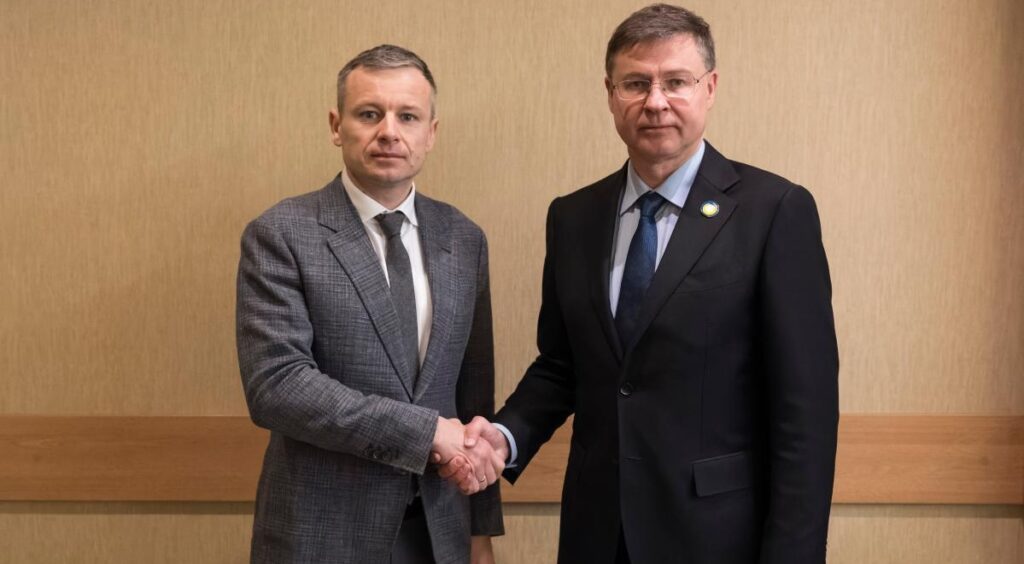
Europeans will tackle any energy/inflation/food crises arising from the US–Iran war. But Brussels will try its best to make sure the measures are narrow and temporary. That’s the message Economy Commissioner Valdis Dombrovskis had for reporters after Tuesday’s Ecofin meeting.
Europe’s fiscal hawks rarely miss a chance to remind colleagues that crises come and go but debt lingers. In Brussels on 5 May, Commissioner Valdis Dombrovskis used the Strait of Hormuz flare-up to make that point again.
Asked whether rising oil prices justified softer budget rules, he shot back. “The Commission works to ensure that support measures for the economy do not lead to increased aggregate demand for energy.” The message was blunt: the Stability and Growth Pact stays put.
Three-digit oil prices have upset ministers from energy-hungry states. Some pleaded for a new “escape clause” like the one activated for defence spending under the REPowerEU scheme. Mr Dombrovskis demurred. “If there are broad measures across many member states supporting consumption, dampening the price signal that may end up with actually sustaining higher energy prices at high fiscal cost and with very limited benefit to households and businesses it was supposed to help,” he warned. The commissioner’s stance left little doubt that Brussels will resist calls for blanket relief.
Built-in buffers
“So we had this discussion yesterday in Eurogroup and it has to be said that ministers were expressing divergent views on the need for additional fiscal flexibility,” the Commissioner conceded. Yet he insisted that the Commission’s job is to “use existing flexibility within our fiscal framework, including the use of automatic stabilisers”. That means the budget cushion that comes from lower tax receipts and higher unemployment benefits in a downturn — nothing more.
Automatic stabilisers suit the Commission because they require no new vote. Progressive income-tax bands, value-added tax linked to consumption and outlays such as short-time-work benefits expand or shrink with the cycle, widening deficits in slumps and narrowing them in booms. Such swings do not count as discretionary loosening. They avoid the political fight of fresh stimulus while still support demand when GDP weakens.
That logic may please northern members but frustrate southerners facing energy protests at home. Officials often note that broad subsidies risk blunting price signals and locking Europe into fossil fuels just when the green transition demands the opposite. The Hormuz shock, in other words, is not a door to fiscal profligacy.
With debt-repayment on the recovery fund due to start next year, the commission also wants to keep powder dry. Rolling over the €800bn joint borrowing, floated by Paris and backed by the IMF, will be debated later in the year. For now Mr Dombrovskis limited himself to process: “The discussions on further steps regarding this RRF debt is closely linked with the next Multiannual Financial Framework.” Translation: ask again once the new EU budget is on the table.
Strings for Kyiv
Russia’s war still tops the economic agenda. “We are currently still in negotiations in very advanced stages with Ukrainian authorities on conditionality underpinning our macro financial programme,” said the commissioner. The €50bn Ukraine Facility, approved in February, ties each tranche to reforms. Taxation is the thorniest. “Domestic revenue mobilisation is an important part of those negotiations as is tax reform, but exact modalities and elements are still under discussion,” he explained, or refrained from explaining.
Even so, “very significant progress has been made on the Ukraine support loan,” he claimed. Member states have blessed changes to the long-term EU budget, the last piece of the legal puzzle to fall together. “The Commission is engaged with Ukrainian authorities to finalise a memorandum of understanding setting out the financing conditions.” Once signed, “this will enable first disbursements under the macro financial assistance part of the Ukraine support alone.” The IMF, already supervising Kyiv’s programme, will keep Brussels honest (or so the idea goes).
Ukraine’s government balks at sweeping VAT changes while missiles still fall. EU officials reply that a modern tax system is vital for long-run solvency. Failure to agree could delay money just as Russia gains from dearer oil. Twenty rounds of sanctions have yet to drain the Kremlin’s war chest. “Sustaining and escalating pressure on the Russian aggressor remains as critical as ever,” Mr Dombrovskis reminded ministers.
Catching the carousel
Fiscal prudence, however, need not kill ambition. “The Commission welcomes the important step forward reached today in a fight against tax fraud,” the commissioner said. Carousel fraud—crooks disappearing with VAT they should remit—costs treasuries about €60bn a year.
Broad measures across many member states supporting consumption (…) may end up sustaining higher energy prices at high fiscal cost, with very limited benefit to household and businesses. — European Economy Commissioner Valdis Dombrovskis
Until now the European Public Prosecutor’s Office and OLAF, the anti-fraud unit, had to chase data through 27 capitals. “So today’s agreement grants some direct access to EU-level VAT information,” he noted. “And in doing so, it makes our fight against VAT fraud more efficient, effective and better coordinated.”
Investigators will soon query national databases directly, spotting suspicious cross-border chains within minutes rather than months. Finance ministries that once fretted about privacy fears accepted safeguards on who can see what. That shift, insiders say, owes much to the political cover provided by the Middle East shock: lost revenue is harder to tolerate when oil pushes up import bills.
Cypriot perspective
Makis Keravnos, Finance Minister of Cyprus and chair of the meeting, resorted to safe ground during the following press conference. “I would like to say some words on the economic impact of the war in the Middle East, as this was also discussed at yesterday’s Eurogroup meeting,” he told reporters. “The situation remains volatile and uncertainty is high,” he said, revealing nothing much after the situation had been volatile and uncertainty high for over two months. “But we are closely monitoring developments and remain well coordinated,” he let the press room heave a collective sigh of relief.
Turning to fraud, the minister struck a rare note of celebration. “I’m pleased to announce that today we reached a general approach on tackling VAT fraud,” he said. “With today’s agreement, we will make the work of the EU bodies investigating fraud and OLAF a lot of more effective,” said Mr Keravnos, whose country’s financial credentials have always been impeccable.