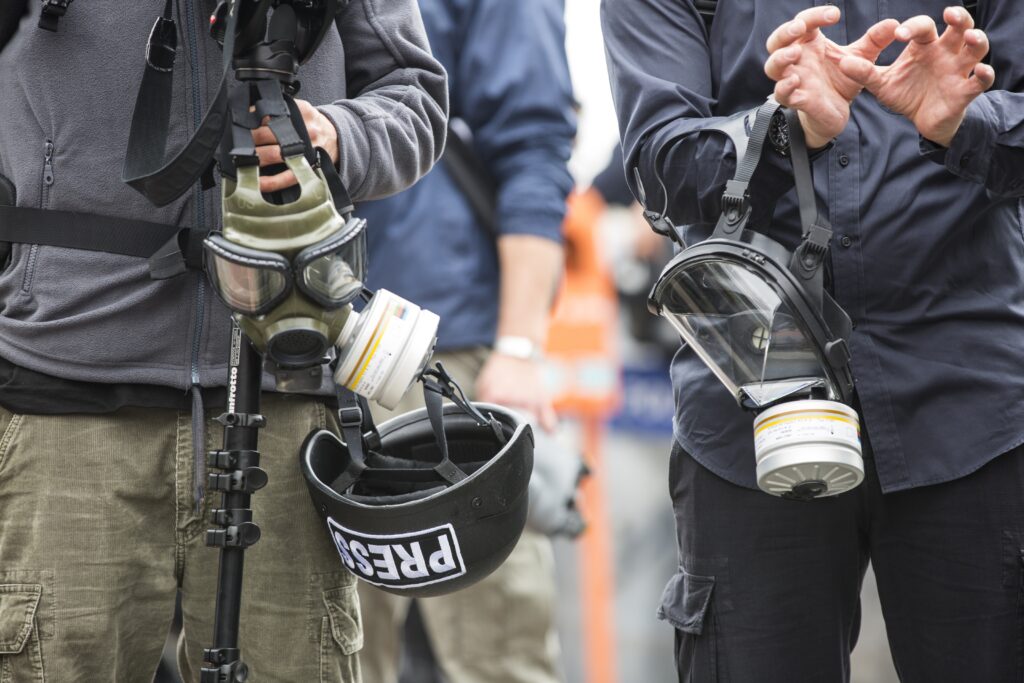
The year 2025 was the deadliest on record for journalists. Tomorrow, the EU’s deadline to transpose its anti-SLAPP law designed to protect reporters from abusive lawsuits expires. Most member states will miss it, leaving the reporters who hold power to account on their own.
The EU adopted the anti-SLAPP directive on 16 April 2024. The law gives journalists and activists a legal shield against strategic lawsuits. Claimants bring these cases not to win, but to drain defendants of money and time until they go quiet. Member states had two years to incorporate it into national law.
Watchdogs warn the law is arriving in weakened form. The Civil Liberties Union for Europe published a report this week finding that many governments have been dragging their feet. The initial transpositions suggest the directive may offer less protection than promised.
Domestic cases left out
The directive covers cross-border cases, but most SLAPP lawsuits are domestic. Few member states have extended protections beyond that minimum. Germany and Malta have explicitly excluded domestic cases. In Ireland, the draft legislation does not fully meet even the minimum standards required.
The chairs of three European Parliament committees warned ahead of World Press Freedom Day on 3 May that threats against journalists are rising. “Methods for impeding their investigative work are getting more sophisticated,” they said, condemning physical violence, arbitrary detention and online harassment.
On Wednesday in Brussels, the Parliament’s subcommittee on Human Rights is discussing press freedom. MEPs plan to push for stronger EU action.
Spyware goes unpunished
The anti-SLAPP deadline is not the only promise falling short. The European Media Freedom Act has been fully applicable since summer 2025. It bans the use of spyware on journalists and their families. Yet a recent case in Italy showed the limits of that protection: someone targeted a journalist with surveillance software, and no one knows who ordered it.
Asked about the case at the European Commission’s midday briefing on 30 April, spokesman Markus Lammert said that ”any attempts to illegally access data of citizens and journalists is unacceptable”. He pointed to the GDPR, the e-Privacy Directive and the EMFA as existing safeguards. He acknowledged that investigations remain a matter for national authorities.
A record year for danger
At least 129 journalists and media workers lost their lives in 2025, making it the deadliest year on record according to the Committee to Protect Journalists. EU High Representative Kaja Kallas warned ahead of World Press Freedom Day on 3 May that ”the killing, injuring, and threatening (…) of journalists, has become a shocking reality”. She added that attackers disproportionately target women journalists through gender-based violence and online harassment.
The killing, injuring, and threatening of journalists, has become a shocking reality.
— Kaja Kallas, EU High Representative
The Reporters Without Borders World Press Freedom Index found that the EMFA is being inconsistently applied across the EU. The Civil Liberties Union for Europe concluded that slow and often superficial implementation has so far rendered the impact of both the EMFA and the anti-SLAPP directive “negligible”, leaving many journalists without effective remedies and continued vulnerability to SLAPPs.
Not all news is bleak. The RSF index found that Ukraine and Moldova have significantly improved their press freedom rankings, overtaking the United States and several EU member states. The Commission said the progress reflects both countries’ commitment to democratic values and their gradual alignment with EU standards.