EU, alongside 36 countries, has joined a long-discussed tribunal on Russian crimes against Ukraine. The project is moving from political declarations into a phase where its legal contours are finally beginning to take shape — a step Ukraine has described as historic.
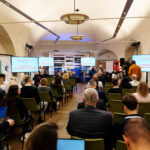
The European Union and dozens of states formally committed at a Council of Europe ministerial meeting in Chișinău to establishing a Special Tribunal for the Crime of Aggression against Ukraine. They endorsed the so-called Enlarged Partial Agreement, which is set to define the legal, institutional, and financial framework of the future court.
Out of the Council of Europe’s 46 member states, 34 have signed up to the declaration, alongside Australia, Costa Rica, and the European Union. Among EU member states, Bulgaria, Hungary, Malta, and Slovakia did not join the initiative. The move marks a shift away from earlier political statements towards the practical construction of an international institution that would, in due course, prosecute those responsible for the decision to launch the invasion of Ukraine.
Today, we have passed the point of no return. The Special Tribunal becomes a legal reality. Very few believed this day would come. But it did. — Andrii Sybiha, Foreign Minister of Ukraine
According to Council of Europe Secretary General Alain Berset, this represents a “decisive step” towards the tribunal’s establishment. He said it should serve not only as a tool of justice, but also as a symbol of hope. “The time for Russia to be held to account for its aggression is fast approaching,” he said.
Historic day… for Putin
Ukrainian Foreign Minister Andrii Sybiha called it a “historic day”. He compared the significance of the planned tribunal to the Nuremberg trials after the Second World War. “Today, we have passed the point of no return. The Special Tribunal becomes a legal reality. Very few believed this day would come. But it did,” he wrote on X.
He added that the development opens the way for Russia’s aggression to become legally actionable rather than merely a political concept. “(Russian President Vladimir) Putin always wanted to go down in history. And this Tribunal will help him achieve this. As a criminal,” Sybiha added, listing other Russian leaders who, in his words, will also receive “a ticket to The Hague”: Sergei Shoigu, Valery Gerasimov, Alexander Bortnikov, Viktor Zolotov, Dmitry Medvedev, Nikolai Patrushev, and Belarusian President Alexander Lukashenko.
EU as an active player
The EU plays a significant role in the latest step forward, engaging not only politically but also institutionally. The European Commission confirmed that the EU is joining the agreement establishing the tribunal’s legal and organisational structure.
“The EU will support justice in every way we can. (…) Russia chose to attack and invade a sovereign country, kill its people, deport Ukrainian children, and steal Ukrainian land. It must face justice and pay for what it has done,” EU foreign policy chief Kaja Kallas stated.
Putin always wanted to go down in history. And this Tribunal will help him achieve this. As a criminal. — Andrii Sybiha, Foreign Minister of Ukraine
The EU also joins the related International Claims Commission, which will assess and quantify compensation claims from Ukraine and its citizens. The bloc has already provided financial backing for these mechanisms, including €10m for the tribunal and further funding for the compensation commission.
According to EU officials, this is part of a broader effort to ensure accountability for international crimes committed during Russia’s invasion. It is also to build a functioning system that complements existing international judicial mechanisms.
Filling the legal gap
The new tribunal is expected to operate alongside the International Criminal Court (ICC), which is already investigating war crimes, crimes against humanity and genocide in Ukraine. However, the ICC does not have full jurisdiction over the crime of aggression — the decision to launch the war itself. This is the legal gap the planned tribunal is designed to fill.
The ICC focuses on crimes committed on the battlefield and against civilians. The new tribunal will target the highest political and military leadership responsible for the invasion.
Council of Europe officials stress that the current phase is not about launching the tribunal itself, but about laying its legal and institutional foundations. Full operational capacity will still require further ratifications, financial commitments, and administrative setup.
For the EU and its wider coalition of partners, the Chișinău meeting represents another step towards building a comprehensive framework that links investigation, prosecution, and financial compensation. While the tribunal is not yet operational, its legal foundations are now formally in place — and the process of turning political commitment into international law is clearly gathering pace.