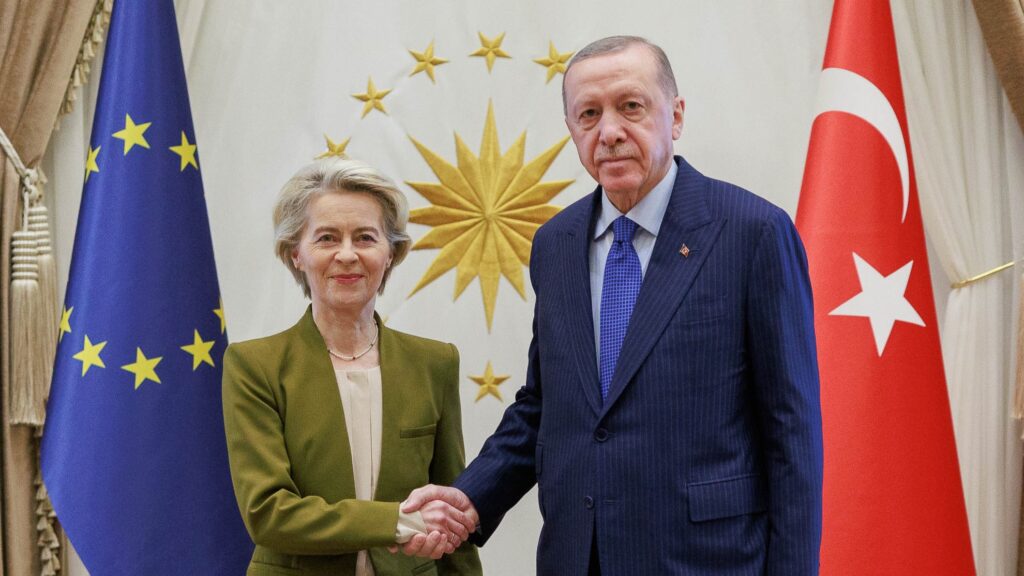
The European Commission has raised more than an eyebrow at a Turkish court ruling that reshapes the leadership of the country’s main opposition party. The move inevitably revives uncomfortable questions about authoritarian president Erdoğan’s tightening grip on political competition. In its response, Brussels has reiterated a message it has delivered to Ankara time and again: EU candidate status is not a symbolic badge, and democracy is not optional decor. It is the price of entry.
The Commission has voiced alarm over the latest twist in Türkiye’s democratic drift, after a court in Ankara annulled the results of a congress of the Republican People’s Party (CHP). The ruling, which effectively rewrites the leadership of the country’s main opposition force, lands at a moment when tensions between government, opposition and the judiciary are once again hardening into a familiar, and increasingly brittle, pattern.
With the continuing wave legal and administrative pressure on opposition, the impression is growing that competitive politics is being steadily squeezed. The latest episode reinforces that view. For Brussels, it is yet another signal that democratic standards in a country still formally on the path to EU membership remain under sustained strain.
Highest democratic standards
“As an EU candidate country and a long-standing member of the Council of Europe, Türkiye is expected to uphold the highest democratic standards and practices. Democracy, the rule of law, the respect for fundamental rights are central to the EU accession process,” said Commission spokesperson Guillaume Mercier.
As an EU candidate country and a long-standing member of the Council of Europe, Türkiye is expected to uphold the highest democratic standards. — Guillaume Mercier, European Commission spokesperson
According to the Commission, it is unacceptable to use legal and administrative proceedings to intimidate opposition parties and politicians or hamper their participation in the political process on an equal footing with governing parties. The opposition must be free to operate, to organise, and participate in the political process without fear of repression.
“Turkish people deserve to enjoy the benefits of a vibrant and competitive democracy where the voice of the people is heard,” the spokesperson added.
When the courts become political actors
The decision to overturn a three-year-old internal party election carries immediate political consequences. It would see CHP leader Özgür Özel replaced by his predecessor, Kemal Kılıçdaroğlu. Kılıçdaroğlu led the party in 2010–2023 . He was eventually unseated after failing to defeat Recep Tayyip Erdoğan in presidential election.
The court justified its ruling by citing alleged procedural violations and unspecified “irregularities” during the congress. That lack of detail is striking, especially since a lower court previously reached the opposite conclusion, finding no substantial wrongdoing.
For the CHP, the verdict goes well beyond routine intra-party dispute. The leadership has denounced it as “an attempted coup through the judiciary” and has appealed immediately to the supreme court.
Özgür Özel convened the party leadership at headquarters in Ankara, where hundreds of supporters gathered outside. In a social media address, he vowed the party would “not give in”. He expressed hope that the higher court would overturn the ruling.
Kılıçdaroğlu, by contrast, called for restraint, suggesting the decision “may serve the interests of the nation.” His response is a reminder that, since his electoral defeat, fault lines within CHP continue to simmer beneath the surface.
Opposition under pressure
The ruling sits within a broader pattern of escalating friction between Türkiye’s governing structures and the opposition. In recent years opposition politicians have faced a steady stream of investigations and prosecutions, which critics say are politically driven.
The most prominent case is that of Ekrem İmamoğlu, the former mayor of Istanbul. He was arrested last March with hundreds of others on corruption charges. Shortly before the CHP formally positioned him as a future presidential candidate.
His detention triggered the largest anti-government protests Türkiye has seen in more than a decade. Alongside his fellow party member, Ankara mayor Mansur Yavaş, İmamoğlu remains one of the country’s most popular political figures, regularly outperforming Erdoğan in opinion polls.
Following the 2024 local elections, in which the secular CHP beat President Recep Tayyip Erdoğan’s Islamic-rooted Justice and Development Pary (AKP), a fresh wave of investigations has targeted CHP mayors and local officials. The opposition sees a coordinated campaign to weaken its institutional base; the government insists it is simply enforcing anti-corruption laws.
A frozen candidacy
Türkiye has been an official EU candidate country since 1999, with accession talks beginning in 2005. But since 2018 the process has been effectively frozen, even if never formally terminated.
The reasons are well rehearsed: persistent disputes between Brussels and Ankara over democracy, the rule of law, judicial independence, political pluralism and fundamental rights. Cyprus has also long blocked progress, citing Türkiye’s continued occupation of the island’s north.
The ambitious democratic and economic reform drive that defined Türkiye in 1990s and early 2000s has ground to a halt.
Strategic partner, troubled neighbour
Relations between the EU and Türkiye remain deeply ambivalent. Ankara is a strategic partner on migration, security and trade — and a NATO ally. And at the same time a country whose political trajectory sits at odds with the values underpinning the European project.
What is unfolding is not a single rupture. But a cumulative sequence of decisions steadily reshaping the balance between politics, justice and opposition. The EU continues to respond with reminders of legal and democratic norms, but its leverage is limited. The CHP case is therefore not being read in isolation. It’s a part of pattern that has pulled Türkiye further away from the accession track rather than closer to it.
The unanswered question is not simply how this particular dispute over CHP leadership will end. It is whether Türkiye’s political system still moves — however unevenly — towards pluralist democracy. Or whether the centre of political gravity has decisively shifted to a space where power is contested and decided beyond the ballot box.