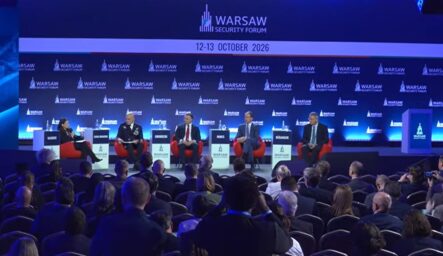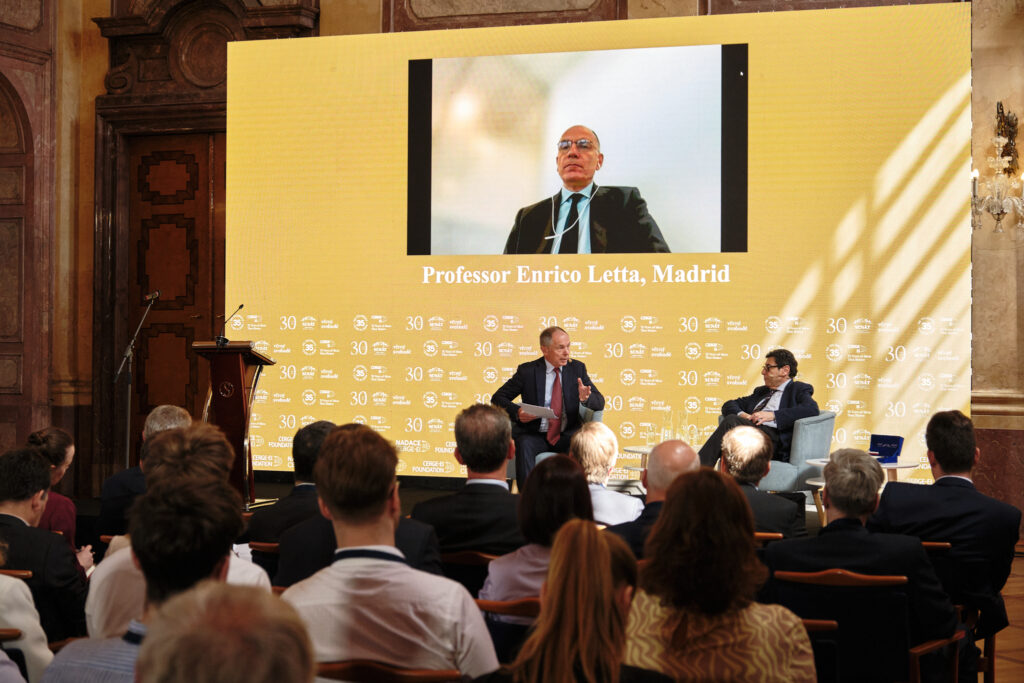
The European Union risks losing the global race for innovation and competitiveness unless it overcomes divisions and finally completes its single market, former Italian Prime Minister Enrico Letta warned. Speaking at the Center for Economic Research and Graduate Education (CERGE-EI) conference in Prague alongside Nobel Prize laureate Philippe Aghion and CERGE-EI co-founder Jan Švejnar, he argued that the bloc’s fragmented financial system has become one of its greatest economic weaknesses.
Defending the core recommendations of his landmark report on the future of the EU single market, Letta’s message was a blunt diagnosis: Europe cannot remain globally competitive if its financial system remains divided into 27 separate markets.
“The fragmented financial market is the worst condition for innovation,” Letta argued, labeling it as a major barrier to scaling European firms and funding breakthrough technologies. While the EU and the United States compete on a relatively comparable economic scale, the picture changes dramatically when financial markets are taken into account, he said.
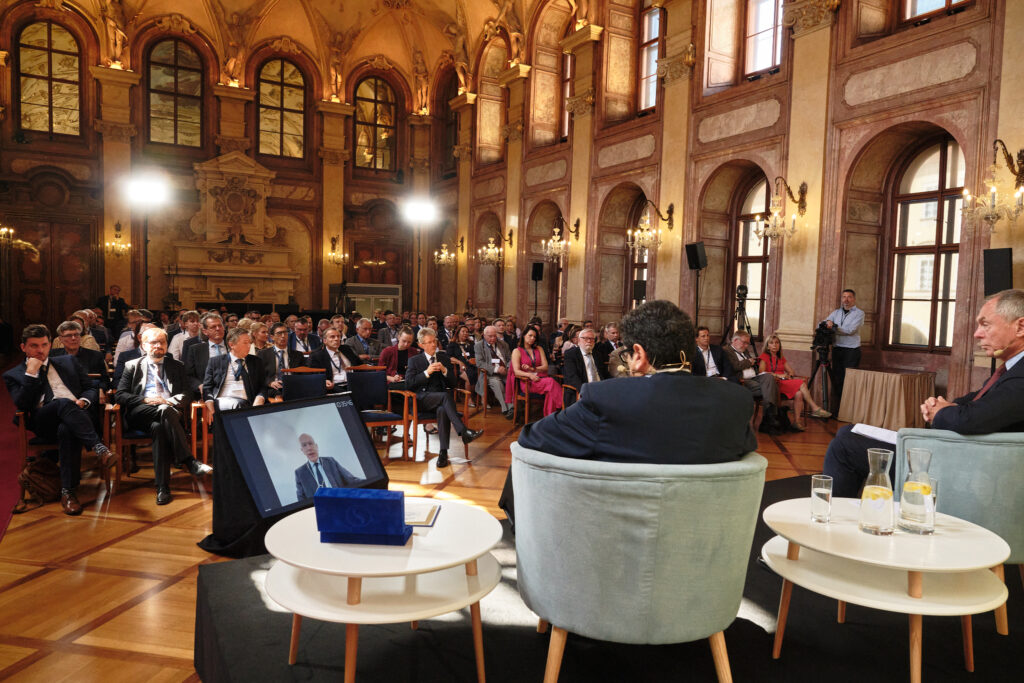
“The US has one financial market. We have 27,” Letta said, contrasting Europe’s highly segmented system with the scale and depth of American capital markets. Europe, he argued, has struggled to channel its vast pool of savings into productive investment and to provide innovative companies with the capital they need to grow. For Letta, this is no technical debate. It is central to the EU’s ability to compete with both the United States and China in advanced technologies, artificial intelligence and industrial innovation.
“Breakthrough innovation needs conditions,” he said, arguing that the EU still lacks the scale of investment needed to finance high-risk technological ventures. As a result, Europe has become more adept at incremental improvements than at generating transformative innovations.
Philippe Aghion, too, argued that while Europe played a leading role in earlier industrial revolutions, it has increasingly fallen behind in breakthrough technologies. “We remain stuck in mid-level, incremental innovation,” he said, warning that Europe is paying an economic and geopolitical cost for its inability to turn scientific excellence into globally competitive firms.
The ‘fifth freedom’
Having diagnosed the problem, Letta offered what he described as a recipe for restoring Europe’s competitiveness.
At the heart of it is a renewed vision for the EU single market, including the introduction of what he calls a “fifth freedom” focused on the movement of knowledge, innovation, education and skills across borders.
The original single market rests on four freedoms: the movement of goods, services, capital and people. But Letta argues those foundations reflect the economy of the twentieth century, not the twenty-first. “We totally missed the intangible,” Letta explained. The EU needs to make it significantly easier for researchers, ideas, startups, innovation ecosystems and highly skilled talent to move across the bloc. Competitiveness, he argues, increasingly depends on human capital and knowledge rather than traditional industrial inputs.

Aghion raised similar concerns, stressing that the EU must substantially increase support for long-term research if it wants to compete technologically. “We won’t be breakthrough innovators without proper funding of research,” he stressed.
To address that, he called for a stronger and more independent European Research Council (ERC), describing it as one of Europe’s most successful tools for supporting scientific excellence but also one that remains underfunded and too vulnerable to political uncertainty.
Aghion is convinced that Europe needs longer-term, stable research funding allowing scientists to pursue ambitious projects, even fail — an approach he said is more firmly embedded in the innovation ecosystems of the United States and increasingly of China as well. “If you want breakthrough innovation, you need to be able to fail,” he said, arguing that five-year grants are often insufficient for transformative scientific work.
A ‘28th regime’ for EU companies – a single rulebook for growth?
If the EU wants to create the next generation of global technology champions, Letta argues, it must first make it easier for companies to grow across borders. That is the thinking behind the so-called “28th regime” for companies, sometimes referred to as the ‘EU Inc.’ model.
The initiative would create an optional EU-wide corporate legal framework that businesses could choose instead of navigating a patchwork of national rules. The objective is straightforward: reduce regulatory complexity, lower administrative costs and make it easier for innovative firms to scale across the single market. Today, companies operating in multiple EU countries often face different legal, administrative and regulatory requirements. According to Letta, those barriers continue to hamper growth and help explain why Europe struggles to produce technology companies capable of competing on a global scale.
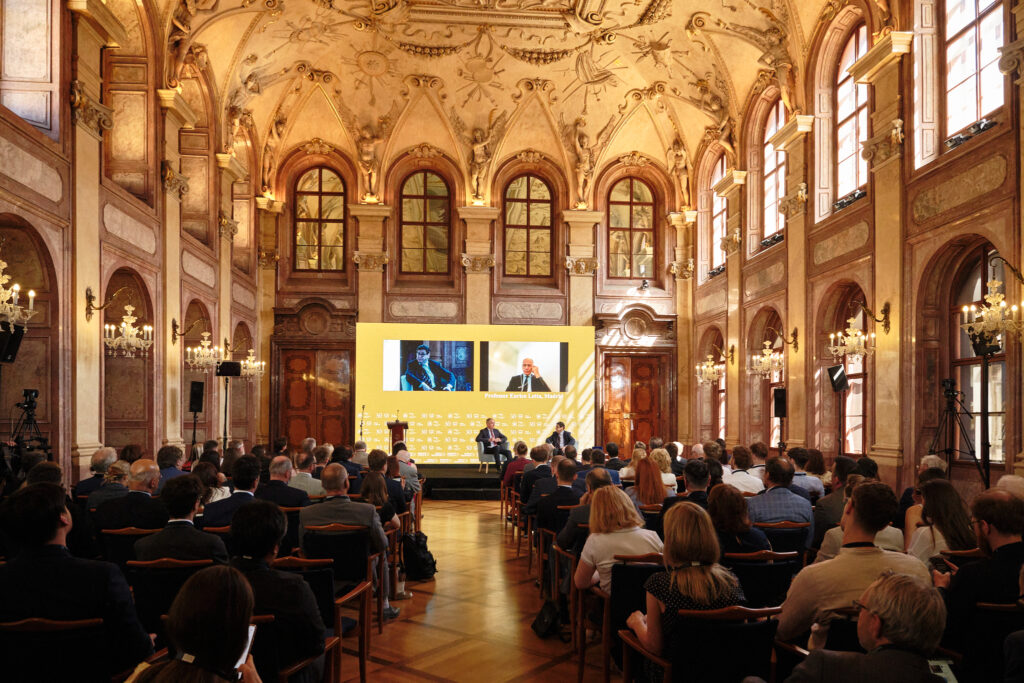
The proposal, recently put forward by the European Commission, would set up a more uniform framework for businesses seeking to operate across the bloc, with a particular focus on startups and high-growth firms. “It is a way to stop fragmentation and simplify,” Letta said.
Europe has no shortage of startups, Aghion added. The problem is scale. Too often, innovative European companies are sold to larger US rivals before they mature, or move abroad to access financing and larger markets. The challenge for the EU is to create the conditions that allow more European companies to grow into global technology ‘unicorns’ without having to leave the continent.
Is the EU delivering on Letta’s vision?
More than two years after Enrico Letta published his landmark report on the future of the single market, Much More Than a Market, and following Mario Draghi’s subsequent recommendations on European competitiveness, attention in Brussels is gradually shifting from diagnosis to delivery.
According to Letta, progress was slow at first. “2025 was largely lost,” he said, citing elections, geopolitical tensions and a succession of crises that crowded out longer-term reform efforts.
More recently, however, momentum has begun to build. European institutions have started advancing parts of the agenda, including plans for a Savings and Investments Union, deeper energy market integration and measures aimed at reducing regulatory burdens.
Yet Letta warned that the EU remains caught in a cycle of crisis management. With policymakers preoccupied by war, energy security and geopolitical uncertainty, structural reforms are often pushed down the agenda. “The problem is that we continue to focus only on short-term issues,” he said. Unless Europe tackles its underlying weaknesses, he argued, its capacity to respond to future crises will steadily diminish.
Competitiveness without abandoning Europe’s social model
Europe’s technological revival risks fuelling populism if large parts of society are left behind by economic change, Philippe Aghion warned. The economist argued that competitiveness and social cohesion must go hand in hand, echoing what Enrico Letta has described as the “right to stay” — the principle that the benefits of economic transformation should be broadly shared rather than concentrated among a few winners.
“The cost of populism is very high,” Aghion said. Brexit, Donald Trump’s political rise and the growth of populist movements across Europe, he argued, partly reflect a failure to support workers and communities affected by economic transitions. “The technological revival of Europe should leave nobody outside.” That, he said, requires continued investment in education, retraining, public services and social mobility alongside efforts to strengthen Europe’s competitiveness. “We can be innovative without renouncing our social model,” he argued.
Beyond Brexit: bringing the UK back to the table
The EU’s competitiveness agenda should not stop at the EU’s borders, Aghion argued. If the continent is serious about strengthening its technological and industrial capabilities, it should work more closely with like-minded partners — starting with the UK. Despite Brexit, Britain remains a leading research and innovation power and should remain closely connected to the EU’s efforts in science, technology and industrial strategy.
“The UK wants to get back to us,” Aghion said, pointing to growing signs of renewed cooperation. Rather than waiting for full institutional alignment, Europe should build what Aghion described as “coalitions of the willing” — partnerships between countries that share democratic values, strong research ecosystems and a commitment to innovation. Such cooperation, he suggested, could extend beyond Europe to countries including Canada.
For Aghion, the stakes go far beyond economic growth. Europe’s competitiveness challenge is not simply economic. But also about preserving a political and social model based on the rule of law, democracy, and inclusivity.