Small in size, big in urgency is what defines Europe’s new defence innovation fund. It is also deliberately unfinished — and that is the point, Parliament’s industry and defence committees agree.
You know something special is afoot when the European Parliament speaks with the voice of practical reason. On Wednesday, it did. The joint session of industry (ITRE) and defence (SEDE) committees made clear that Parliament intends to move a crucial defence innovation tool faster than Brussels usually does.
On a tight deadline, the committees met on 3 June to advance the AGILE regulation. The fund is a €115m pilot instrument of channelling EU funding to defence startups, small firms and technology innovators at a speed that existing programmes cannot match. With 309 amendments already tabled and a vote before the summer recess in sight, time—as Brussels institutions often hear—is of the essence.
A pilot with a purpose
The urgency is not procedural theatre. Russia’s war against Ukraine has demonstrated, in the bluntest possible terms, that cheap software-driven solutions, autonomous systems and rapidly scalable technologies can be decisive on the battlefield. Europe’s existing defence funding architecture has its anchor in the European Defence Fund, is good for large, multi-year cooperative programmes. AGILE is to fill the gap between that structure and the front line.
“It is designed to strengthen the innovation capacity of SMEs in the defence sector and to accelerate the development, the deployment, delivery of these emerging and disruptive products and technologies to our armed forces,” said Dinka Dinkova, who represented the Commmission at the session. “This is not just yet another programme where we develop technologies or we develop reports,” said the deputy head of the innovation and new space unit at DG DEFIS.
The €115m envelope is modest. Ms Dinkova acknowledged as much, noting that the budget comes from the redeployment of existing defence and space programmes. Existing priorities would not suffer significant disruption. The instrument is explicitly a pilot, a testing ground for mechanisms that could become part of the next multi-annual financial framework and the future European Competitiveness Fund.
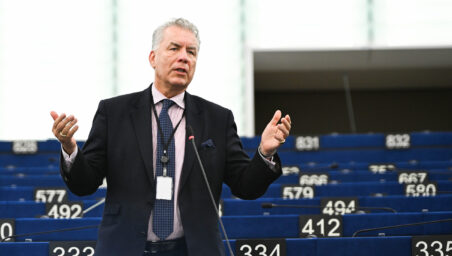
That framing shaped much of the discussion. MEP Christian Ehler (EPP/DEU), speaking in the catch-the-eye procedure, pressed the committee to think beyond AGILE’s immediate scope. “We are now already negotiating the ECF, the framework of the next defence programme,” he said. “And the question is: what kind of conclusions are we going to draw?” Mr Ehler warned that Parliament risked working in silos, finalising AGILE at roughly the same time as the European Defence Fund position, without ensuring the two were coherent.
More harm than good?
Mr Ehler’s second concern was just as pointed. Lump-sum financing—paying recipients a flat-rate amount rather than reimbursing costs—is central to AGILE’s design. It is to remove the compliance burden that has historically kept the most innovative, smallest companies out of EU programmes.
Wouldn’t it be time where we say we exclude these fast-running programmes from the Do No Significant Harm principle? — MEP Christian Ehler (EPP/DEU)
He accepted the logic but flagged the tension with budget control. He also raised the ‘Do No Significant Harm’ principle, under which small companies developing defence software must, in some cases, document the carbon footprint of the computing servers they use.
“Wouldn’t it be time,” the German member asked, “if you pretend that AGILE is agile, that that would be the moment where we say we exclude these fast-running programmes from the DNSH principle, because we ask for ridiculous self-declarations for small companies which are not going to make any environment changes?”
Lump sums are necessary…
Ms Dinkova replied that defence and military activities already enjoy general exclusion from the DNSH principle’s application, and that the broader question would return in the context of the European Competitiveness Fund negotiations. On lump sums, she was direct: the Commission had crafted the proposal with the need to balance speed against compliance, and the instrument’s agile nature required keeping requirements proportionate.
The lump-sum question also surfaced in the rapporteurs’ remarks. MEP Ivars Ijabs (Renew/LAT), co-rapporteur for ITRE, said lump sums must remain the default option while allowing deviations where genuinely necessary.
MEP Tonino Picula (S&D/HRV), co-rapporteur for SEDE, was equally clear: compliance burdens had for too long been “an invisible wall that keeps the most innovative, most agile companies out of EU programmes.” A startup, he noted, does not have a grants management department.
… and so are big companies
A related tension ran through the session: the role of large defence companies. AGILE targets SMEs, startups and scale-ups. But several speakers argued that innovations developed by small firms cannot reach armed forces without the involvement of prime contractors and first-tier subcontractors, who handle testing, certification, integration and supply-chain access.
Including larger actors is not about weakening support for SMEs, it’s about making that support effective. — MEP Jan Farský (EPP/CZE)
MEP Jan Farský (EPP/CZE) put it plainly: “Including larger actors is not about weakening support for SMEs, it’s about making that support effective.” Ms Dinkova agreed that primes would be involved in defining calls and in testing and demonstration campaigns, but stressed that direct financial support would remain focused on smaller firms.
Ukraine’s association with AGILE was described by Ms Dinkova as both a strategic and a moral necessity. Member states will define calls in close cooperation with the Commission and associated third countries, based on needs identified on the ground. They will also participate in testing campaigns and retain direct procurement options for products emerging from the programme, bypassing standard procurement procedures.
Member states and strategic hygiene
Mr Picula proposed linking AGILE-developed products to fast-track mechanisms within Ukraine support frameworks, and including them in a military sales catalogue to create further procurement incentives. Ms Dinkova did not object in principle, though she noted the instrument’s limited scope.
On eligibility, Mr Picula was unambiguous. “Entities that are established in or effectively controlled from countries whose actions are incompatible with the Union’s foreign and security policy objectives will not be eligible,” he said. “This is not protectionism. This is basic strategic hygiene.”
Ms Dinkova confirmed that third-country entities face strict requirements: relocation to Europe, management structures within the EU and full compliance with eligibility rules. There is, she said, no backdoor.
Not a one-off
The session closed with broad consensus across political groups on both the timetable and the instrument’s core logic. The SEDE co-rapporteur expressed confidence that a political agreement in trilogue could be reached in the early months of the upcoming Irish Presidency.
AGILE should not be seen as a one-off. It is a starting point. — Dinka Dinkova, DG DEFIS
Ms Dinkova welcomed the pace. “We are very glad that you have understood the urgency,” she told the committees. “AGILE should not be seen as a one-off. It is a starting point.”
The Council, according to Ms Dinkova, was close to adopting its own position, possibly that same day. If trilogue proceeds on schedule, AGILE could enter into force with at least a year of operational life before the next MFF cycle begins. Its architects hope it will be enough to prove the concept and shape what comes after it.