The Middle East crisis is costing the EU around €650m a day in fossil fuel imports, and patience in the European Parliament is running thin. Energy Commissioner Dan Jørgensen faced a grilling from MEPs who want relief now, not in 2030. The exchange exposed a paradox Brussels has yet to resolve.
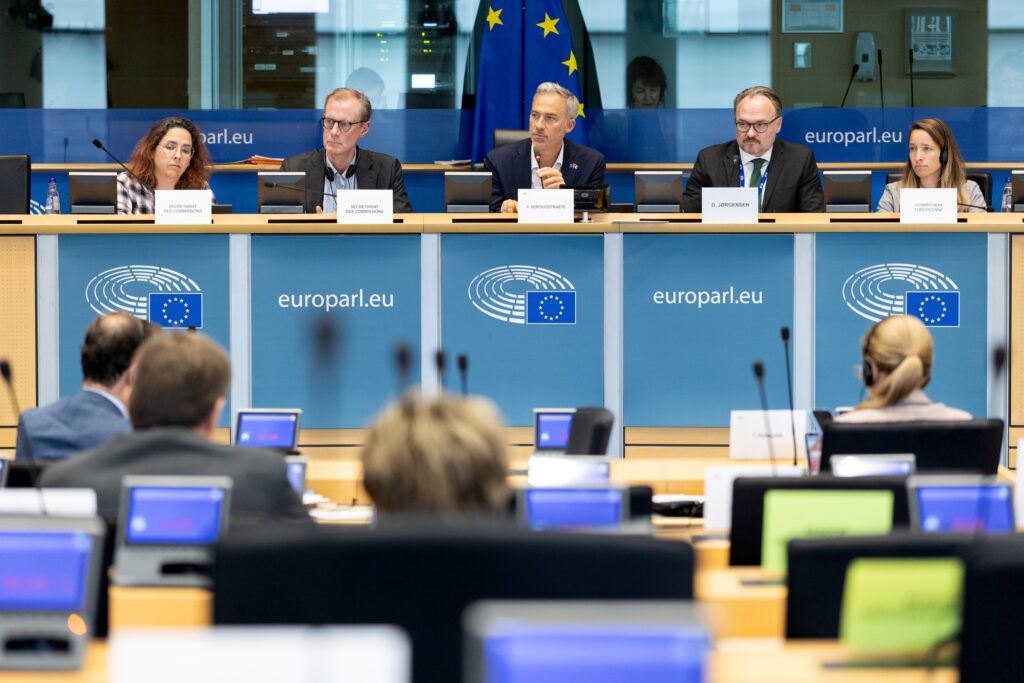
Energy Commissioner Dan Jørgensen spent the morning presenting the EU’s Strategic Roadmap for Digitalisation and AI in the Energy Sector at the Berlaymont building. By afternoon, he was at the European Parliament, where MEPs were waiting with tough questions on costs, security, and the pace of the clean energy transition.
Several MEPs began by congratulating Mr Jørgensen on the formation of Denmark’s new government, which includes his own Social Democratic Party. The cordial atmosphere did not last long.
Mr Jørgensen opened by warning that recent geopolitical tensions have once again exposed Europe’s vulnerability to imported fossil fuels. The crisis in the Middle East has driven up the bloc’s import bill sharply, he said, underlining the need to accelerate the shift towards domestically produced clean energy.
Yet several MEPs questioned whether the Commission’s answer—centred on electrification, renewable energy and grid expansion—can provide relief quickly enough. Members of the Parliament’s energy committee feared that Europe’s long-term ambitions are colliding with short-term economic realities.
The paradox of energy policy
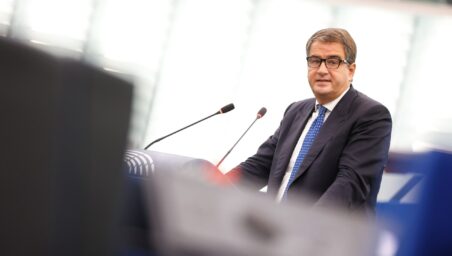
Paolo Borchia (PfE/ITA) argued that measures such as expanding electricity grids and deploying more renewable energy are investments whose benefits may only materialise in the 2030s. With households and businesses already struggling with high prices, he asked what the Commission could realistically deliver before the end of next year.
Mr Jørgensen acknowledged the dilemma, describing energy policy as a “paradox” in which the most urgent actions often take years to produce results. He defended the Commission’s focus on electrification and grid investments, arguing that Europe should have started many of these projects years ago. He pointed to heat pumps and district heating as tools that can begin lowering costs sooner.
Several MEPs also questioned whether the Commission is betting too heavily on electrification, arguing that Europe’s future energy mix should remain technology-neutral. Andrea Wechsler (EPP/DEU) urged the Commission to give a greater role to hydrogen, biomethane and other low-carbon fuels. “Europe clearly needs more electrification but in the current crisis decarbonisation cannot be reduced to electrons alone,” Ms Wechsler said.
Mr Jørgensen said that electricity would form the backbone of the transition but insisted that hydrogen-based fuels would remain essential for sectors such as aviation, shipping and energy-intensive industry. “It’s not only electrons, it’s also molecules,” he told MEPs.
Heat from data centres
Questions over Europe’s strategic autonomy also surfaced repeatedly. MEPs from several political groups highlighted Europe’s dependence on imported resources — fossil fuels, uranium for nuclear power stations or critical raw materials needed for clean technologies. Others warned that European manufacturers are struggling to compete with foreign suppliers, citing the difficulties facing domestic solar panel producers.
Just hours earlier, the European Commission had revealed its tech sovereignty package. The package contains plans to integrate data centres into the energy system. The Commission sees the centres as critical to the EU’s digital sovereignty, but they also consume vast amounts of energy.
Mr Jørgensen insisted that Europe wants to attract investment for such centres while imposing strict requirements on energy efficiency, water use and clean energy sourcing. Data centres, he argued, must become “part of the solution instead of part of the problem”.
Heating and cooling accounts for 50 per cent of our energy use in the European Union and 70 per cent of that comes from fossil fuels today. — MEP Niels Fuglsang (S&D/DNK)
Several MEPs highlighted the untapped potential of waste heat from data centres. “Heating and cooling accounts for 50 per cent of our energy use in the European Union and 70 per cent of that comes from fossil fuels today,” said Niels Fuglsang (S&D/DNK), pointing to the possibility of using waste heat to warm millions of homes. Mr Jørgensen signalled that the Commission is preparing a heating and cooling strategy, including waste heat recovery, before the summer break.
Europe’s weak spot
One point of broad agreement in the energy committee was that implementation remains Europe’s weak spot. MEPs repeatedly questioned whether member states are delivering on commitments already agreed at EU level, from smart meter deployment to cross-border energy infrastructure.
Europe clearly needs more electrification but in the current crisis decarbonisation cannot be reduced to electrons alone. — MEP Andrea Wechsler (EPP/DEU)
MEPs broadly agreed on the need to reduce dependence on imported fossil fuels and strengthen Europe’s energy sovereignty. But they signalled they want answers on how the transition can deliver lower prices and security today, not just in 2030.
Mr Jørgensen largely shared that ambition. The Commission, he said, is prepared to become more forceful with member states that fail to implement existing rules. “We are in a crisis now,” he told MEPs. “We need to start doing what we promised each other to do.”