Africa is becoming a launchpad for Russian influence operations aimed at Europe. An investigative journalist laid out the evidence before MEPs: disinformation campaigns, manipulated migration routes, and networks that now target elections on both continents.
The European Parliament heard a stark warning about Russian influence networks in Africa. Investigative journalist Philip Obaji spent years reporting on the Wagner Group, disinformation campaigns, and political interference across the continent. He brought his findings to MEPs.
Obaji opened his remarks by explaining why he continues to pursue these investigations. The work carries personal risk, but he sees it as essential. “I continue reporting because the truth matters, and because disinformation flourishes where facts are silenced,” he told MEPs.
Far beyond Russian propaganda
Russia’s activities in Africa extend far beyond propaganda campaigns. “Russia’s activities in Africa are not limited to military cooperation, resource extraction, or diplomatic engagement,” Obaji said. “They encompass sophisticated information operations designed to shape public opinion, attack Western institutions, promote pro-Kremlin narratives, and undermine confidence in democratic governance,” he added.
Africa, he argued, is becoming a laboratory for influence operations. “The objective is not merely persuasion but polarisation,” he said. He added that Russian-backed information campaigns have contributed to legitimising military coups, weakening democratic institutions, and fuelling anti-Western sentiment, particularly across the Sahel region.
Link with EU migration
Obaji also warned of a direct link between these influence operations and migration pressures affecting Europe. Instability generated by such campaigns contributes to displacement and migration. The same networks exploit migration as a divisive political issue within European societies.
The perception of migration has turned out to be absolutely decisive when it comes to elections.
— Juan Fernando López Aguilar, MEP (S&D/ESP)
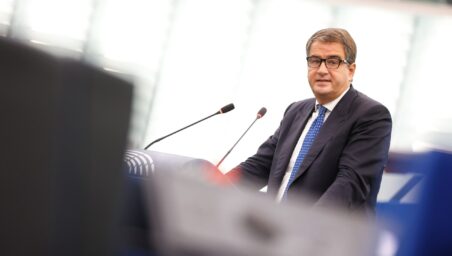
Juan Fernando López Aguilar (S&D/ESP) highlighted the growing political significance of migration. He also pointed to its vulnerability to disinformation campaigns. “The perception of migration has turned out to be absolutely decisive when it comes to elections,” he said. “It is the number one issue in which fake news, manipulation, and outright lies are on the winning side.” He warned against narratives portraying migrants as predators of public services and called for policies focused on integration rather than exclusion and stigmatisation.
Transport and disinformation
Russia’s involvement extends to the migration journeys themselves. According to Obaji, the pro-Russian military junta in Niger dismantled a key legal framework aimed at curbing irregular migration. It repealed the 2015 law that criminalised migrant smuggling. This effectively restored Agadez as a major transit hub for routes across the Sahara toward Libya and the Mediterranean. Pro-Russian commentators on local media allegedly encouraged African migrants to undertake the journey to Europe.
“I have also seen Russian trucks, Wagner trucks, transport migrants from the capital to Agadez, hoping that they could find smugglers that would take them across the desert to Libya, as well in Burkina Faso,” Obaji said. “So we’re seeing that Russia is directly involved in terms of disinformation and also in terms of physically moving people to areas where they can get, you know, on trucks and get smuggled to Libya — and from there, there are also Russian paramilitaries from the Wagner Group who help these same people get on boats in Libya, you know, for them to be able to cross the Mediterranean Sea.”
Obaji further alleged that the migration networks overlap with recruitment networks. The latter are used to recruit Africans to fight alongside Russian forces in Ukraine. “We found a link between the networks pushing migrants through Belarus across the Polish border and the same networks working to recruit Africans to fight in the war in Ukraine,” he said.
European elections
Obaji also focused on online influence operations originating from West Africa but targeting European audiences. He cited the example of the 2025 Dutch parliamentary elections, during which researchers identified more than 550 fake accounts on X that sought to manipulate political debate. “Many of these accounts were operated from West African countries, particularly Ghana and Nigeria,” he explained. “Their purpose was not simply to support one political actor or another. Their broader objective was to deepen social divisions, erode trust in democratic institutions, and manipulate online visibility through coordinated amplification.”
According to Obaji, this represents a new model of transnational disinformation: strategic direction from Russia, operational execution through international networks, and digital delivery directly into European democratic spaces. Helmut Brandstädter (Renew/DEU) argued that the EU should strengthen its communication efforts in Africa and more actively expose Russian influence operations. “I think it would also be our duty to explain to the African public what’s really happening,” Mr Brandstädter said. “We need to show that we are not their enemies and explain what the Russians are doing to them.” Obaji agreed, calling for greater European support for independent journalism, fact-checking initiatives, and media literacy programmes.
The same networks spreading falsehoods in Africa today may be targeting European voters tomorrow.
— Philip Obaji, investigative journalist
Africa, Obaji concluded, is not merely a target of Russian disinformation. “Increasingly, it is being used as an operational environment from which influence campaigns can be projected outwards,” he said, warning MEPs that “the same networks spreading falsehoods in Africa today may be targeting European voters tomorrow.”