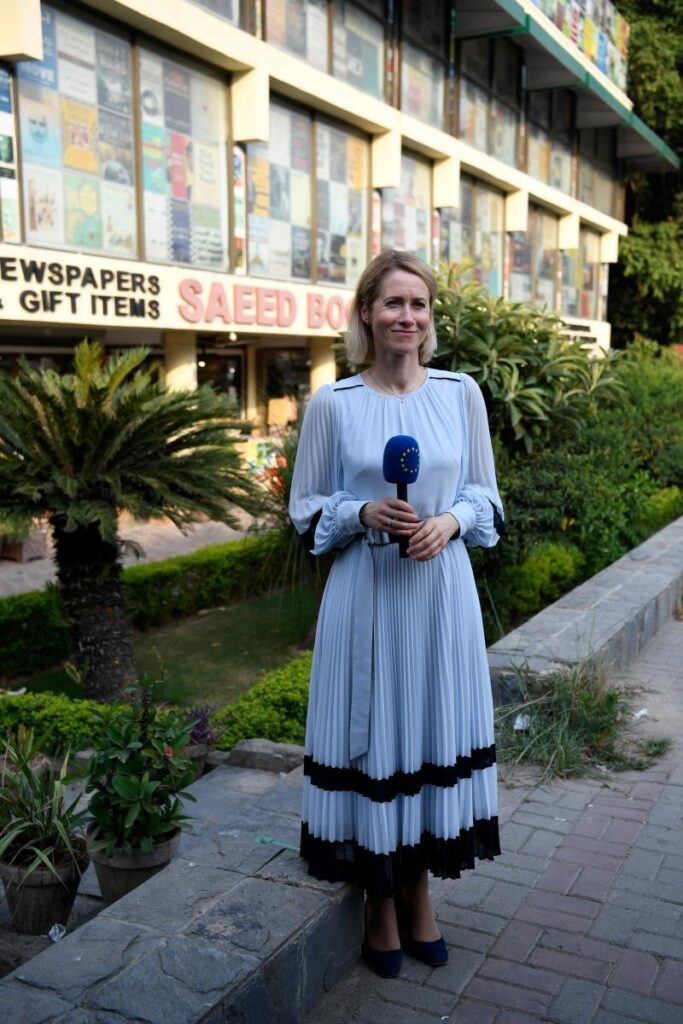
Europe must keep pressure on Moscow, avoid duplicating NATO, and stay relevant in Ukraine diplomacy, Europe’s top diplomat told reporters on Monday.
The E3—the Anglo-Franco-German diplomatic initiative to handle Putin—does not go against the European Union’s objectives, Kaja Kallas said. But Irish greed might, the high representative suggested.
Ms Kallas spoke after an informal meeting of EU defence ministers on 8 June. She returned repeatedly to sanctions, drones, and the need to make existing EU tools work better. Among the topics raised was an Irish company co-owned by a Russian entity, which reportedly sends at least half of its alumina exports to Russia.
Irish company, Russian money
A journalist asked Ms Kallas whether she would consider sanctions against the firm during her visit to Ireland the following day. Ms Kallas did not announce a decision. She acknowledged the role of the press in flagging such cases.
“So of course, every time when you media do good job to actually flag these issues, we are also raising these issues when we are talking about know next sanctions that we can do,” she said. “Because our aim is to really deprive Russia of the funding that they get from various resources,” the Commission VP insisted.
She left the door open. “So clearly we can discuss whether what kind of impact it has and whether member states are willing to put this forward and agree also on this to again, you know, put more pressure on Russia,” she said. “But, you know, definitely I think it will also be a topic that we will discuss tomorrow.”
Asked whether she had revised her view on a standing EU army or quick reaction force, Ms Kallas said she had not. She placed defence firmly in the national domain. “So generally, defence is a national competence and we are trying to push member states to work more jointly together because also if the member states are strong, the European pillar in NATO is strong as well,” she said.
No to a parallel army
She then explained her objection to a new force. “Now, why I don’t support additional army, it’s because, you know, every member state has one army. If you allocate this Army, I mean, 23 member states are also members of NATO. If you allocate this army to NATO, then you can’t use it. You can’t also create another army, just, you know, a parallel one,” she said.
The risk, in her view, was confusion. “That’s why it is very important that we don’t create structures that could create confusion,” she said. She pointed instead to existing tools. “We, of course, also on the European level have Article 42.7, which is not equal to Article 5 in NATO, to be very, very clear,” she said.
Ms Kallas said that the EU had proposed how to operationalise that clause and that crisis response teams for hybrid attacks had “been quite successful”. Her conclusion was unambiguous: “We need not create an alternative army to those armies that already exist.”
Strategic patience
A Reuters reporter opened the press conference by asking whether the EU and eastern member states risked being sidelined from Ukraine-Russia diplomacy, in particular after the E3 met President Zelenskyy in London the previous day. Ms Kallas said the EU had already been working through the substance. She noted that member states had voiced the view that “Clearly the countries that know Russia better than anybody should be heard.”
She urged patience. “We feel that it’s not there yet,” she said, referring to Russia’s readiness to negotiate genuinely. “That’s why we were also discussing today how to put more pressure. That’s why we are coming up with the 21st package of sanctions and actually moving further to push them really genuinely to negotiate. But we are not there yet.”
We need not create an alternative army to those armies that already exist.
— Kaja Kallas, the EU’s top diplomat
Responding to a question about drone incidents on the EU’s eastern flank, Ms Kallas said Europe had much to learn from Ukraine. “We have a lot to learn from Ukraine regarding this because they have put it up very, very effectively,” she said.
The Eastern Flank
The first lady of European diplomacy then cited a figure from the day’s meeting. “We heard today from the deputy minister that the interception rate is 97 per cent that they are taking these drones down need to learn from them,” she said. Her warning was plain: “It shows clearly that the threat is also to European soil.”
On the Middle East, Ms Kallas said the EU had discussed freedom of navigation and was pressing for diplomacy to prevail. She said the EU had “offered nuclear experts on the negotiations” and could bring confidence-building expertise to the table. She stressed that a ceasefire alone would not suffice. “It is not the only ceasefire that we need, but the long term peace that also requires the voice of the regional actors to be taken into account,” she said.