The sun shines, the wind blows, but the money has not been following. The European Commission launched T-MED today, an initiative to mobilise up to €25 billion for renewable energy and clean technology across the Mediterranean by 2035 and shore up Europe’s own energy security in the process.
For a young engineer in Morocco or Tunisia, T-MED could mean a job that does not require emigrating to find it. For a European household, it could eventually mean cheaper electricity from a grid powered by sun beyond the continent’s southern shore. Those are the promises behind the initiative the European Commission launched today.
Solar and wind energy in the southern Mediterranean costs 30–40 per cent less to produce than in the EU. The region’s total technical potential reaches over 2,300 GW, more than twice the EU’s current installed capacity. In some partner countries, renewables still account for just 1–3 per cent of the energy mix. The gap between potential and reality is stark.
Where the money comes from
The Commission has put more than €5bn in guarantee capacity from the European Fund for Sustainable Development Plus on the table. The money is part of T-MED, a flagship initiative under the Pact for the Mediterranean, signed in Barcelona in November 2025. The goal is to lever in private capital and reach €25bn in total investment by 2035. A call for private investors is open until 15 June; a second call for project promoters runs until 15 August.
The numbers still warrant caution. Private capital has long been held back by unpredictable regulation, permitting delays of up to 48 months, and opaque subsidy regimes. Africa holds roughly 40 per cent of global solar potential but attracted less than 2 per cent of global renewable investment in 2024. T-MED’s so-called Regulatory Accelerator tackles these barriers directly, tying EU financial support to measurable progress on reforms.
The security argument
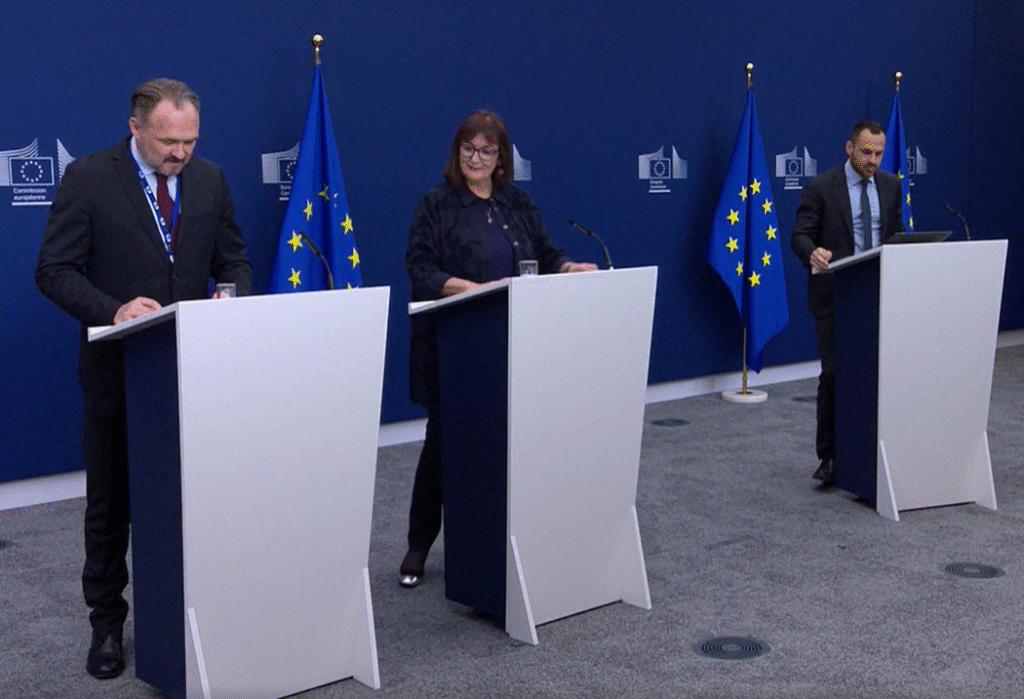
Commissioners Dubravka Šuica and Dan Jørgensen presented the initiative jointly. Both framed T-MED as a response to something bigger than just climate targets. “At a time of geopolitical uncertainty, growing energy demand and increasing climate pressures, unlocking this potential is in the shared interest of both the EU and its southern Mediterranean partners,” Ms Šuica said.
Energy security cannot only rely on diversifying fossil fuel imports. We must move towards electrified energy systems based on clean energy, strong interconnections and efficient networks.
— Dan Jørgensen, Commissioner for Energy and Housing
Mr Jørgensen was more blunt: “Energy security cannot only rely on diversifying fossil fuel imports. We must move towards electrified energy systems based on clean energy, strong interconnections and efficient networks.”
The subtext is the instability now roiling the broader Middle East. T-MED is partly a bet on partner countries reforming fast enough to make the ambition real.
Ambition versus pipeline
By 2035, T-MED aims to develop at least 15 GW of new renewable capacity, train 100,000 workers in clean energy sectors, and deliver regulatory reforms in at least five partner countries. The Investment Platform becomes operational in September 2026. The first EU–Mediterranean clean tech industrial collaborations should follow by 2027.
The real test comes in the months ahead: whether the investor calls attract a genuine project pipeline, or whether the ambition stalls at the level of political declarations.