What comes in the wake of FCAS death depends on solving European defence’s American dilemma: complement, or compete?
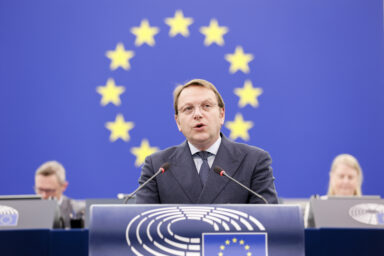
German Chancellor Friedrich Merz and French President Emmanuel Macron met on the sidelines of the EU-Western Balkans summit in Montenegro last week. They concluded that a months-long impasse between European aerospace firm Airbus and France’s Dassault Aviation was unlikely to be resolved. The €100bn Future Combat Air System (FCAS)—Europe’s largest defence programme—was finished.
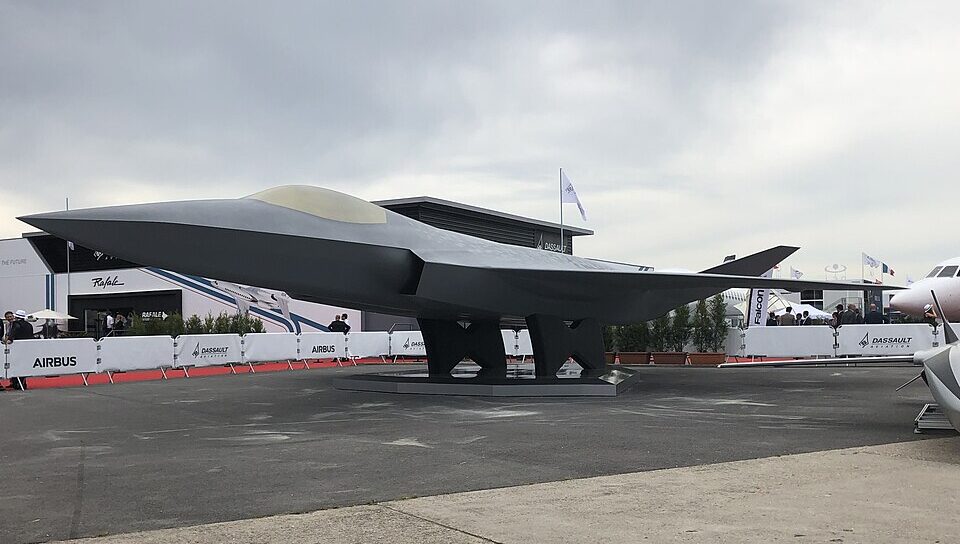
European states have known since the early 2000s that they would need to replace their existing fighter aircraft. The idea behind FCAS went beyond a jet. Plans included a combat cloud and uncrewed systems operating alongside the fighter. Mr Macron and then German Chancellor Angela Merkel launched the programme in 2017. Spain joined in 2019. The goal was an aircraft that could complement or compete with the American F-35.
Irreconcilable differences
The collaboration between Airbus and Dassault was difficult from the start. The two companies never agreed on how to divide work packages, technical specifications, or decision-making control. Several deadlines passed without agreement. Even in a strategic context transformed by the Ukraine war and American disengagement, co-operative defence development in Europe proved fraught with difficulty.
The two sides’ needs diverged fundamentally. France required an aircraft capable of carrying nuclear weapons and landing on an aircraft carrier. That is essential for replacing its Rafale jets, which fly from the carrier Charles de Gaulle and carry part of France’s nuclear deterrent. Germany wanted a conventionally armed jet with no carrier requirement. That gap proved unbridgeable.
Looking to develop two separate aircraft—possibly with new partners—while continuing co-operation on the joint cloud and uncrewed systems might work. But it would presumably undo a significant part of the cost savings promised by collaboration. Leaders in both countries grew frustrated. The episode demonstrates the limits of governments’ ability to set incentives for private industry where industry does not want to co-operate.
The inability of Berlin and Paris to either resolve the disagreements or declare the project dead had frustrated all FCAS participants. Mr Merz’s decision to end the partnership falls against a broader backdrop: Germany has embarked on a historic military build-up worth more than €750bn by 2030. Yet it also leaves Germany without a plan for the aircraft supposed to form the backbone of its air force from the 2040s onwards.
The decision and its consequences
German Defence Minister Boris Pistorius acknowledged the search for alternatives had already begun. “We’ve already been in talks with various stakeholders about this for months now, as you can imagine,” he said. “But I don’t want to speculate publicly about which project it might be or under whose leadership.”
Mr Merz has proposed that Germany, France, and Spain continue working together on the combat cloud. This is one of the programme’s pillars, designed to connect aircraft, sensors, radars, drones, and satellites in real time. Yet it remains unclear whether other elements of FCAS, including drones, sensors, and engines, can survive without the fighter jet at its core.
If Europe cannot produce its own alternative to the F-35, it will remain dependent on an increasingly unreliable America for a crucial part of its defence, possibly until well into the 2040s. That would dash the stated ambitions of both Mr Macron and Mr Merz.
Team Gen 6 steps forward
German industry has not waited. Eight aerospace and defence companies stepped up. Airbus’s Germany-based defence and space unit, Autoflug, Diehl Defence, Hensoldt, Liebherr, MBDA, MTU Aero Engines, and Rohde & Schwarz wrote to Mr Merz’s office and Mr Pistorius proposing a new alliance. The group calls itself Team Gen 6 and plans to announce the initiative at the ILA Berlin Air Show this week.
“It is a signal that, as German industry, we are prepared to stand ready to develop a sixth-generation fighter for Europe in Europe,” one person familiar with the matter told FT. The chief executives of all eight businesses are scheduled to meet at the air show to sign and unveil the alliance.
The companies plan to announce they are ready to pool their capabilities as a core team to ensure ‘war-readiness’ in the air for future decades, according to a draft of the position paper. The alliance would exclude Dassault, the original lead partner on the fighter element of FCAS. Other non-German partners may still be required to turn a concept into reality.
Partners wanted
One possibility is continued co-operation with Spain, alongside partnerships with Swedish defence contractor Saab or the British-Italian-Japanese Global Combat Air Programme (GCAP) consortium, as the British think-tank Chatham House mentioned this week in a commentary. Airbus has previously developed fighter jets with the UK and Italy on the Eurofighter Typhoon. Some industry analysts say it would need a partnership again.
The collapse of FCAS does not simplify Europe’s combat-air landscape; it complicates it further. Europe now has at least four next-generation fighter programmes under way. The UK, Japan, and Italy have worked on GCAP since December 2022. Though it started later than FCAS, GCAP now appears on surer footing, with governance structures agreed and work on some elements already under way. But the UK Treasury is reportedly worried the project’s international nature will make costs hard to rein in.
If Sweden and Türkiye cannot be persuaded, the so called ‘E3’ powers of the UK, France and Germany should at least live up to their rhetoric and invest in a joint outcome. — Chatham House
Saab is developing a successor to its Gripen, an aircraft Ukraine recently selected to form the backbone of its fighter wing, valued for its ability to operate from improvised airstrips. Türkiye is also developing a new stealth fighter. Meanwhile, Germany is reportedly considering buying more American F-35s. The UK doubled down on its own F-35 investment only last year, announcing a purchase of the nuclear-capable F-35A variant in addition to its F-35Bs.
The mistakes of the 1990s, revisited
This proliferation echoes a previous European error. In the late 1980s and 1990s, Europe developed three competing fighter designs: the Eurofighter Typhoon, Dassault’s Rafale, and Saab’s Gripen. France refused to join the Typhoon consortium then, too, and went its own way. That era of rivalry was affordable because America’s commitment to European security through NATO seemed solid.
At that time, European defence projects had the luxury of pursuing goals beyond pure military need. It means investing in local industry, keeping skills and production capabilities alive, and competing for export revenue. Both GCAP and FCAS still carry elements of that old procurement model, giving equal weight to international prestige, domestic economic growth, and exportability, rather than focusing on Europe’s increasingly urgent defence needs.
Those conditions no longer hold. Russia’s full-scale invasion of Ukraine and faltering American commitments to European security have changed the calculus sharply. Separate programmes mean European countries spread resources thin rather than pooling them, and pit projects against each other for the same export markets. That hardly speaks to a continent pulling in one direction on defence.
The cost of fragmentation
Sweden, now a NATO member, no longer has a strategic rationale for a separate export-oriented project. There is no longer an argument for targeting an export market that does not want to buy NATO kit. The so-called E3 powers—the UK, France, and Germany—should pool money and resources toward a single next-generation system. If Sweden and Türkiye cannot be persuaded, the E3 should at least live up to their rhetoric, the Chatham House commentary suggests.
With American disengagement is looming and the Russian threat significant, the emphasis must shift to prioritising the quality of equipment and the speed of its delivery. But the lesson of FCAS is blunt. Governments have limited tools to force private defence companies to co-operate when those companies prefer not to. If one partner refuses to play well with others, what can governments do? The FCAS saga has provided the answer: not much.