For years, EU rules had no good answer for companies that had grown too big to be small, but were still far too small to be big. On Tuesday, Brussels struck a deal that tries to change that.
Picture a mid-sized manufacturer in Łódź, or a health-tech company in Tallinn that has just crossed the 250-employee mark. Until now, that milestone came with an unwelcome gift: the full weight of EU compliance rules designed for large corporations, with none of the support that smaller businesses enjoy. The company had not changed overnight. The rules had.
That is the cliff edge the Omnibus IV deal, agreed on Tuesday between the Council and the European Parliament, is designed to remove. It creates a new legal category called small mid-cap enterprises, or SMCs, to sit between small and medium enterprises, known as SMEs, and large companies.
Firms with fewer than 1,000 employees and either annual turnover of up to €200m or a balance sheet of up to €172m will keep many of the lighter rules they benefited from as SMEs. The co-legislators pushed both thresholds above the Commission’s original proposal, which had set the limit at 750 employees and €150m in turnover.
Closing the cliff edge
The companies in question are not marginal players. The Commission estimates they account for 6 per cent of EU employment, concentrated in electronics, aerospace and defence, energy, and health. These are the sectors where Europe most needs homegrown companies to scale up and compete globally, and where the regulatory penalty for growth has been most counterproductive.
The new rules aim to make that calculus simpler. A company that has grown should not face a sudden wall of new obligations with no transition. The Commission will review the thresholds within five years of the legislation entering into force, with an eye on whether the definition is working as intended.
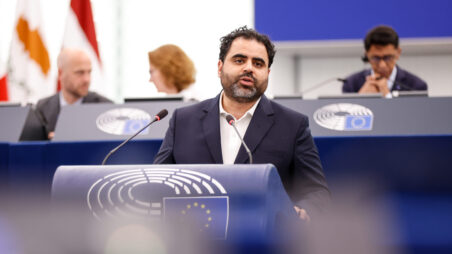
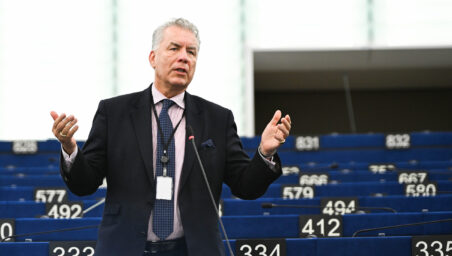
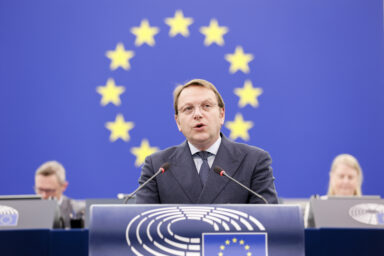
Behind the deal are two co-rapporteurs from the European Parliament: Mariateresa Vivaldini (ECR/ITA) and Kristian Vigenin (S&D/BGR), who steered the file through a joint ECON-LIBE committee, and the Cyprus presidency, who called the agreement “another concrete step towards a more competitive Europe.”
Paper out, pixels in
The deal’s second strand is less headline-grabbing but touches more companies more directly. Businesses will be able to replace paper declarations of conformity, the documents certifying that products meet EU standards, with digital versions. Instructions for use can go digital too, with a paper backup required only where safety demands it.
The deal amends twenty pieces of EU product legislation. A new fallback mechanism allows the Commission to draw up common specifications where harmonised standards do not exist or prove insufficient, though the co-legislators stressed this should remain a last resort.
Industry reaction has been mixed. Eurochambres welcomed the direction of travel but warned that Omnibus IV had “a limited impact on the broader business community,” urging the Commission to come forward with “genuine simplification proposals.” Ahead of the final talks, Business Europe and a coalition of industry groups backed the Council’s approach on digitalisation, describing it as “a grounded, balanced and clear path,” in contrast to what they saw as a less workable Parliament position.
The fourth of ten
Tuesday’s deal is the fourth instalment of a ten-package simplification drive the Commission has been running since February 2025. EU leaders demanded what the Budapest declaration called a “simplification revolution,” driven in large part by reports from former Italian prime ministers Enrico Letta and Mario Draghi. Both named regulatory complexity as a structural drag on European competitiveness. The targets are concrete: a 25 per cent cut in administrative costs for all businesses, and 35 per cent for SMEs, by 2030.
With this agreement, we are taking yet another step in turning the promise of simplification into concrete deliverables for European businesses.
— Marilena Raouna, Deputy Minister for European Affairs, Cyprus
Cyprus presidency deputy minister Marilena Raouna called the deal “another concrete step towards a more competitive Europe.” She said the agreement would help businesses “grow, innovate and create jobs across the Union.” “With this agreement, we are taking yet another step in turning the promise of simplification into concrete deliverables for European businesses,” she added.
The provisional agreement must still be formally endorsed by both institutions and survive a legal and linguistic revision before becoming law. For the companies in Łódź and Tallinn, that means the cliff edge is not gone yet. But for the first time, there is a plan to fill it in.