It kills nearly ten million people a year and is expected to rise sharply in the coming decades. Cancer has for the first time been elevated to the top tier of global political priorities. G7 leaders issued an unprecedented heads-of-state declaration dedicated solely to the disease.
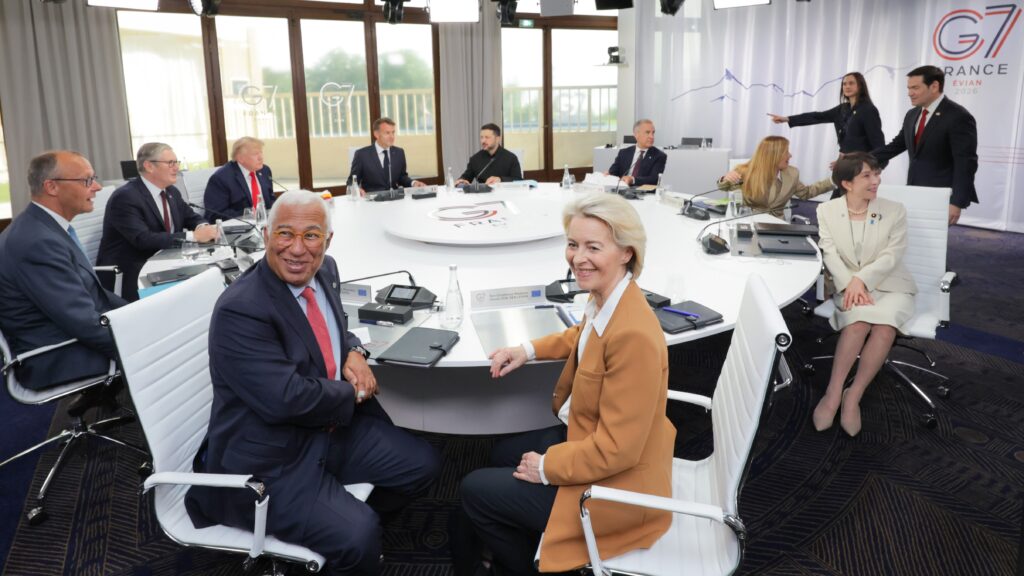
The G7 leaders closed their summit in Évian on 17 June with nine separate declarations rather than the usual single communiqué. Under the French presidency, the agenda stretched across health, balanced growth, critical minerals supply chains and a safer digital space for minors. It also covered international partnerships, drug trafficking, migrant smuggling, and a geopolitical statement on Ukraine, the Middle East and Lebanon.
Two of the nine texts focused on health. One set out a broader framework for international cooperation on cancer. The second responded to the Ebola outbreak in the Bundibugyo region of the Democratic Republic of Congo and Uganda, with more than $1 billion pledged for the emergency response.
First of its kind
The Leaders’ Call on the Fight Against Cancer is a first of its kind. It is the first declaration G7 leaders have devoted entirely to the disease, signed by heads of government rather than health ministers. Previously, cancer had featured only in broader health commitments.
Cancer kills nearly ten million people a year. The leaders expect new cases to rise by about 80 percent globally by 2050 as populations age. That, they say, places an ever-greater burden on societies, health systems and economies.
The declaration sets out three priorities. The first targets paediatric, adolescent and young adult cancers. No single country holds enough data to study the full range of tumour types. So leaders agreed to bridge national registries and build interoperability standards.
They will integrate clinical, genomic and imaging data “without the necessity for direct data transfer”. This federated approach draws on artificial intelligence and keeps patient records in place.
Ambitious targets
The second targets cancers with poor prognosis. Leaders committed to a shared international definition and research agenda. They established ambitious targets for screening and for diagnosing more cancers at stage 1.
They also set a specific goal: significantly reduce lung cancer mortality in the next ten years. Progress they said, depends on clinical trial cooperation. It also depends on translating advances through digital technologies, AI and quantum research.
The third covers access to care. Leaders backed stronger, self-reliant health systems. They called for comprehensive cancer centres “as anchors of research excellence, care quality and education”.
They also backed the secure use of AI and quantum tools for early detection, clinical decisions and palliative care. And they welcomed advances that bring the elimination of cervical cancer “within reach”. Leaders pledged to review progress on the commitments.
Vaccines under way
The second health text responded to the Ebola outbreak in the Democratic Republic of Congo and Uganda. Leaders warned that existing vaccines, diagnostics and therapies fall short, as most have been developed against the better-studied Zaire strain rather than the much rarer Bundibugyo variant behind the current outbreak.
The financial response is large. The United States has deployed more than $370 million and has committed up to a further $500 million. The EU has pledged €493 million. A continental preparedness plan is mobilising $518 million. Leaders recognised the important role of the private sector. They encouraged the accelerated development of tools for prevention, preparedness and response.
The G7 cannot afford to lose its leadership in pharmaceutical innovation. — David Reddy, Director General, IFPMA
The industry responded quickly. On 16 June, alongside an Africa CDC meeting, International Federation of Pharmaceutical Manufacturers and Associations (IFPMA) underscored that commitment. Pharmaceutical companies Gilead and MSD are investigating repurposed therapeutics and small molecules antivirals. Regeneron, Mapp Biopharmaceutical and public partners are advancing monoclonal antibody candidates.
Bundibugyo-specific vaccines are in rapid development, including projects led by International AIDS Vaccine Initiative (IAVI), Oxford University, the Serum Institute of India and Moderna. Johnson & Johnson, MSD and Roche are adding funding, equipment and diagnostics.
Digital safety and other issues
Beyond health, the resilient-growth statement flagged supply chain pressure. It named energy, agricultural inputs and fertilisers. It pledged to identify vulnerabilities affecting strategic sectors, including critical technologies. A separate declaration covered critical-minerals supply chains. The call on a safer digital space for minors urged providers to make conversational-AI tools safer for children. It also asked them to protect their physical and mental health online.
Leaders covered more ground too. They addressed drug trafficking, migrant smuggling and international development financing. Their geopolitical statement backed Ukraine. It also called for stability in the Middle East and Lebanon. The presidency framed Évian as a summit of convergence and unity in response to multiple crises.
The industry’s ask
Four days before the summit, IFPMA and Leem, the French pharmaceutical industry association, made their case. The two urged leaders to put pharmaceutical innovation at the centre of their competitiveness agenda. IFPMA Director General David Reddy went further. He warned that the G7 “cannot afford to lose its leadership in pharmaceutical innovation”. He pressed leaders to treat medicines and vaccines as strategic economic assets. That backing, he said, means competitive intellectual property frameworks and security of supply.
Mr Reddy pointed to the numbers. Pharma reinvests close to a third of its gross value added in research and development (R&D). The sector added $2.3 trillion to global GDP in 2022, nearly half from G7 economies. That lead is now under pressure as China holds about a third of the global R&D pipeline.
A linked debate is moving in Geneva. WHO Director-General Tedros Adhanom Ghebreyesus and Brazilian President Lula da Silva sent an open letter timed to the summit. They urged G7, G20 and BRICS leaders to push negotiators on the WHO Pandemic Agreement.
At stake is its Pathogen Access and Benefit-Sharing (PABS) annex. The annex governs how countries share pathogens and the resulting vaccines, tests and treatments. Negotiators meet from 6 to 17 July. The annex did not feature in any Évian declaration.