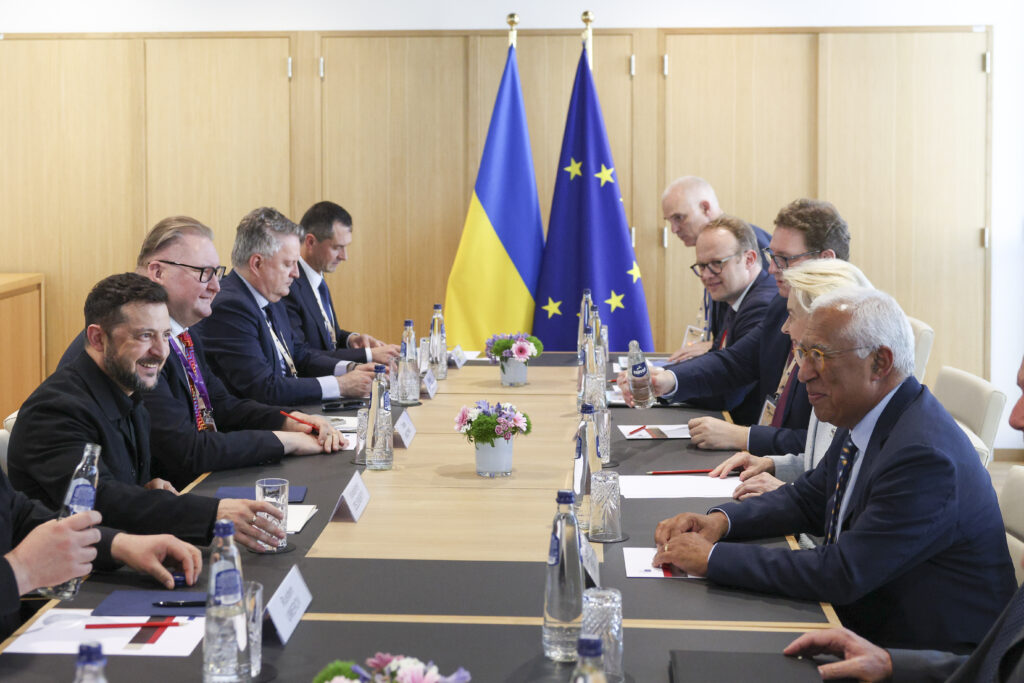
EU leaders closed their summit with a rare display of unity on Ukraine. Hungary’s new prime minister, Péter Magyar, dropped his predecessor’s veto, but only after softening language on speeding up Ukraine’s EU accession. Leaders also agreed to renew Russia sanctions yearly instead of every six months.
The European Council reaffirmed its “firm and unwavering support” for Ukraine, committing again to political, economic, military and humanitarian support for Kyiv and its people. Leaders welcomed the start of Ukraine’s accession process, including the opening of the fundamentals cluster, the first of six steps Ukraine must complete to join the EU. Brussels insisted that any lasting peace must respect Ukraine’s sovereignty and territorial integrity, with no border changed by force.
Hungary’s Péter Magyar made clear the unity had a price. “At my initiative, a clause referring to accelerating accession was removed from the text at the very last moment,” he wrote on X after the summit. “It wasn’t easy.”
The EU also confirmed it is willing to help guarantee Ukraine’s security, including through EU missions and cooperation with international partners. Costa was also asked about recent brief diplomatic contacts with the Kremlin. He explained he had asked his office to open a diplomatic channel with Russia, to keep the EU ready to defend its interests when the time comes. He stressed the contacts so far had been brief and limited, with no exchange of substantive information or negotiation involved.
Costa opens channel to Moscow
President Costa stressed the need for confidence in the EU’s support for Ukraine. He said the bloc must “be ready to assume responsibility, if and when conditions allow, for dialogue with Russia, in order to contribute to a just and lasting peace that also protects Europe’s interests.” President Volodymyr Zelensky has made a similar call, urging Europe to “take a more active role in diplomatic efforts.” A senior EU official said several leaders indicated during the talks that Costa, under the Treaties, is the natural figure to represent the EU’s interests in any dialogue with Moscow.
A senior official described a “new sense of unity” around the table, pointing to the fact that all 27 leaders backed the conclusions as proof. All EU efforts, the official said, point in the same direction: strengthening Ukraine and pressuring Russia ahead of any future peace talks.
The conclusions also contain a new element. After months of controversy over Russia’s participation in international cultural and sporting events, including at the Venice Biennale, the European Council said Russia’s involvement should not be normalised until Ukraine sees a just and lasting peace.
Latest attacks in Romania
The Council firmly condemned Russia’s recent escalation. It pointed to attacks on civilian and energy infrastructure and repeated violations of member states’ airspace, such as in Romania.
Following the efforts and work put in by our country, the European Council conclusions will mention the issue of drones that have violated national territory. — Nicușor Dan, President of Romania
Romanian President Nicușor Dan had already flagged this on X. “Following the efforts and work put in by our country, the European Council conclusions will mention the issue of drones that have violated national territory,” he wrote. He added that this would mean more attention to the Eastern Flank and a boost for dedicated projects such as Eastern Flank Watch.