Unless you are an industry insider, chances are that you have never heard of Carmenta. Yet the company’s technology features inside systems that most everyone in European defence depends on.
Carmenta, headquartered in Gothenburg, makes geospatial software. That description undersells it. The company’s tools sit at the heart of command-and-control systems used by some of the largest defence integrators in the world, processing millions of data points in real time, fusing radar feeds, camera inputs, infrared sensors, and background maps into a single operational picture. Torbjörn Lönnqvist, the CEO, explained to EU Perspectives the nuts and bolts of the trade.
Speed, Mr Lönnqvist says, is everything. “No delays are accepted in this kind of application,” he says. “It could be radar plots, and then it could be millions of radar plots that are updated at quite high frequency. And of course we need to match that.”
Design wins
The company sells primarily a software development kit, or SDK, that its customers, firms such as Thales, KNDS, Airbus, Saab, and BAE Systems, embed into their own products. A single integrator may use Carmenta’s technology across up to twenty different projects simultaneously. Occasionally, armed forces that conduct their own software development buy directly from the company. But the typical customer is a large systems house building a platform that will eventually reach the battlefield.
The clearest sign of Carmenta’s growth is a metric Mr Lönnqvist calls “design wins”: the moment a customer formally chooses the company’s technology and begins building with it. “We can see it’s almost close to doubled the number of new design wins the last years compared to how it was before,” he says.
The driver is not hard to identify. The war in Ukraine, and the surge in European defence budgets that followed, have created urgent demand for software that shortens development cycles. “What we provide is an SDK that our customers use when they build their applications,” he explains. “By using this software, you reduce the time for development and the time to market a lot.”
The catch is that revenue lags far behind. Most of Carmenta’s income comes from runtime licences, fees triggered only when a customer deploys a finished application. That gap between a design win and a deployed system typically runs to two, three, four, or five years.
The kill chain that drones feed
“Of course we support our customer during the development in order for them to be successful,” Mr Lönnqvist says. “We do training, we do workshops, sometimes we do expert consultancy services. But some customers we don’t help at all. They use our SDK, they build the application and then they come back and say, okay, now we deploy it.”
The company has subsidiaries in Germany, France, the United Kingdom, and the US. Its American operation, started three or four years ago, has already begun generating design wins. Mr Lönnqvist is cautious about projecting too much from that, but the direction is clear.
The fastest-growing segment of Carmenta’s new business is unmanned systems. Mr Lönnqvist will not give precise figures, but he is direct about the trend. “Quite many of our new design wins are in this area, definitely,” he says. “It’s much, much more new design wins that is within companies developing applications for drones or also different kind of counter-UAS systems.”
Data fusion in action
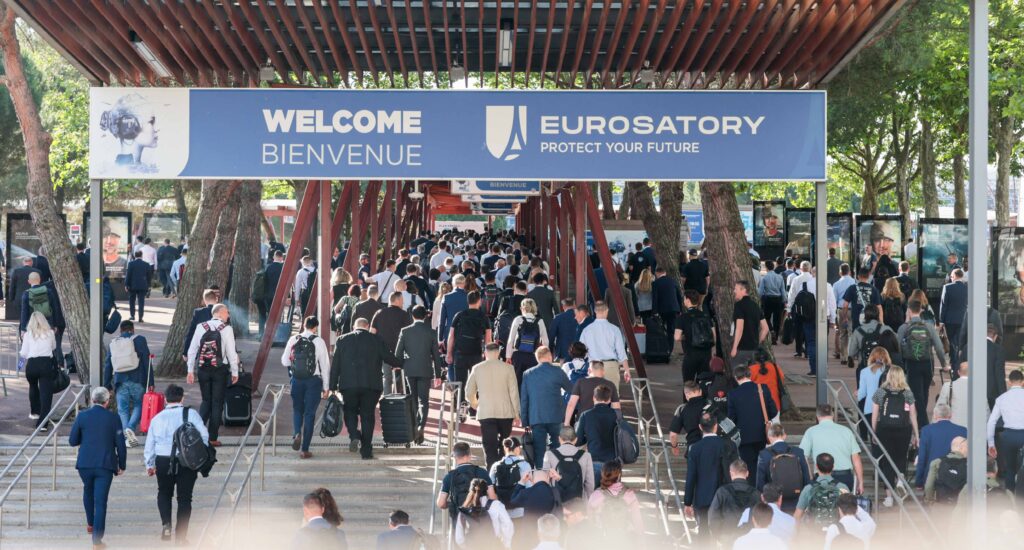
At Eurosatory 2026, the company demonstrated what that means in practice. One showcase involved optimising drone flight paths for stealth: calculating a route from point A to point B that keeps the drone hidden from enemy sensors by following valleys and terrain features.
The alternative optimisation trades concealment for speed. “Sometimes the time is more critical,” Mr Lönnqvist explains. “Then you maybe say, okay, it’s worth taking the risk to be seen here, I take the risk and then I fly a quicker way.”
No delays are accepted in this kind of application.
— Torbjörn Lönnqvist, CEO of Carmenta
Carmenta’s Chief Technology Officer Tobias Moberg framed the broader ambition at the event. “Multi-domain operations rely on the ability to bring together data from different systems and make it usable in real time,” Mr Moberg said. “Carmenta technology focuses on enabling high-performance data fusion, visualisation and interoperability, so developers can build applications that maintain a consistent operational picture, even in rapidly changing conditions.”
Useful standardisation
The company’s frame agreement with Airbus Defence and Space, extended earlier this year, illustrates how deeply embedded its technology already is. The partnership, now more than a decade old, covers platforms including the A400M, A330 MRTT, Eurofighter, C-295, Tiger, and Eurodrone.
Mr Lönnqvist described the renewal as ensuring “the continued delivery of innovative geospatial capabilities for Airbus’s leading air platforms”. He noted that the collaboration would also support future programmes including the—now likely defunct—Future Combat Air System (FCAS).
Ask Mr Lönnqvist about the European defence market and the answer is measured but pointed. He sees the EU’s push for standardisation, tools such as the Ecovadis supplier assessment platform, as broadly positive. The initial compliance effort is real, he concedes, but once completed it saves time across multiple customers and markets. For a Swedish company with a small domestic base, easier cross-border access to EU procurement matters.
Europe’s problem
The deeper issue is structural. “The problem we have had is that it’s so many different kinds of systems produced in the EU,” he says. “You have several different fighter aircraft, a lot of different tanks. In the US you decide, okay, I should have this tank, I should have these aircraft, and I have that in big volumes. The problem in the EU is that the volumes go down for each supplier compared to the US, where you choose one and that one gets the whole US market.”
Cooperation projects have struggled to fix this. Mr Lönnqvist points to FCAS, the Franco-German-Spanish next-generation fighter programme, as an example of the difficulty. “France and Germany, they are struggling. I think they have stopped the cooperation there in a certain way,” he says.
(Sometimes) you say, okay, it’s worth taking the risk to be seen here, I take the risk and fly a quicker way.
— Torbjörn Lönnqvist
“These long-term projects that go for so long a time — it’s not easy to say that you cooperate now, you cooperate in 10 years, you cooperate in 20 years, 30 years, 40 years.” He adds that many European countries chose American technology for long-term programmes precisely because they trusted Washington’s reliability. Some of them are now reconsidering that choice, but the programmes run for decades.
The small and innovative
The tension Mr Lönnqvist identifies most urgently is one that sits at the intersection of market structure and procurement policy. Europe’s defence technology ecosystem has expanded dramatically. When Carmenta joined the Swedish Defence and Security Organisation in 2010, the body had roughly 30 to 40 member companies. Today it has more than 400.
“It’s the same in Germany, same in France,” he says. “It’s ten times more companies and a lot of them are small, innovative companies. Some of them are startups. Some of them are coming from another market, not from the defence market, but now have entered it.”
The problem is that major procurement contracts still flow overwhelmingly to large integrators, who are then free to develop capabilities in-house rather than buy from smaller specialists. “In some cases, I think it would be good to put a little bit more pressure on the bigger system integrators to really incorporate smaller companies’ technology in their solution,” Mr Lönnqvist says.
Extra burden?
The alternative, he argues, is wasteful. A large integrator that decides to build a niche capability itself may take ten times as long, spend far more, and produce an inferior result compared with buying from a specialist. “It should be some kind of benefit, some kind of incitement for them to really use more,” he says.
He is careful, however, about how such an incentive should be designed. A blanket rule requiring a fixed percentage of contract value to flow to smaller firms would, he fears, become another bureaucratic burden. “I think it’s more in big procurements that you really should consider what makes sense,” he says. “Does it make sense that 10 per cent of the total amount should go to other (manufacturers), or should it be 30 or should it be 50 or should it be five? I don’t know. But I think that must be done case by case.”
In some cases, I think it would be good to put a little bit more pressure on the bigger system integrators to really incorporate smaller companies’ technology in their solution.
— Torbjörn Lönnqvist
The reason is accountability. If procurement rules specify which subcontractors an integrator must use, the integrator will blame those subcontractors when things go wrong. “The system integrators that have the whole contract must be responsible for the whole contract and then must have the choice to choose also partners,” he says. “So it’s tricky.”
Orchestrating the unmanned world
Mr Lönnqvist’s final thought is less a complaint than a research agenda. The question his company is most actively working on is how autonomous systems across different physical domains should cooperate with each other. “We have so many customers and we do a lot of research on how autonomous systems on land, in the air, and on the sea should cooperate,” he says.
The scenario he describes is specific: a ship carries an unmanned ground vehicle, or UGV; the ground vehicle carries an unmanned aerial vehicle (UAV). At what point should the ship release the ground vehicle? At what point should the ground vehicle release the drone? “Where should it release the UGV, and where should it, on the UGV, release the UAV in order to do a specific mission? That is something that I think will be very important, how these different systems will cooperate.”
It is a question that sits at the edge of what current doctrine and technology can answer. For a company whose software already underpins much of Europe’s command and control infrastructure, it is also, unmistakably, the next design win.