Moving across borders for work should not mean navigating a maze of conflicting social security rules. A new EU reform seeks to protect mobile workers, crack down on abuse by letterbox companies and simplify procedures for businesses — a package its Parliament rapporteur calls a major step forward for a more mobile Europe.
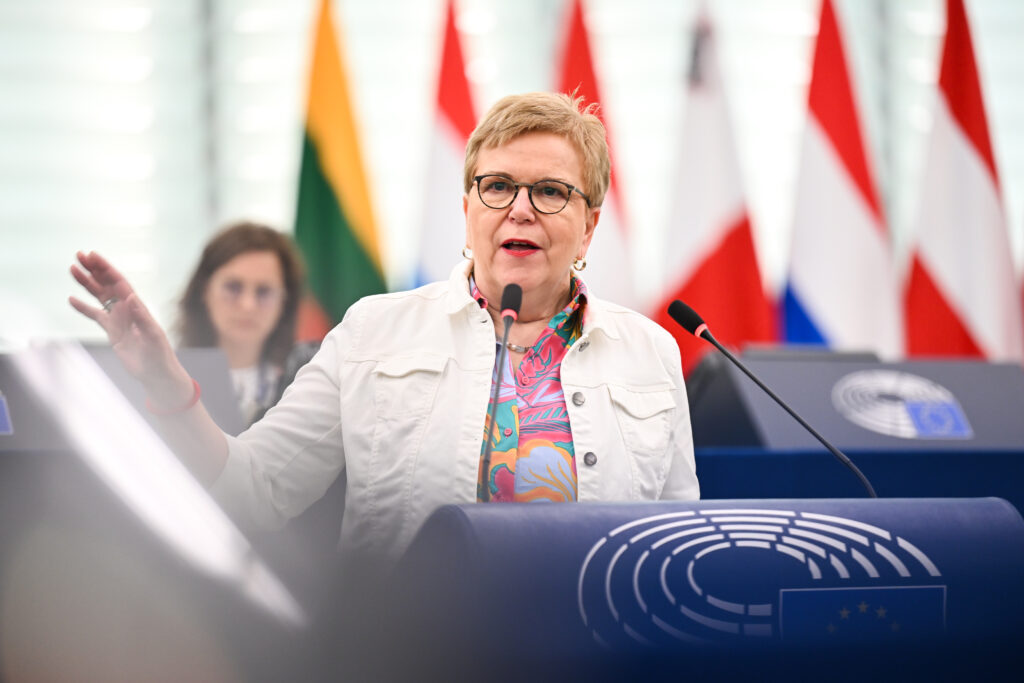
“It sounds technical, but it has a huge impact on 14 million people in Europe”. This is how MEP Gabriele Bischoff (S&D/DEU), Parliament’s rapporteur on the file, describes the significance of the reform of the social security for EU workers who live or work in another member state.
Approved in Strasbourg with 511 votes in favour, 87 against and 61 abstentions, the agreement clarifies which national legislation applies in cross-border situations. It strengthens cooperation between national authorities to tackle fraud and abuse, and introduces simpler rules for accessing benefits.
We managed to deliver more social rights, better rights for mobile workers, but at the same time also a simplification. — Gabriele Bischoff (S&D/DEU)
“We managed to deliver more social rights, better rights for mobile workers, but at the same time also a simplification,” Ms Bischoff told EU Perspectives. She added that the changes should also benefit companies, especially in border regions.
Long-term care under clearer rules
One of the most interesting aspects of the reform concerns the care workers. The reform strengthens legal certainty for people in need of long-term care and for those providing it. It introduces a common definition of the service and a list of covered benefits. According to Ms Bischoff, “citizens here will not be left out in the cold”.
The legislation also clarifies the distinction between cash family benefits designed to compensate parents who interrupt or reduce their working hours to care for a child and other family benefits. The objective? Promoting a fairer sharing of parental responsibilities and removing financial disincentives for parents who choose to reduce their working time.
Another key objective of the reform is to strengthen the fight against social dumping by making social security rules more transparent and easier to enforce. Ms Bischoff points first to the requirement for employers to notify authorities in advance when posting workers abroad.
Previously, member states interpreted the requirement differently, with some applying it only “whenever possible”. “So prior notification is now the obligation, full stop,” she said, adding that the change would make enforcement much more effective and would be essential in the fight against social dumping and fraud. She also mentioned the A1 certificate, a document issued by a worker’s home country confirming which national social security system applies to them.
Crackdown on letterbox companies
The regulation also introduces new criteria to identify genuine cross-border activities and prevent companies from exploiting differences between national social security systems. These criteria will also help address the issue of letterbox companies in cases of pluriactivity, when authorities need to determine where social contributions should be paid. “We have more and more people in Europe that are posted to more than two countries,” Ms Bischoff noted.
Prior notification is now the obligation, full stop. — Gabriele Bischoff (S&D/DEU)
She explained that the new rules also take into account “where most of the turnover is generated” as an additional factor. “We wanted to make sure that we don’t set any incentives for letterbox companies where they just look for where the cheapest contributions are and the real activity is somewhere else,” she added.
Under the new rules, companies will no longer need to obtain an A1 certificate for business trips where employees are not selling goods or providing services.
Digitalisation, the next frontier
While welcoming the agreement as a major milestone, Bischoff believes the reform should not be seen as the final step: digitalisation is the next priority. “I really tried for some time to use digitalisation more to facilitate processes, but the member states were not interested enough to support this. I think here we still have a real potential to improve and make it simpler.”
She expects the European Commission’s upcoming Fair Mobility Package (foreseen this autumn) to introduce new digital tools, including the S-Pass. “This will be also a further step up here. Then we still have to continue to push. We will have the digital wallet soon.”
Bischoff also recalls discussions already held with social security institutions and Commission officials on how digital solutions could simplify procedures across Europe. “We did have a conference with all social security organisations, but also people in the Commission that developed the wallet and the Corona app. We could build something similar and with the S-Pass really facilitate it. But that’s a question of the future”.
For the rapporteur, the newly adopted legislation represents a significant advance. “This is a major step,” she concluded. But future reforms will need to keep pace with changes in labour markets and digital technologies.