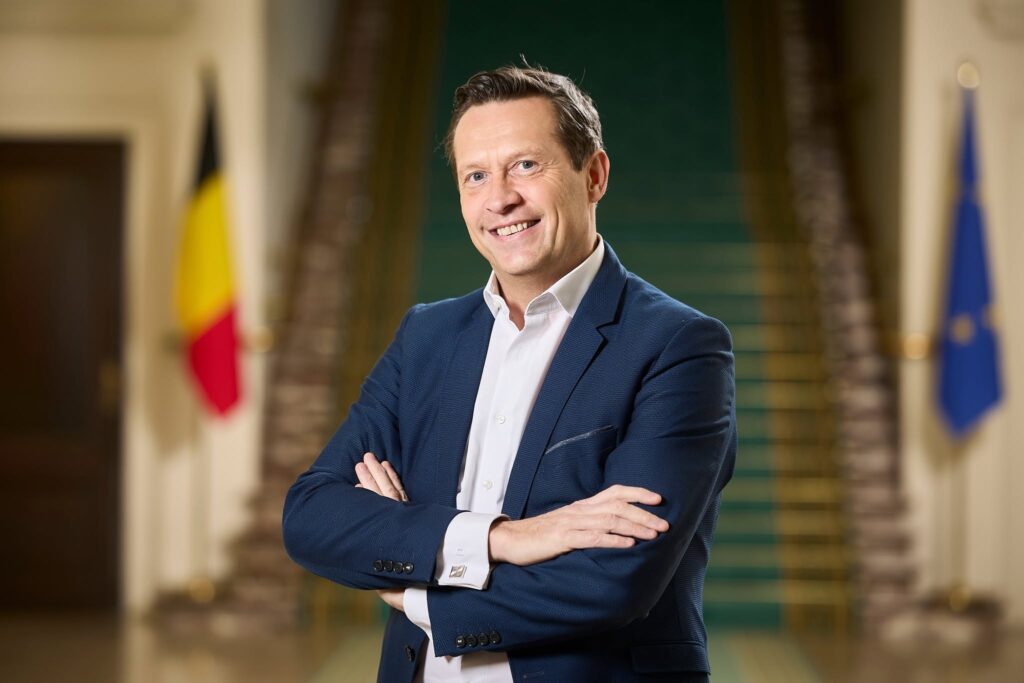
A month of protests in Albania has moved far beyond tourism. It has become a test of whether Brussels holds candidate countries to European values, not only technical checklists. Belgian lawmaker Michel De Maegd tells EU Perspectives that Tirana’s EU path cannot come at the expense of the rule of law.
The protests began 41 days ago over plans to build tourism infrastructure on Sazan Island and in the Vjosa-Narta region, both protected natural areas. What started as opposition to a single project has since grown into a broader movement demanding transparency, accountability and respect for the rule of law.
Michel De Maegd (LE/BEL), a member of the Belgian Chamber of Representatives, has announced he will question Belgium’s Foreign Minister over the developments. In an interview with EU Perspectives, he argues that Albania’s accession must be judged on its commitment to European values, not only on reforms achieved on paper.
You describe the protests as more than a dispute over one tourism project. What do they reveal about the state of democracy, transparency and the rule of law in Albania?
They reveal a broader demand from Albanian citizens for transparency, accountability, and respect for the rule of law. Many people are not necessarily opposing economic development or foreign investment as such. What they are questioning is the way decisions are taken: who decides, on what basis, with which guarantees, and for whose benefit.
The concerns raised by citizens are deeply European concerns: protection of the environment, public consultation, independent institutions, transparency, and the fight against corruption. In that sense, these protests should not be seen as an obstacle to Albania’s European path. On the contrary, they show that a significant part of Albanian society wants a more European Albania, based on rules, rights and democratic accountability. It is not my role to interfere in Albania’s internal political choices, but any country wishing to join the European Union must respond to citizens’ concerns through dialogue, transparency and respect for European standards.
You argue that Albania’s EU accession should be judged on values as much as on technical reforms. Has the EU been firm enough with Prime Minister Edi Rama’s government, or has it prioritised geopolitics over democratic standards?
Albania is an important partner and its European perspective must be supported. But support for enlargement cannot mean lowering our standards. EU accession is not only a technical process. It is also a question of values, trust, and credibility. The rule of law, the fight against corruption, judicial independence, environmental protection, and democratic culture are not secondary issues. They are at the heart of the European project.
I understand that the EU must also consider geopolitical stability in the Western Balkans. But geopolitical considerations must never lead us to be weak on democratic standards. If citizens in a candidate country feel that the EU is silent when European values are under pressure, then the credibility of the enlargement process is weakened. So my view is clear: the EU must remain supportive of Albania’s accession, but it must also be firm, consistent and demanding.
Protests have focused on tourism developments planned for protected areas, including Sazan Island and the Vjosa-Narta region. Should the Commission make stronger environmental protections a condition for Albania’s accession?
Yes, environmental protection must be part of the conditions attached to Albania’s European path. This is not a marginal issue. The protection of nature, biodiversity, and protected areas is part of the European acquis. If Albania wants to join the European Union, it must align with European standards, including environmental standards. In this case, the concerns relate to very sensitive areas, including Sazan Island and the Vjosa-Narta region. These are not ordinary development zones.
They have ecological value and symbolic importance. Before any project moves forward, there must be a complete, independent, and public environmental impact assessment. There must also be transparency on the investors, land rights, permits, and guarantees offered to local communities. Foreign investment is welcome, but it must be legal, transparent, sustainable, and compatible with European standards. A candidate country cannot advance towards EU membership while giving the impression that protected areas can be weakened or bypassed for powerful investors.
You have announced you will question Belgium’s Foreign Minister about these developments. What concrete action should Belgium and the EU institutions take if concerns over corruption, environmental protection and democratic governance persist?
Belgium always acts within the European framework, with seriousness and consistency. First, we need to ask for full transparency on the project: investors, permits, land issues, environmental studies, and public consultations. Second, the EU should insist on a complete and independent environmental impact assessment before any irreversible development takes place. Third, the Commission should closely monitor whether Albania’s legislation and practice remain aligned with the European acquis, especially on the environment, public procurement, anti-corruption, and the rule of law. Fourth, if serious concerns persist, the EU should make clear that some accession chapters cannot be closed until the required standards are respected.
The message must be: yes to Albania’s European future, but not at the expense of the rule of law, transparency, or environmental protection.
— Michel De Maegd, Belgian MP (LE/BEL)
This is not about punishing the Albanian people. On the contrary, it is about protecting the credibility of their European future. Belgium should continue to support Albania’s EU perspective, including through stronger diplomatic engagement, but always on the basis of merit, reforms, and respect for European values. The message must be: yes to Albania’s European future, but not at the expense of the rule of law, transparency, or environmental protection.
Many Albanians support EU membership but feel European leaders have reacted too weakly. What message would you send to those protesting because they believe European values are not being consistently defended?
My message to Albanian citizens is one of respect and support. I support the right to demonstrate peacefully, to defend one’s rights, and to ask for transparency, accountability, and protection of the environment. These are legitimate demands. They are also profoundly European demands. When citizens ask for the rule of law, for public decisions to be transparent, for nature to be protected, and for institutions to be accountable, they are speaking the language of the European Union.
I also want to be clear: it is not for me, as a Belgian parliamentarian, to decide who should govern Albania. That is for the Albanian people and Albanian institutions to decide. But I can say that Albania’s European future must be built with its citizens, not against them. The European Union must hear their concerns. Supporting Albania’s accession means supporting the Albanian people’s aspiration to live in a country governed by European standards. Their mobilisation should not be dismissed. It should be understood as a call for a stronger, more transparent, and more European Albania.