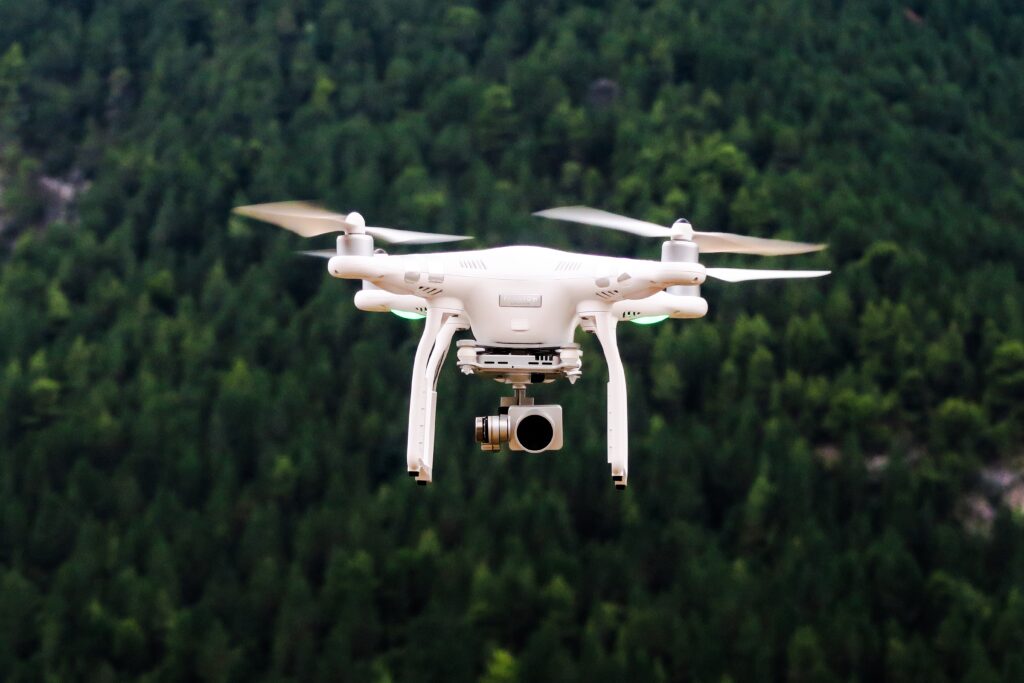
Ukraine gets more drones, production capacity, and a broader European market. The Union gets to build a counter-drone base and to bind Ukraine’s innovation to European industry.
The Commission officially launched the EU-Ukraine Drone Alliance during the third EU-Ukraine Defence Industry Forum in Kyiv. The purpose of the deal which saw the light of day on 17 July is to improve the security of both sides and strengthen Europe’s overall capacity in this area. ,
The Alliance will help the EU and Ukraine work more closely on developing drones and systems to stop hostile ones. It forms part of wider EU efforts to strengthen Europe’s defence in a fast-changing area.
Joint ventures, joint production
The Alliance brings together companies, start-ups, researchers, armed forces, and other users from EU countries and Ukraine. Its core goal is to support a strong drone industry, encourage new counter-drone technologies, and build Europe’s overall capacity. The Commission says the Alliance now begins to implement the Drone Deal that President Ursula von der Leyen announced in Kyiv on 15 July.
The Deal will build joint ventures between Ukrainian and European companies. It will also accelerate the development and production of next-generation drones and counter-drone systems. That serves two purposes: meeting Ukraine’s needs now, and improving Europe’s defence readiness later.
The first practical step is organisational. The Commission is preparing the first meeting of the 18 founding members, due in Brussels in September. Those members came through an open call for expressions of interest, with a deadline of 25 May 2026.
EU founding members include ORQA d.o.o., Indra Group, Fincantieri, WB Electronics/WB Group, Destinus, Delair, RSI Europe, TERMA A/S, and Quantum Systems. Ukraine contributes LLC Skyfall Industries, LLC Greentech Harvest, LLC Tencore, LLC Deviro, LLC Vyriy Industry, Scientific Production Company “ATHLON AVIA” LLC, LLC TEHAVTOFART PIVDEN (TAF Industries), UFORCE, and F-Drones.
A model for other weapons
The Commission frames the Alliance as a mechanism for speed. The Drone Deal will bring together Europe’s industrial capacity and Ukraine’s expertise in drone innovation. It will provide a European framework to encourage further national deals, and then funding to scale up joint production and orders.
The Deal also reaches beyond drones. The Commission says it should serve as a model for scaling up battle-proven capabilities in other areas—including ballistic and anti-ballistic missile systems—and for working across the wider defence supply chain. It combines Ukraine’s battlefield-tested capabilities with Europe’s industrial strength and manufacturing scale.
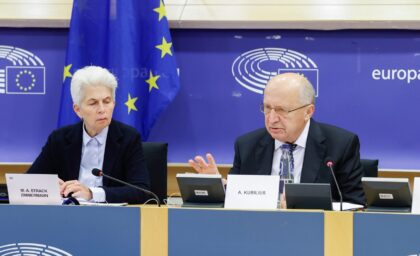
As Russia is scaling up its drone production volumes, we should augment our joint efforts as well. — Andrius Kubilius, EU defence commissioner
The political timing is deliberate. President von der Leyen first announced the Alliance in her State of the European Union speech in 2025. The Commission now describes it as a key deliverable of the Joint Communication Preserving Peace – Defence Readiness Roadmap 2030, published in October 2025, and of the Action Plan on Drone and Counter Drone Security of February 2026.
Money already moving
The Alliance also connects to money already in motion. The Drone Deal follows a €1bn disbursement to support Ukraine’s drone capabilities under the €90bn Ukraine Support Loan. It also follows an earlier €3.9bn tranche dedicated to drone procurement.
Defence Commissioner Andrius Kubilius explained the reasoning behing the move. “Without any delay, we start to implement recently announced EU-Ukraine Drone Deal. EU and Ukraine drone and counter-drone producers will start their work to jointly amplify our efforts in drone development segment. As Russia is scaling up its drone production volumes, we should augment our joint efforts as well,” he said.
That captures the Alliance’s real-world purpose. It is not a think-tank exercise. It connects procurement, production, and battlefield demand in one framework. The Commission says the Alliance should help Ukraine keep its current capabilities, while helping Europe catch up in a field where speed matters. The question is whether the Alliance can turn the framework into joint ventures, faster production, and usable systems at scale.