Merz and Macron push to sideline Kaja Kallas. An old power struggle between the two heads of European foreign policy—the Commission versus the diplomats—tilts the former’s way.
France and Germany have publicly called for options to restructure the EU’s diplomatic service (EEAS) by the end of the year, demanding a rapid timetable to emphasise the need for the bloc to have “strong and better” foreign action. The irony is sharp. The capitals that helped design a hybrid EEAS are now complaining that the structure does not deliver the speed and coherence they want.
When the European External Action Service came into being in 2010, it was a political compromise dressed up as institutional progress. Council Decision 2010/427/EU placed the new body under the High Representative, but tethered it simultaneously to the European Commission and to member-state capitals. The result was a hybrid body with a double chain of command. Now, sixteen years on, the powers that designed that hybrid say the double-headedness is the problem, and they want it fixed, fast.
A hybrid of their own making
The EEAS operates like a shared EU foreign ministry of sorts. Its head, High Representative and Vice-President Kaja Kallas, reports to both the European Commission and the bloc’s capitals. That dual accountability was always a recipe for friction. Today, the friction has become a crisis.
The 2013 “EEAS 2.0” academic review already labelled the governance model “unsustainable”, identifying the Service’s hybrid chain-of-command and budgetary dependence on the Commission as structural weaknesses. That was thirteen years ago. No serious reform followed. The complaints on record today, duplication, slow decision-making, incoherent crisis response, are the same complaints that went unaddressed then.
The capitals are unhappy to see the EEAS’s failure to co-ordinate effective responses to recent geopolitical crises. These abound: wars in Ukraine and Iran, the whims of US President Donald Trump, and the increased use of economic coercion as foreign policy tools. Paris and Berlin have privately discussed drastic action to reform the service’s functions and powers. The discussions include shifting certain EEAS powers to the Commission outright.
“With the geopolitical developments we are facing, Germany and France emphasise the need to reform the EU’s internal set-up for external action, to allow for stronger, swifter and more co-ordinated EU responses at the international level,” the two capitals said in a joint statement following intergovernmental consultations. The EU’s two largest economies called for EU leaders to use a summit in October to formally request a study of potential remedies “by the end of 2026.”
The Kallas question
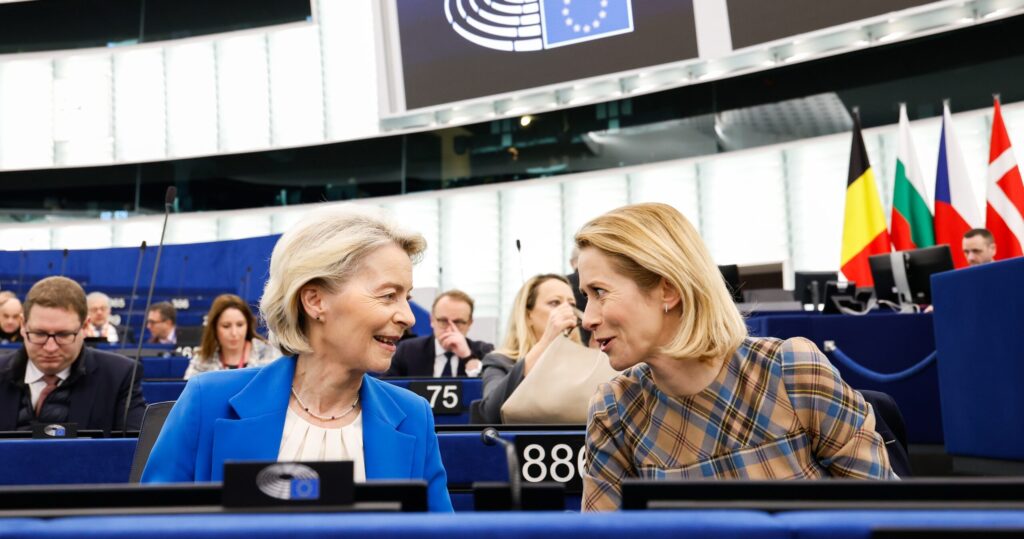
The picture of the reform debate would not be complete without its protagonist. Ms Kallas, former Estonian prime minister and now the EU’s top diplomat, has drawn criticism from several capitals for what they privately describe as an overly hawkish posture. French President Emmanuel Macron and German Chancellor Friedrich Merz have occasionally met with Russian envoys against Ms Kallas’s advice. They have also accused Brussels of lacking strategic flexibility in its approach to Moscow.
Yet the picture is more complicated than a simple leadership purge. The option papers circulating among member states also propose scenarios that could strengthen the High Representative by giving the post authority over geo-economic tools. This may provide proof that the exercise is not purely about sidelining one person. Personal politics clearly colour the debate, but the proposals address genuine institutional bottlenecks identified for more than a decade.
Ms Kallas herself has not retreated. In an internal email to EEAS staff addressing the reform calls, she said: “I welcome this debate . . . we also all know that the system could work better.” She has also said EU foreign ministers will discuss the future of the EEAS at an informal meeting in Ireland in September. The Franco-German timeline proposal was in part designed to ensure that discussion was not just a one-off and would lead to formal reform proposals.
The legislative machinery
Amending the EEAS requires only a new Council decision adopted by qualified majority after consulting Parliament, and no treaty change is needed. That is a lower bar than many assume. Draft multi-annual framework and external-action regulations applying from 2028 already contain an ‘EEAS clause’ that must be aligned with any forthcoming reform, under Council document 11758/25.
The likely path runs as follows. The Commission and the EEAS will table a non-paper in autumn 2026, mapping which reforms require a new Council decision amending 2010/427/EU, adjustments to the 2028-34 external-action budget under the Global Europe instrument, and changes to the staff regulations requiring co-decision with Parliament.
I welcome this debate . . . we also all know that the system could work better. — Kaja Kallas, head of the EEAS
A member-state working group under the Foreign Affairs Council will then negotiate text in 2027. A qualified-majority vote is legally possible, but unanimity remains politically advisable. The European Parliament will scrutinise in parallel, and MEPs have previously leveraged budgetary powers to extract accountability concessions, as they did in 2010 and 2013.
“This should comprise the role and the institutional set-up of the relevant EU institutions and bodies, including the HRVP, the Commission and the EEAS,” the Franco-German joint statement adds. That formulation is deliberately broad. It leaves open the most radical option, folding most EEAS functions into the Commission, while providing political cover for a more modest outcome.
Institutions and humans
Several questions remain open. Will the Franco-German paper attract enough support to become a consensus package, or will medium-size states, Italy, Spain, and Poland, resist any format that concentrates power among the largest members? Could the Commission seek to absorb parts of the EEAS without a formal merger, exploiting its budgetary leverage? And will Ms Kallas’s mandate, which runs to late 2029, give her enough time to demonstrate that the current structure can deliver, before the reformers make their case irreversible?
The tension between the Commission and the diplomatic service reached a sort of climax last November. Ms Kallas then failed to push through the appointment of Martin Selmayr, a powerful Brussels éminence grise, as her right-hand man. (Never mind the official title of deputy secretary-general for geoeconomics and interinstitutional issues.) Ursula von der Leyen, European Commission president, blocked the move, sending Mr Selmayr to Vatican, the EU equivalent of Saint Helena. Ms Kallas’s position has been precarious since then.
The current push to overhaul the EEAS combines structural reform logic with leadership rivalries. A future High Representative from a larger member state would be equally constrained by the same reform tracks. How Paris and Berlin sell their initiative to the wider EU-27 will decide whether the outcome is seen as a move against an individual or as a long-overdue modernisation of EU diplomacy. The latter, by the EU’s own admission, should have happened more than a decade ago.