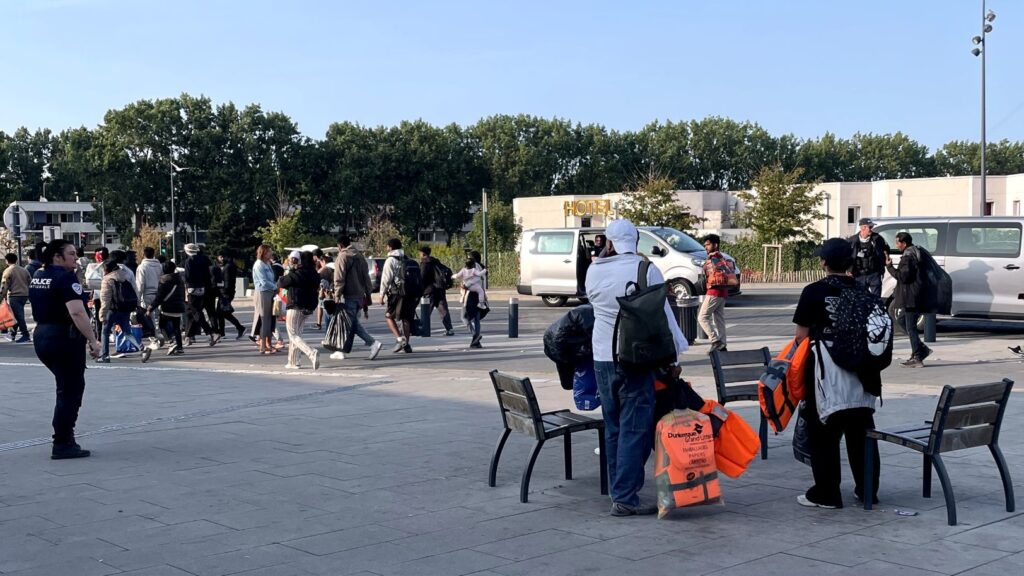
Thousands of migrants still arrive in Calais, France: the last stop before embarking on another journey, out of the EU, towards the United Kingdom. The “one in, one out” scheme launched by Paris and London a year ago was designed to curb these crossings. Yet the route remains one of Europe’s most contested migration challenges, with Brussels now stepping up its role.
On the eve of the last Council meeting, on June 16, the EU presented a Plan for the Channel migration route, which is part of the new EU Pact on Migration and Asylum. To date, Frontex, the European Border and Coast Guard Agency, is already starting to increase its presence on both coasts.
The history behind
Although the United Kingdom has been funding France for thirty years to minimise departures from its shores, the scale of the support has expanded significantly over the past decade. Since 2014, the British have paid France millions of euros: from approximately €15 million initially allocated to €209 million planned for 2026–2027.
On April 23, French Interior Minister Laurent Nuñez and British Home Secretary Shabana Mahmood signed a new agreement aimed at extending British funding to northern France.
The new agreement will last three years, from 2026 to 2029, and effectively extends the Sandhurst Treaty, signed in 2018 and renewed in 2023. London has also agreed to an increase in funding and is expected to soon pay France €766 million.
Compared to the previous treaty, there are some changes: the funds will not only be used for coastal control and vessel departures, but also to finance the building of a new administrative reception center (CRA).
Currently under construction, the CRA will become one of the largest in Europe. The new center will house everything from administrative offices for police to a branch of the Dunkirk court dedicated exclusively to migrant cases.
A tougher border policy
The funding is seen by French humanitarian organisations as a step forward in anti-migration policies on the north coast. “This is not a simple continuation of existing policies: this agreement marks a clear tightening, the consequences of which will be dramatic. Governments have consciously chosen to put even more lives at risk,” denounces the association Utopia 56 Calais.
Several French NGOs are reporting an intensification of police actions on the coast following the “one in, one out” agreement signed between France and UK a year ago. In other terms, migrants that arrive illegally by small boats to the UK can be sent back to France. In return the UK will take the same number of migrants from France who have not tried to cross the Channel before and pass security and eligibility checks.
Indeed, violent interceptions, continuous expulsions, and arrests have pushed some people to change course and leave from Belgium. Humanitarian sources have confirmed a shift in departure points. The Belgian coast bordering France, in the past often used as a storage area for boats and other equipment needed for the crossing, has seen more attempts to launch journeys. Other departures have been reported from the Flemish coast, much further from the United Kingdom, as well as from Normandy region of France.
France vs. EU
French Minister for Citizenship Marie-Pierre Vedrenne stated at a Home Affairs Council in June that the Channel crossings must be a European challenge. “We are talking about an external border of the European Union” and therefore “we must have European discussions”, she said. Her counterparts acknowledged that these irregular migration flows remain difficult to manage and continue to draw people towards the EU’s external border with the United Kingdom.
As it stands, the EU plan does not provide funding or economic assistance for border countries: a point that could concern France, which, without such financial assistance, would find itself managing the phenomenon solely at the national level.
Meanwhile, France is pursuing what it calls a “zero point of fixation” policy: migrants’ lives must be devoid of any lasting stability. As a result, tents in Calais, Dunkirk, and Grande-Synthe are dismantled and removed by police every 24–48 hours, water sources are damaged, and food distribution is limited.
For now, the EU will strengthen operational capacity at the borders between the United Kingdom and the most exposed member states. The aim is to “improve situational awareness, information sharing and operational cooperation”. The measures include reinforcing Europol’s European Migrant Smuggling Centre and the UK–France Joint Intelligence Cell in Calais. Frontex personnel and equipment will also be deployed along the English Channel and North Sea borders.
To date, what remains, however, is the precariousness of migrants’ lives between France and England.