The race for autonomous driving may not find its first winners on Europe’s motorways or America’s highways. It may be won in the car park.
Low-speed manoeuvres such as automatic parking are becoming a key proving ground for software-defined vehicles. The Chinese automotive industry touts them as a testbed for artificial intelligence, data, and over-the-air updates.
The logic is straightforward. Low-speed autonomy allows car manufacturers to test, validate, and commercialise automated driving functions in simpler conditions than high-speed road environments. That is one reason parking has become a useful proving ground for software-defined vehicles, where sensors, code, artificial intelligence, and updateable features increasingly determine a car’s value.
Europe’s early lead stalls
The market reflects the interest. According to Mordor Intelligence, the global market for automated parking systems is likely to grow from $3.2bn in 2026 to more than $10.7bn in 2033. Modern parking technologies include park assist, remote parking, and automated valet parking — a Level 4 autonomous transport service that allows a driver to drop off a car at a pickup location and order it to park via an app.
Western carmakers moved first, but have struggled to follow through. At the end of 2024, Mercedes-Benz and Robert Bosch ended their two-year automated valet parking partnership. The technology had been offered at Stuttgart Airport’s parking garage to owners of Mercedes S-Class and EQS models equipped with the Intelligent Park Pilot. Mercedes claimed the project had achieved the world’s first certification of a Level 4 system for highly automated parking in a series production car.
The company also stated that automated driving and parking remained a key business area, and that development of those systems would continue. Yet the end of the partnership points to a larger problem for Western carmakers: certified technology does not guarantee mass acceptance. Even after years of development, these systems have yet to fundamentally change how most people park.
Western companies have focused mostly on highway autonomy, where technical, regulatory, and safety challenges are greater. Chinese competitors have taken a different path. They focus on urban use cases that can provide immediate value to the end user.
Chinese brands push further
According to SBD Automotive, brands such as Xpeng, Nio, BYD, and Seres Group’s Aito already use advanced parking systems, with Huawei a supporting investor. They do not just assist with parking; they let the car take over completely. “This represents a fundamental shift in a driver’s role from monitoring the automated manoeuvre to simply delegating the whole parking process to the car,” said Varun Krishna Murthy, consulting manager at SBD Automotive.
That shift changes the consumer promise of automation entirely. According to transport experts, Chinese brands are moving faster because they see parking as a piece of clever software, rather than a convenience function.
“The future of automated driving may not be shaped solely by what happens at highway speeds. Some of its most meaningful competitive advantages could emerge at walking pace,” Mr Murthy said.
From memory parking to crab walk
Chinese parking systems are also spreading beyond the local area. Nio’s memory parking can learn a route to a location—a home garage or office car park—and repeat it as necessary. Its super remote parking allows users to park or retrieve the car with their smartphone.
Denza, owned by BYD, markets a system called ‘crab walk’ in its Denza models, allowing large vehicles using BYD’s E3 platform to move diagonally and pivot-turn using four-wheel steering. The system was designed for densely packed urban parking spaces, where customary parking manoeuvres can be difficult.
This represents a fundamental shift in a driver’s role from monitoring the automated manoeuvre to simply delegating the whole parking process to the car. — Varun Krishna Murthy, SBD Automotive
Zeekr, the premium electric car brand owned by the Geely Group, uses both high-precision and low-precision sensors to park perpendicularly in ultra-narrow parking spots where car doors can barely open. These examples illustrate how parking has become an arena for visible, everyday software innovation.
The wider supply chain
Major automotive suppliers such as Bosch, Valeo, Aumovio, and Aptiv are accelerating the development of end-to-end automated parking systems, according to analyst Market Intelo. The market for advanced sensor fusion is expanding, combining lidar, radar, and camera sensors. The price has dropped by 35 to 40 per cent over the previous three years, while the detection rate exceeds 99 per cent, Market Intelo reported. That could help parking automation move from a premium product to a more common one.
Parking may seem less dramatic than autonomous motorway driving, but it is commonplace, stressful, and highly visible to drivers. It is also one domain in which automakers can test automation in a controlled environment where fully autonomous highway systems do not yet exist.
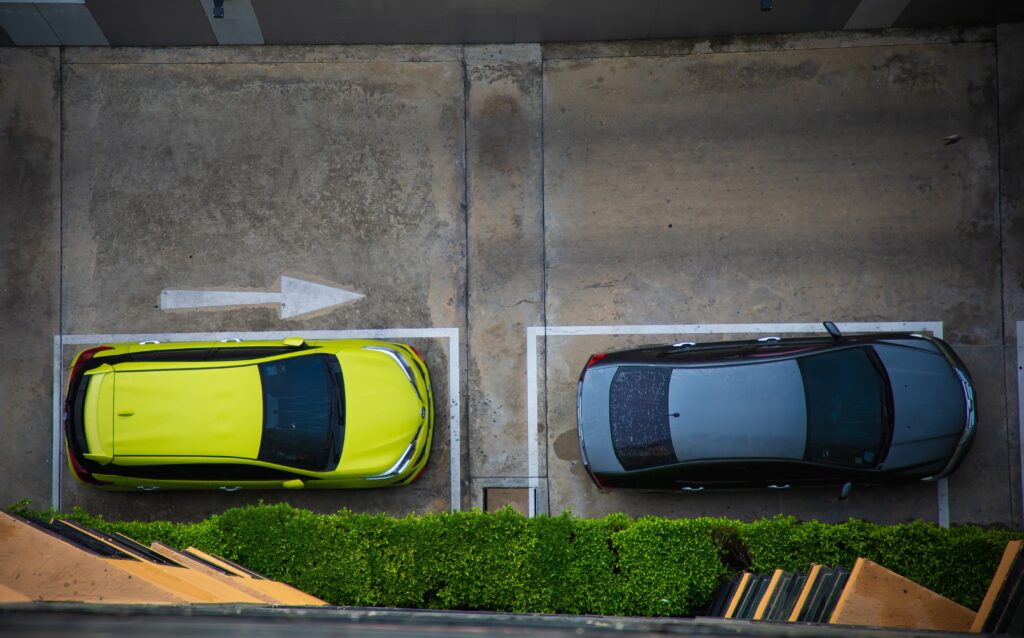
Chinese brands are turning that confined space into a software battleground. The use of artificial intelligence and over-the-air updates makes one of the most ordinary driving tasks a point of competitive differentiation. The next major step in autonomous driving may not come at speed, but between two white lines in a crowded city car park.