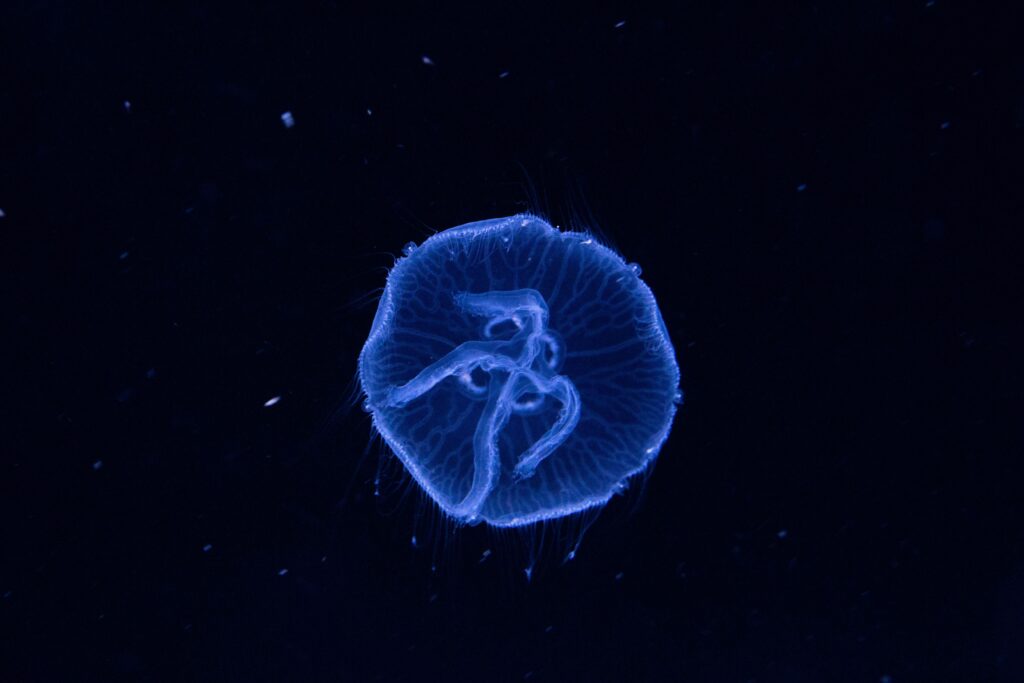
For the second year running, a swarm of jellyfish knocked out Western Europe’s biggest nuclear plant. Gravelines in northern France lost most of its output overnight as the creatures clogged its cooling pumps. Warmer seas mean this is starting to look less like a fluke and more like a pattern.
Three of Gravelines’ six reactors switched off automatically on 10 August, after tonnes of jellyfish filled the intake filters that draw seawater into the plant for cooling. A fourth reactor ran at half power, leaving just one of six units at full capacity, while a sixth was already down for scheduled maintenance. Gravelines, near Dunkirk on the English Channel, features six 900-megawatt reactors making it Western Europe’s largest nuclear plant.
Électricité de France (EDF), which operates the site, said the shutdown created no safety risk for the facility, its staff, or the environment. The closure fell on exactly the same calendar date as a similar swarm that knocked out the plant a year earlier, a coincidence that suggests this is becoming a fixture of French summers rather than a one-off. It came a day after France recorded a nuclear shortfall of 15.6 per cent on 9 August, according to AFP calculations based on EDF data, following weeks of heat and drought related reactor curtailments in June and July.
An unwelcome yearly ritual
Scientists say warming seas are making these swarms more frequent and harder to predict. Marine heatwaves along the Atlantic coast and in the Mediterranean have repeatedly broken records this year, with sea temperatures in June and July running as much as 6°C above normal in places. Jellyfish, unlike fish or coral, tend to thrive rather than suffer in these conditions.
Species that struggle when water gets too warm or short of oxygen do not trouble jellyfish, which tolerate both. They also benefit when overfishing removes their natural predators. That combination lets them bloom in exactly the conditions that put other marine life under strain, turning a warming sea into a jellyfish friendly one.
The EU’s own climate monitoring confirms the trend. Copernicus, the EU’s Earth observation programme, found that the first half of 2026 was the third warmest half year on record for the Mediterranean, with 80 per cent of the sea experiencing strong to extreme marine heat between January and June. Researchers with the World Weather Attribution project separately concluded that this year’s ocean heat would have been almost impossible without man-made climate change.
France is not alone in facing this problem. Coastal power plants elsewhere in Europe have suffered similar jellyfish driven shutdowns before, including a three day closure in Sweden in 2013 and repeated incidents at a plant in Scotland. As European summers grow hotter, more of the continent’s coastal infrastructure could face the same test.
Energy security under strain
For a continent already stretched by summer demand, the timing could hardly be worse. France typically supplies both itself and neighbouring countries with nuclear generated electricity during peak periods, and interruptions ripple across the interconnected European grid just as air conditioning use peaks.
The Gravelines closures followed weeks of heat and drought driven curtailments elsewhere in the French fleet, adding to questions about how resilient nuclear power, often promoted as a stable, low carbon backbone of the EU’s energy mix, actually is against a warming climate. Coastal reactors depend on a steady supply of cool seawater, a resource that becomes less reliable exactly when demand for electricity is highest.
The reproductive window is getting wider and wider. — Derek Wright, US National Oceanic and Atmospheric Administration
Scientists tracking the trend point to the same underlying cause. Rising sea temperatures are giving jellyfish more time and better conditions to reproduce. “The reproductive window is getting wider and wider,” said Derek Wright, a marine biologist with the US National Oceanic and Atmospheric Administration (NOAA). For a plant such as Gravelines, built decades before anyone worried about jellyfish blooms, adapting to that widening window may prove far harder than clearing a filter.