Mario Draghi’s new push to revive Europe’s competitiveness agenda is already drawing criticism over who has a seat at the table. Central and Eastern Europe is largely absent from the new Rhine Group, raising questions about whether its recommendations will reflect the economic experience of all 27 member states.
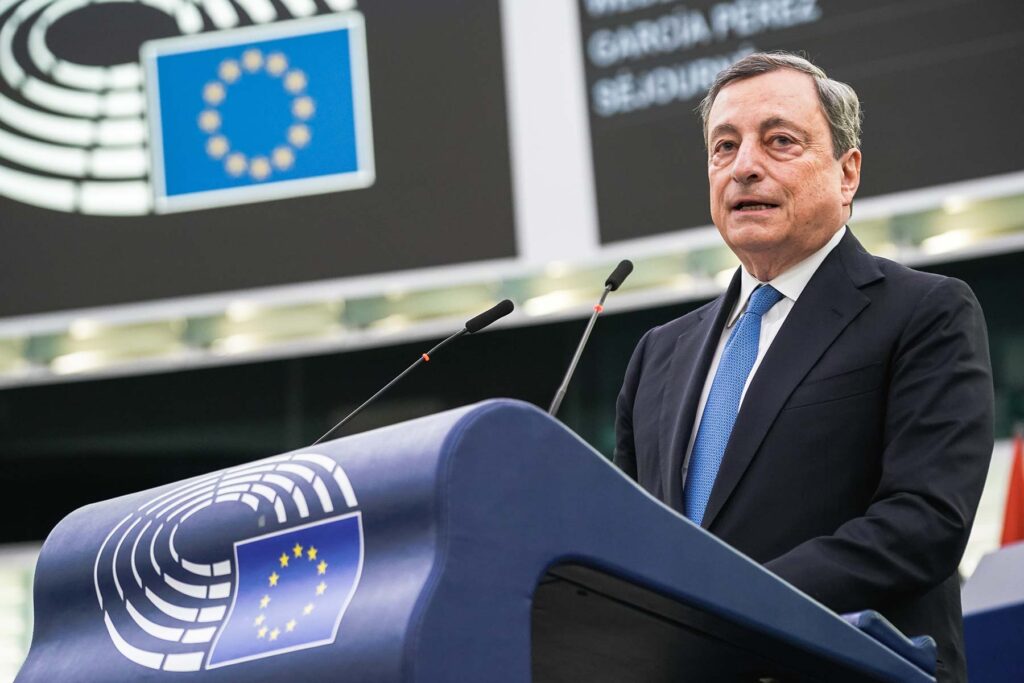
Former European Central Bank president Mario Draghi, author of the competitiveness report that shaped the EU’s economic agenda, has co-founded the Rhine Group, bringing together more than 50 politicians, economists, executives and academics to develop proposals for strengthening European competitiveness.
He co-chairs it with Stripe co-founder Patrick Collison, while LSE economist and former Spanish member of the European Parliament Luis Garicano serves as executive director.
The organisation will operate independently of the EU institutions. “The reform agenda is largely paralysed,” Mr Garicano told El País. Its members therefore plan to commission research, identify priorities, and publish recommendations intended to help the European Commission and national governments implement economic reforms.
Eastern Europe largely absent
The Rhine Group includes economist Philippe Aghion, former French minister Bruno Le Maire, former European Central Bank official Benoît Cœuré, and senior figures from companies including BBVA, Mastercard, Klarna and Shopify.
The focus, however, has quickly shifted from who is in the group to who is missing.
Former Estonian president Toomas Hendrik Ilves appears to be the only member with clear political or institutional roots in Central and Eastern Europe. The published list includes no representative based in Poland and no prominent economists, policymakers or business leaders from Czechia, Slovakia, Hungary, Romania, Bulgaria, Croatia, Slovenia, Latvia or Lithuania. The gap has already drawn criticism from politicians in the region.
Polish economist Marcin Piątkowski has criticised the imbalance and launched the social-media appeal #InvitePoland. He argued that a group examining Europe’s economic future should learn from the transformation of Poland and other countries in the region. “Europe should learn not only from what has gone wrong, but also from what has gone right,” Mr Piątkowski wrote.
He described Poland as Europe’s growth champion since 1990 and argued that competitiveness debates have paid insufficient attention to convergence across Central and Eastern Europe.
Poland illustrates regional convergence
Central and Eastern Europe (CEE) continues to trail western and northern Europe on several measures of income, investment, and innovation. Nevertheless, many countries in the region have recorded sustained economic convergence since joining the EU.
International Monetary Fund (IMF) Managing Director, Kristalina Georgieva, pointed out that Poland had achieved the world’s second-fastest income convergence rate over the previous two decades, excluding financial centres and oil-exporting countries. Polish productivity increased by an average of 3% annually over the period, compared with 1% in the euro area.
Poland is also the only CEE member of the E6, an informal group comprising the EU’s six largest economies alongside Germany, France, Italy, Spain, and the Netherlands. Their finance ministers are already coordinating on competitiveness, capital markets, investment, and defence.
Growth extends across CEE
The CEE growth story extends beyond Poland. Eurostat data show that Romania, Croatia, Lithuania, Bulgaria, and Poland followed steady upward trajectories towards the EU average in GDP per capita between 2015 and 2025. Estonia has developed a substantial technology sector, with more than 10,000 ICT companies, while Czechia combines a strong manufacturing base with one of the EU’s lowest unemployment rates.
“Europe should learn not only from what has gone wrong, but also from what has gone right.”
— Marcin Piątkowski, economist
CEE convergence has been supported by access to the single market, cohesion funding, foreign investment, competitive production costs, and integration into western European supply chains. As these cost advantages narrow, the region faces the same questions of domestic innovation, investment, and higher-value production addressed by Mr Draghi’s agenda, making its experience relevant to the wider competitiveness debate.
Group targets implementation gap
The Rhine Group builds on Mr Draghi’s influential 2024 competitiveness report, which connected Europe’s productivity problems with fragmented markets, insufficient investment, high energy costs, and slower technological development.
The Commission incorporated its main priorities into the Competitiveness Compass, covering innovation, industrial decarbonisation, and external dependencies. The report has also influenced EU initiatives on capital markets, business regulation, state aid, and strategic investment. However, translating the agenda into legislation and coordinated national reforms has proved more difficult.
The Rhine Group therefore intends to translate the broader recommendations into priorities capable of gaining political and institutional support. Its members will meet at least once a year to agree on the questions they want researchers to examine.
Not the first time
Concerns about geographical representation also followed the publication of Mr Draghi’s original report. A European Law Blog analysis argued that CEE experts, governments, and businesses had played only a limited role in its preparation.
According to the analysis, Estonian technology company Bolt was the only CEE business among the companies consulted. It contrasted the process with that of former Italian prime minister Enrico Letta, who consulted governments and policymakers across the region while preparing his report on the single market.
The Rhine Group’s composition therefore risks reinforcing an existing perception that European economic strategies are developed predominantly through western European professional networks, even when they are intended to address the needs of all 27 member states.
The organisation has no formal legislative authority. Its composition nevertheless matters because the experiences represented within the group could influence which problems receive attention and which solutions appear politically or practically realistic.