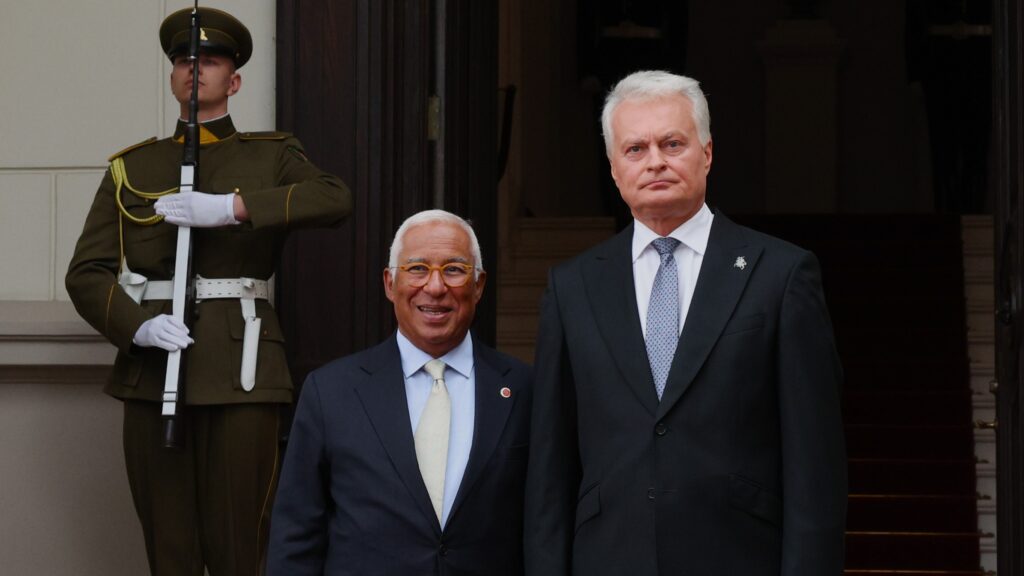
On the EU’s eastern flank, Russia’s war against Ukraine is measured not only in security risks, but in money too. Higher defence costs and the need to protect critical infrastructure must therefore be reflected in the EU’s next budget, president Gitanas Nausėda told António Costa during his visit to Lithuania.
The Lithuania’s head of state stressed the need for long-term military and financial support for Kyiv. Mr Nausėda spoke from the position of a country on the very eastern edge of both the EU and NATO. European Council President António Costa backed his message, calling Lithuania an “expert” on the security threats facing Europe’s eastern flank.
Europe must not tire of supporting Ukraine. On the contrary, we need to do more now. — Gitanas Nausėda, President of Lithuania
The visit was another stop on Mr Costa’s annual Tour des Capitales, during which the European Council president visits member states ahead of key autumn negotiations. After Slovakia and Estonia, he arrived in Vilnius on Wednesday, from there he will continue to Latvia. On Thursday, he will wrap up the first leg of his tour in Prague.
When war is not a distant crisis
Mr Nausėda’s message to Mr Costa focused largely on Ukraine and the security situation on the EU’s eastern flank. Lithuania is geographically and strategically far closer to the war than member states at the other end of the bloc.
The country shares borders with Russia’s Kaliningrad region and Belarus, a close ally of Moscow. Vilnius therefore does not see Russia’s war against Ukraine simply as a conflict taking place somewhere beyond the EU’s borders. It sees it as part of the wider security environment in which Lithuania itself operates.
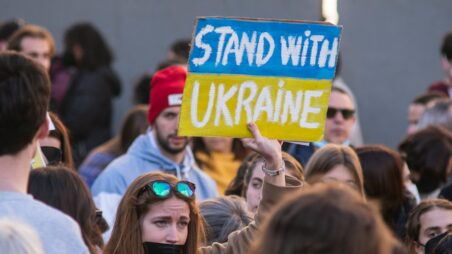
“Europe must not tire of supporting Ukraine. On the contrary, we need to do more now,” Mr Nausėda said. He argued that the EU must provide Ukraine with sufficient long-term financial and military support. He put particular emphasis on strengthening Kyiv’s air defence and keeping pressure on Moscow.
Mr Nausėda also called on the EU to adopt the 22nd package of sanctions against Russia as quickly as possible. It should target sectors that fund Russia’s war machine, he said, including energy, the financial system and the so-called shadow fleet.
Costa: Lithuania is an “expert” on eastern-flank threats
Mr Costa echoed the President Nausėda’s view, appreciating his country’s experience. “The geography makes Lithuania a real expert in dealing with security challenges of the European Union’s Eastern flank and the Baltic Sea region,“ he said.
Hybrid threats and drone incursions into European airspace show how important EU preparedness has become, including air defence and border protection, Mr Costa noted. Such threats cannot be tackled by individual countries alone. “They require coordinated action at the European Union level,“ he stressed.
EU should be ready for a joint response to hybrid threats by 2030, with member states, the European Commission and other EU institutions working towards a common approach, he added.
Security must also shape the EU budget
The security debate in Vilnius naturally tied into the main focus of Mr Costa’s tour this year: the EU’s long-term budget for 2028–2034 (MFF).
Council President repeated what he had stressed a day earlier in Tallinn: an agreement on the new MFF must be reached by the end of this year. The next budget must reflect Europe’s radically changed circumstances and give greater weight to defence, security, competitiveness and strategic resilience.
President Nausėda stressed that, for eastern member states in particular, the new situation comes with very real financial costs. “It is particularly important for Lithuania that the future budget reflects the completely new security landscape,“ he said.
The EU’s eastern states are facing the direct economic and security fallout from Russia’s war, according to Mr Nausėda. They therefore need to invest more in protecting critical infrastructure and counter ongoing hybrid attacks.
At the same time, he rejected the idea of funding new security priorities at the expense of the EU’s traditional policies. “New challenges of the EU cannot be addressed by weakening what has strengthened Europe for decades, such as cohesion, common agricultural policy and the competitiveness of our countries,“ he said.
The next EU budget will look different
Mr Costa agreed with the principle. But he said Europe would need a new way to fund both its traditional policies and its new ambitions. “The next budget must reflect the demands of the challenging times we live in — and must have competitiveness, industrial transformation, defence, security, and strategic resilience at its heart,“ he said.
Cohesion policy and the Common Agricultural Policy will remain important pillars of European development, he added. At the same time, the next MFF will look significantly different from previous EU budgets, both in its structure and priorities.
Those new priorities, however, will require new sources of funding. Mr Costa therefore again stressed the importance of finding new sources of funds for the EU budget. “All this, we must finance within the limits of finite resources,“ he said. “That is why a balanced and ambitious package of so-called new own resources (…) will be an essential part of an overall agreement.“
Lithuania says Ukraine’s future lies in the EU
Lithuania also links its security concerns to Ukraine’s future EU membership. Mr Nausėda called for faster progress in accession talks with both Ukraine and Moldova. Vilnius wants the EU to open talks on the remaining four negotiating clusters with Ukraine by the end of this year.
Ukraine, Moldova and the Western Balkans are progressing on their paths towards the EU, and it’s the best investment we can make in the future peace, security and stability of our continent. — António Costa, President of the Council of the EU
“Ukraine’s future lies in the European Union,“ the Lithuanian president said. Mr Costa described enlargement to include Ukraine, Moldova and the Western Balkan countries as the “best investment we can make in the future peace, security and stability of our continent”.
Vilnius takes over the EU presidency in January
From January 2027, Vilnius will have a more direct say in the debate. Lithuania will take over the rotating presidency of the Council of the EU from Ireland. Mr Costa praised Vilnius’s preparations for the presidency and said its priorities align with the EU’s strategic goals. “Lithuania will play a decisive role in creating and shaping European unity,“ he said.
Mr Nausėda listed European security and defence, comprehensive support for Ukraine and EU enlargement among Lithuania’s main priorities. He also highlighted competitiveness, preparations for hybrid threats and protecting the EU’s external borders.
The EU must learn not only how to respond to crises, but also how to prepare for them, he said. Airspace violations, GPS jamming, critical-infrastructure sabotage and the weaponisation of migration are no longer isolated incidents. They have become a permanent feature of Europe’s security environment.
Costa heads to Prague
Vilnius was the third stop on this year’s Tour des Capitales. Mr Costa began in Slovakia, where he held talks with Prime Minister Robert Fico, before travelling to Estonia to meet Prime Minister Kristen Michal. In Tallinn, he also stressed that the next EU budget must respond to the security challenges facing Europe’s eastern regions.
Mr Costa will conclude his visit to Baltic states in Riga, where he is due to meet Latvian Prime Minister Andris Kulbergs.
On Thursday, Costa will continue to Prague. He will meet Czech Prime Minister Andrej Babiš to discuss the EU’s 2028–2034 long-term budget, competitiveness, the fight against irregular migration and further EU enlargement.