Nine years after the assassination of the investigative journalist Daphne Caruana Galizia, Malta is still struggling to answer the basic questions: who ordered her murder, and how to safeguard media freedom.
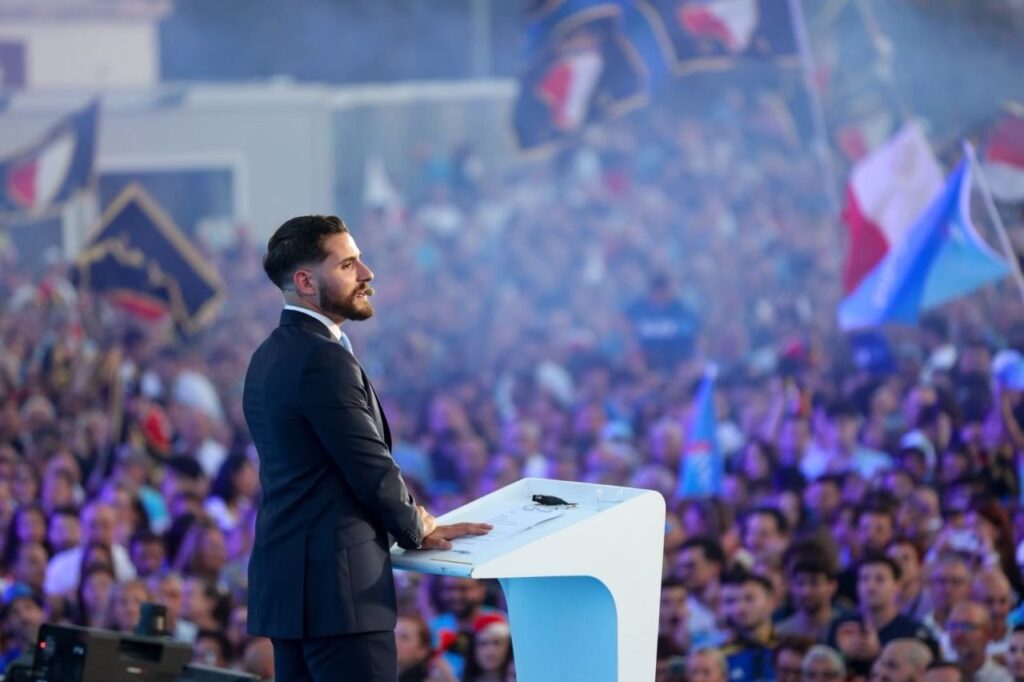
In an interview with EU Perspectives, opposition leader Alex Borg argues about the link between the fight for justice and a broader battle over media freedom. The latter, says the leader of Malta’s opposition Nationalist Party (PN) affiliated with the European People’s Party (EPP), includes a range of sub-topics, such as the protection of journalists, source confidentiality, and the independence of the media from political power.
The acquittal of businessman Yorgen Fenech a forthnight ago (of charges of criminal conspiracy and complicity in Galizia’s murder) has renewed concerns over impunity, institutional failures, and the safety of journalists in the EU’s smallest member state. Roberta Metsola, the Maltese President of the European Parliament wrote after the verdict that the EU “will not surrender, and we will not give in” (in its struggle to right the wrongs).
What does this verdict mean for Malta’s political class?
Today, nine years after the assassination of Daphne Caruana Galizia, we have no justice. The masterminds behind the assassination are still on the loose. No one has obviously gone behind bars for this homicide.
Five years ago, we had a public inquiry. It gave several recommendations to enhance and strengthen the institutions and their independence. But unfortunately, these recommendations have not seen implementation. In fact, just after the verdict of the jury, I immediately called—as the opposition leader of Malta—on the speaker to convene the Parliament urgently in order to discuss the situation. We also tried to propose a motion to implement the recommendations of the public inquiry.
Robert Abela’s Partit Laburista government didn’t accept our motion to discuss it. And obviously, now we’re still without the implementation of the recommendations. What Malta needs at the moment is two major things: reform, partly through the recommendations of the public inquiry, and justice. Until justice is served and the (murder) masterminds are actually brought to justice, this chapter, unfortunately, will not be closed.
Malta has to do “something”, especially on the reforms and justice system. How?
Reforms start from the recommendations. We have touched several things with regards to a functioning democracy. We need stronger protection for journalists, greater transparency (on the relationships) between politicians and big business, proper regulation for lobbying, stronger rules against abuse of office and obstruction of justice, better access to public information, and stronger safeguards against excessive political influence over institutions.
The inquiry also proposed the recognition of journalism through the constitution, Malta’s highest law, as a pillar of democracy. It recommended to strengthen mechanisms specifically designed to protect journalists from threats. The inquiry made several recommendations with regards to anti-SLAPP measures. (Editor’s note: SLAPP, or Strategic Lawsuit/Litigation Against Public Participation is a baseless lawsuit by powerful entities to silence critics by burying them in high legal costs and lengthy court battles.)
We have transposed a European directive on SLAPP, but in several domestic cases, journalists are still at risk. So there’s still much more we need to do in order to make sure that our journalists are safe. That they are at liberty to investigate and function properly without any interference or outside influence.
Back then, Caruana Galizia wrote on her blog: “I advise young people to leave Malta, if they can, before it is too late. (… Go) where politicians and their corruption are not constantly in front of your eyes, and where the rule of law works.” If she is correct, how can Maltese journalists be safe?
We need to see political will to bring reform. The reform then brings with it more trust in politicians and institutions. I believe that when people see this episode in Malta they slowly start losing trust in their politicians and in their institutions.
We called for an urgent convening of our Parliament and issued a deadline to the government to implement the recommendations of the public inquiry by the end of October. If the government doesn’t implement it by the deadline, we will present a so-called omnibus — a bill which amends several laws across the board. We will present it in the Parliament at the first opportunity that the opposition has to present a private members’ bill.
Other than that, we are also following everything that is happening with in connection to the investigations on Caruana Galizia. Following the jury’s verdict, the judge explicitly stated in her sentencing remarks that she would be calling for further investigations into material evidence and witness statements presented during the trial that point to third parties.
We are also following that closely to make sure that everything moves along properly and independently without any political interference or influence. To make sure that at the end of the day, justice is actually served. Nine years after the assassination, we still have no justice. Justice hasn’t been served, and justice delayed is justice denied.
What’s your take on the Media Freedom Act? Do you have any concerns?
Whenever it comes to media freedom, I’m always in favour. More independence and strengthening journalists’ power gives them the freedom to work without interference and without threats.
I’ve also discussed the idea whether Malta should go towards having a self-regulated media agency. So it would be composed of journalists themselves. It cannot be within the power of the government, whoever is in government, because if the government decides about journalists, there won’t be any independence. So we started the discussion. If the journalists get to regulate themselves, I think it gives them much more freedom, much more liberty, much more power in order to be able to investigate properly, investigate without being scared.
I think that this is the discussion that we need to discuss ASAP with regards to editorial independence, the sources of journalists and the protection of sources, and public service media — for example, media ownership or state advertising. All these are crucial for Malta, especially with regards to our state television. We have transposed certain EU directives and regulations, but I believe that much, much more needs to be done in order to make sure that our journalists have their minds at rest, that they can function properly.
I still believe that Malta has a lot of potential and I will not give up on it. We are a European democracy with people who deeply value freedom, justice, and the rule of law. The greatest mistake would be to defend Malta’s reputation by pretending that nothing went wrong. The best way to defend Malta’s reputation is to fix what went wrong.