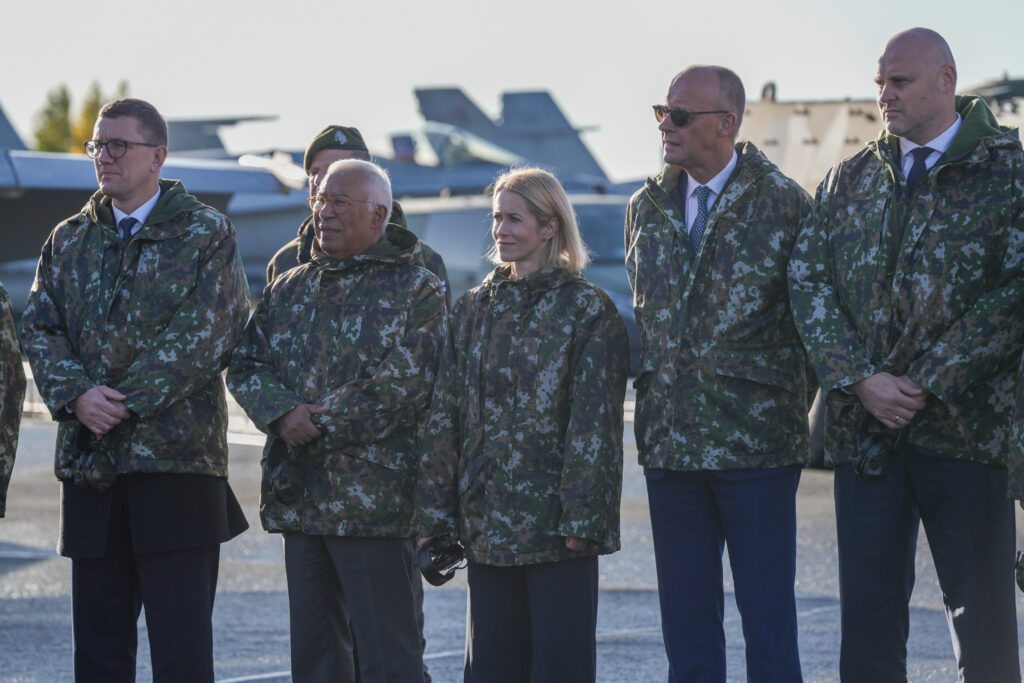
European leaders want a stronger EU security role in the Arctic as Russia expands its military presence. They identified icebreakers, dual-use transport links and space capabilities as priorities, but left decisions on funding to the new Arctic strategy and EU budget negotiations.
“Russia poses the most significant and long-term threat to Arctic security and stability,” Finnish Prime Minister Petteri Orpo said after the first European Arctic Summit in Rovaniemi on Monday. The EU must now treat the region as a “strategic frontier”, he added.
German Chancellor Friedrich Merz struck a similar tone. “High North and low attention is over,” he said. He warned that Russia was strengthening its military capabilities and using its Arctic presence for hybrid operations, and argued that the EU needed to complement NATO’s work.
The summit produced agreement on the threat and on the capabilities Europe lacks. But leaders did not approve a common icebreaker fleet, allocate dedicated funding or set a concrete timetable. Those decisions will depend on the new EU Arctic strategy expected in October and negotiations over the bloc’s 2028–2034 budget.
Morning warnings turn into investment demands
Before the meeting, EU foreign-policy chief Kaja Kallas warned that Russia was reopening former Soviet military bases and conducting missile exercises in the High North. China was also showing greater interest as retreating sea ice opened new maritime routes.
“We have to remain vigilant,” Ms Kallas told reporters. The forthcoming EU Arctic strategy would therefore have “security at its core”.
We definitely need icebreakers. This is not just an issue for Finland, for Norway, for Sweden.This is something for the entire European Union.
— Friedrich Merz, German Chancellor
International Partnerships Commissioner Jozef Síkela said the strategy would combine three priorities: peace and security, economic development and support for local communities. Climate would cut across all three, as the Arctic was warming four times faster than the global average.
The final discussion moved beyond that broad framework. Leaders called for investment in dual-use transport, military mobility, space capabilities, energy infrastructure and critical raw materials. They also supported closer coordination with NATO and Arctic partners outside the EU, including Norway, Iceland, Canada and the United Kingdom.
Icebreakers expose the gap between ambition and money
Finland used the summit to propose a common EU fleet of icebreakers. The ships can keep Arctic routes open and support civilian, commercial and military activity in waters that remain difficult to navigate despite declining sea ice.
“We definitely need icebreakers,” Mr Merz said. “This is not just an issue for Finland, for Norway, for Sweden. This is something for the entire European Union.” He supported developing the capacity jointly.
Russia poses the most significant and long-term threat to Arctic security and stability.
— Petteri Orpo, Finnish Prime Minister
Yet the summit did not decide how many ships Europe required, who would build them or how the EU would pay for them. Finnish shipyards possess extensive icebreaker expertise, but any purchase would remain subject to European procurement rules.
European Council President António Costa said the updated strategy would establish the EU’s priorities before governments considered funding through the next long-term budget. The test will soon be whether Europe puts projects and money behind its new Arctic ambitions.