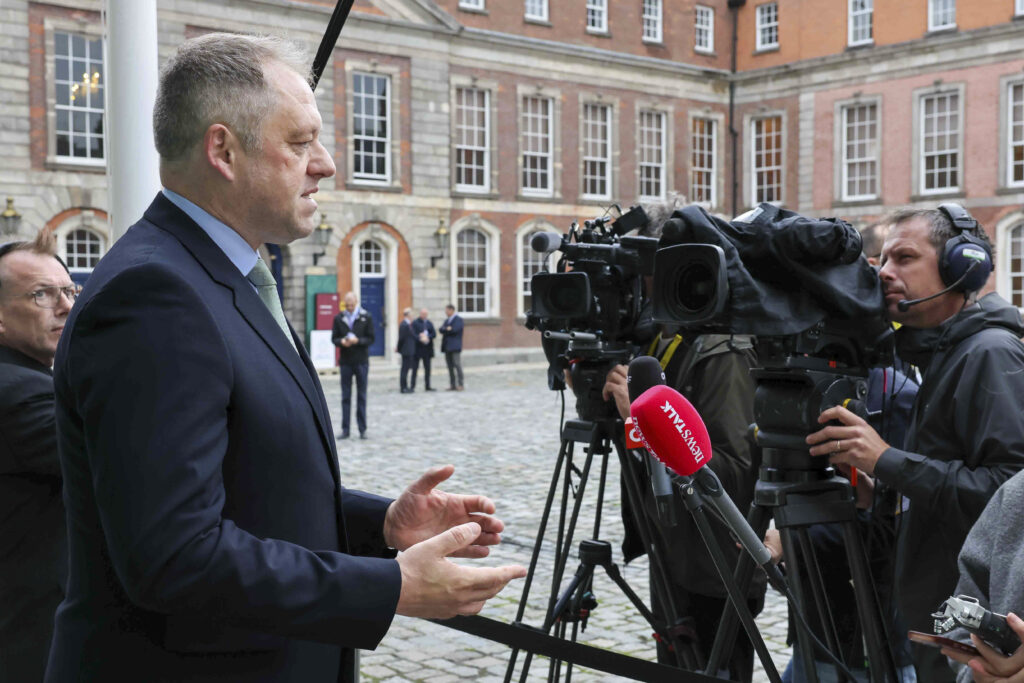
EU governments remain divided over the bloc’s next seven-year budget, but Ireland says two days of talks in Dublin brought the agreement closer. Ministers are seeking a deal by the end of 2026 so that new funding programmes can operate when the budget begins in 2028.
“The message to all stakeholders is clear: we need to reach an agreement on the next long-term EU budget by the end of the year,” Irish European Affairs Minister Thomas Byrne said after the informal meeting concluded on Friday. “We need compromise. We need flexibility.”
Budget Commissioner Piotr Serafin said discussions among ministers, European Parliament representatives and the Commission had narrowed some differences. “Of course, there is still a long way to go,” he said. “But after the sessions yesterday, today and after the bilaterals, we are getting closer to that objective.”
Ireland also held 14 bilateral meetings with other governments alongside the two-day gathering. The Thursday session brought ministers together with Parliament’s budget committee leadership, while Friday talks concentrated on governments’ spending priorities. Negotiations will continue at the General Affairs Council on 22 September.
Negotiations enter decisive phase
The talks have continued for more than a year. The next major step will come in October, when Ireland is expected to put forward a compromise “negotiating box” ahead of the European Council.
The Commission presented its nearly €2tn proposal for the 2028–2034 Multiannual Financial Framework on 16 July 2025 and completed the package with detailed sectoral proposals that September.
Since then, governments and Parliament have debated its size, revenue sources and a major restructuring that would combine several programmes into broader national and regional plans. The framework requires unanimous approval from all 27 EU governments and the consent of Parliament, giving every member state considerable leverage over the final agreement.
Mr Serafin warned that a delayed political agreement could prevent programmes from being ready when the new financial period starts. “We need to have an agreement on the next long-term budget by the end of the year if we want it to be fully operational as of 2028,” he said.
The deadline is therefore tighter than it appears. Once the political compromise is reached, the EU must still complete individual spending laws, prepare national plans and establish the systems needed to distribute the money.
National divisions remain
Despite Ireland’s more optimistic assessment, the divisions remain stark. Governments disagree not only over how much the EU should spend, but also over how it should raise the money. German European Affairs Minister Gunther Krichbaum described the Commission’s proposal as “pure fantasy” and called for substantial reductions, including to agricultural spending, according to Agence Europe.
Spain rejected major cuts and instead supported new EU revenue sources, known as “own resources”, slower repayment of post-pandemic borrowing and the possibility of further common debt. France also backed additional own resources, while remaining open to reductions in administrative spending.
We need to have an agreement on the next long-term budget by the end of the year if we want it to be fully operational as of 2028.
— Piotr Serafin, Budget Commissioner
The Commission argues that shared European investment can produce better results than separate national programmes, particularly in defence, security and competitiveness. “One scenario is doubling down on inefficient, fragmented spending across 27 member states,” Mr Serafin said. “The scenario proposed in the Commission package is pooling resources and having more common projects and more common investments.”
The proposal has also raised concerns among lawmakers, regions and local authorities that its restructuring could weaken established funding. As EU Perspectives reported in December, members of Parliament warned against financing new priorities at the expense of agriculture, cohesion and social programmes.
Montenegro leads enlargement discussion
Alongside budget negotiations, ministers also used the meeting to discuss how candidate countries could benefit from closer integration before becoming full EU members. Montenegro remains the most advanced candidate, and Mr Byrne said it “wants and deserves” to close all remaining negotiating chapters by the end of 2026. Albania, Ukraine and Moldova were also discussed.
Justice and Democracy Commissioner Michael McGrath said candidate countries could gradually gain some advantages of membership, including closer participation in the single market, as they completed reforms. “The entry ticket remains the same,” he said, stressing that full membership would continue to require progress on democratic standards, the rule of law and other accession conditions. The Commission plans to present additional safeguards for future enlargements by the end of September.
However, the immediate pressure remains on the budget. Enlargement, defence and competitiveness will all require funding, while governments remain reluctant to increase their national contributions. Ireland must now turn the progress reported in Dublin into a unanimous agreement before time runs short to prepare the new programmes for 2028.