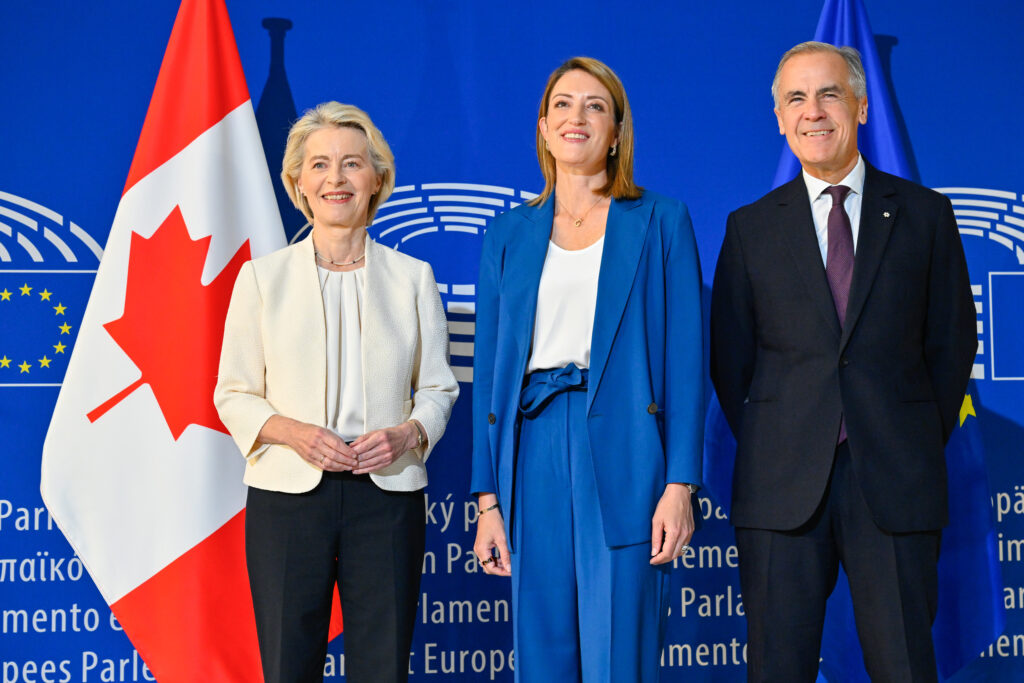
Canada could soon enjoy EU membership perks without actually joining. Ottawa wants shelter from tariffs and Chinese pressure; Brussels wants Canadian lithium and a loyal ally. That mutual hunger might be enough to invent a status the EU’s treaties have never known.
“I said we must urgently reimagine our partnerships. So, I would like to work with you on opening the door for Canada to become the first associate member of the European Union,” European Commission President Ursula von der Leyen said on 16 September at the State of the European Union speech.
Ms von der Leyen’s proclamation is an endorsement of what Canadian Prime Minister Mark Carney came to Europe to secure: an associate membership that would let both sides better withstand pressure from the US and China. This is a big step for Mr Carney’s ‘middle powers’ strategy of uniting like-minded nations, which he first articulated at the World Economic Forum in Davos in January.
Minerals, markets and mandates
The proposal would be the first of its kind. Negotiators still need to work out the details, and any final deal would require unanimous approval from all 27 member states.
Yet the pressure and the incentives on both sides will be hard to ignore: 57 per cent of Canadians support joining the EU, according to a recent Nanos poll, and 84 per cent see strengthening economic ties as the most viable way forward.
As Ms von der Leyen noted in her speech, Canada also holds lithium reserves that could, if production capacity is scaled up, supply half of cumulative global demand between 2030 and 2050, a major strategic asset. The country also produces aluminium, nickel, and platinum the EU urgently needs.
The EU is already Canada’s second largest trading partner, worth roughly €164bn in 2025. Finnish President Alexander Stubb has called the partnership “a marriage made in heaven“. The associate membership could let goods, services and workers in strategic industries move more easily between the two markets, and Canada and the EU together have a combined GDP of around €23tn.
A partnership years in the making
Augusto Lopez-Claros, Executive Director of the Global Governance Forum, told EU Perspectives in May that “Canada is already operating as if it were a member of the European Union – except for the fact that it doesn‘t happen to be located in Europe.”
Canada is already operating as if it were a member of the European Union – except for the fact that it doesn’t happen to be located in Europe. — Augusto Lopez-Claros, Executive Director of the Global Governance Forum
Since the Comprehensive Economic and Trade Agreement (CETA) between Canada and the EU, bilateral goods and services trade between the two markets has grown 72 per cent, reaching €125bn in 2024, and Canadian aluminium exports to the EU are up 378 per cent.
Mr Carney has called Canada “the most European of non-European countries”. Now the question is how European Canada will be.